
Win Your Next School Debate in 7 Days — A Crash Course for Teens
Quick take
A 7-day debate crash course for teens who want to win school debates and MUNs. Learn how to read motions, build arguments, handle rebuttals, and speak with confidence.
Explore this topic
Article body
Win Your Next School Debate in 7 Days — A Crash Course for Teens Who Hate Confrontation
I once went blank mid-sentence in a debate, in front of my entire class. The silence lasted maybe four seconds. It felt like standing in a stopped lift — just me, the echo of what I was saying, and forty faces waiting. I didn't win that debate. But I learned more from it than from any debate I walked away from comfortably, because I finally had a reason to actually study what winning looked like.
Here's what I found out: debate isn't about being loud, quick, or born with a gift for confrontation. The teens who win inter-school debates and MUNs are almost always just the ones who prepared a structure. Most of your classmates won't bother. Seven days of this plan and you won't be most of your classmates.
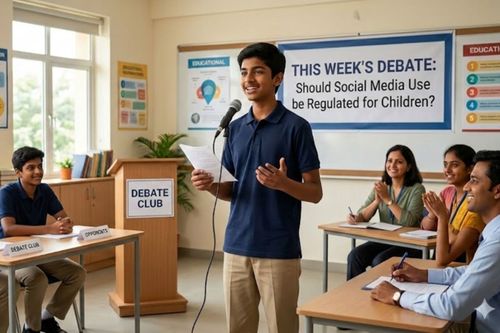
Debate isn't about being loud or born confident. It's about having a structure when everyone else doesn't.
Day 1: Learn to Read the Motion
Before you can argue anything, you need to understand what's actually being argued. Most school motions follow one of three formats: THW (This House Would) — a policy proposal. THBT (This House Believes That) — a factual or values claim. TH Regrets — a retrospective judgment on a past decision.
The moment you receive a motion, do three things. First, ask: what world does this motion create if it passes, and what world exists without it? Second, ask: who benefits from each world, and who gets hurt? Third — and this is the one most debaters skip — ask: what principle is actually at stake? Individual freedom? Collective welfare? National interest? Every strong debate argument is ultimately an argument about a principle, not just a policy.
Take today's practice motion — "THW make mental health days as officially recognised as sick days in Indian schools" — and write out both sides' core principles in two sentences each. That's Day 1 done. Twenty minutes.
Day 2: Build Your Argument
Forget everything you've seen in Bollywood courtroom scenes. The strongest debate arguments follow a structure called ARE: Assertion, Reasoning, Evidence. You open with your main claim (the assertion), explain the logic of why it's true (the reasoning), then anchor it with a real example or data point (the evidence). Then you link it back to the principle you identified on Day 1.
Here's what this looks like applied to our practice motion, Government side: "Mental health absences are as legitimate as physical health absences — (assertion) — because the brain is an organ, and like any organ it can malfunction in ways that prevent functional participation in school — (reasoning) — as evidenced by the fact that India's ASER 2024 report found that academic anxiety is among the top reported reasons for student disengagement — (evidence) — which means denying official recognition denies students the dignity and support structures we already extend to physical illness — (link to principle)."
That's one argument. A strong debate speech for a five-minute slot typically needs two clear arguments, not five half-built ones. Less is more. Build two fully. Leave the others in your notes.
Day 3: Rebuttals — the Skill That Actually Wins
Most school debates are lost not in the speeches but in the rebuttals — the moments when you respond to what the other side just said. The most common mistake is attacking the opponent's example instead of their principle. If they say "teen anxiety is increasing and schools are ignoring it" and you respond by disputing their statistics, you've missed the point. Their argument is a principle claim, not a statistics claim. Attack the principle.
The three-step rebuttal is simple enough to use under pressure. First: state what they said, briefly and fairly. "The Opposition argues that mental health days would be misused." Second: show why it's wrong. "The same concern was raised about physical sick days, and schools already manage that through documentation and repeat-absence review." Third: show that your point still stands. "The risk of occasional misuse doesn't outweigh the cost of treating legitimate mental health crises as invisible."
Today's practice: find any opinion piece in The Hindu or Indian Express. Summarise their main argument in one sentence. Then counter it using the three-step. Do this for three separate articles. You won't debate those articles — you're training the rebuttal instinct, not the subject knowledge.
Day 4: Delivery — Voice, Pace, Presence
Content can win on paper. Delivery is what wins in the room. Three things matter more than everything else combined.
The first is pace. When your heart rate goes up, you will speak faster — and fast speech sounds like nervousness, which undermines credibility even when the argument is strong. Practise the 20% slower rule: whenever you feel the anxiety spike, consciously speak 20% slower than feels natural. It will feel excruciatingly slow from inside your head. It will sound confident to everyone watching.
The second is the pause. A two-second pause after a strong point is not dead air. It's emphasis. It gives the room time to absorb what you said, signals that you believe it's worth absorbing, and costs you nothing. Practise holding a pause after your assertion before launching into your reasoning.
The third is eye contact — and in a school or MUN setting, this means looking at three different points in the room in rotation. Not just the judge. Not just your friends. The side wall, the centre of the room, the judge — and rotate. It creates the impression of speaking to everyone, which is exactly what you're doing.
Days 5 and 6: Research, then Practice Out Loud
Day 5 is your evidence bank. For almost any motion in a school debate, five categories of India-specific data will serve you well across topics: educational access (ASER reports), economic indicators (Budget data, NITI Aayog figures), health (NCRB data, ICMR reports), crime and safety (NCRB again), and youth data (Ministry of Statistics, census figures). Spend thirty minutes today finding one real statistic in each category. You won't use all five — but having them means you'll never scramble for evidence when you need it.
Day 6 is the mock debate. Pick a motion you've never seen before — take one from today's news. Set a timer for five minutes. Argue one side, alone, out loud. Record it. Then watch it back for three things: where your pace spiked, whether your arguments followed the ARE structure, and whether your rebuttal instinct kicked in when you imagined the other side's counter. The mirror version of this works too, but the camera is better because you can replay it and you can't lie to yourself about what you looked like.
Day 7: The Pre-Debate Ritual
Reread your notes once on the morning of the debate. Then put them away. Everything you need is in your head — and shuffling through papers while you should be listening to the other side is a sign of preparation anxiety, not preparation.
Before you walk in, do the 4-7-8 breath: inhale for four counts, hold for seven, exhale for eight. Do it three times. It's used by athletes before competition for a reason — it physiologically slows your heart rate in about ninety seconds. It works.
And then this, which is the most important thing on the whole list: "nervous and debating" is still debating. Every person who looks calm at the podium is managing something on the inside. The ones who win aren't the least nervous. They're the ones who prepared enough that the nervousness runs out of ammunition.
What judges actually look at in school debates:
Clarity of argument — can the judge follow your reasoning without effort? If yes, you're already ahead of half the room.
Quality of rebuttals — did you actually respond to what the other side said, or did you repeat your own speech?
Logical flow — does point two follow from point one? Does your conclusion follow from your arguments?
What judges are generally not scoring: vocabulary, speaking speed, how much you researched, or how forcefully you delivered your points. Plain language, well-argued, consistently beats impressive language, poorly structured.
Quick Tips
- Open with your strongest point, not your weakest. Most speeches spend the opening warming up. Your opening is when attention is highest.
- One sentence test — if you can't say your main argument in one sentence, it isn't clear enough yet. Keep refining until you can.
- MUN format differs from inter-school debate — know which you're preparing for. MUN rewards diplomacy and resolution-building; inter-school debate rewards direct argumentation.
- Lose gracefully — a judge who sees you respond well to losing will remember you. Debate is a small world and reputation travels.
- Find your style — some people debate with logic, some with emotion. Both win. Neither is wrong. The wrong move is trying to debate in someone else's style.
Day 1 starts right now.
Pick any motion from today's news. Choose a side — flip a coin if you have to. Set a five-minute timer. Argue it out loud, alone, in your room. That's the whole thing. You just did Day 6 before Day 1, which means you already know you can do it.
The blank-mid-sentence moment is survivable. The prep that prevents it is seven days of this plan.Comments 0
Keep reading
Similar blogs by topic

Open Source: The Free Thing That Runs the Entire Internet
Your phone, the servers that sent you this page, and every supercomputer on earth run on software volunteers wrote and gave away. Here's how that happened, why it's fragile, and why it's the one industry that will let a sixteen-year-old touch real infrastructure.

I Asked ChatGPT to Do My Internship Search. Here's What It Got Wrong.
It gave me five perfect-sounding internships in ten seconds. Three didn't exist. Here's what AI is actually good for in a job search, and the one part it cannot do for you.

Goku Isn't Talented. That's the Whole Point.
Goku loses constantly, and every time the show cuts to him training. We remember the Super Saiyan moment and delete the montage that earned it — and we do the exact same thing to ourselves.