
I Spoke on Camera Every Day for 14 Days — My Confidence Improved
Quick take
Build camera confidence in 14 days with a simple daily speaking routine. Learn how to look at the lens, slow your pace, reduce filler words, and sound more confident on video.
Explore this topic
Article body
I Spoke for 2 Minutes on Camera Every Day for 14 Days. My Speaking Anxiety Got Embarrassingly Better.
The first video I ever recorded of myself was 47 seconds long. I deleted it before watching it back. The second one was two minutes. I deleted that too. The third one I made myself watch before deleting — and that's when I finally understood what I actually needed to fix. Not the camera angle. Not the lighting. The way I spoke.
I talked too fast. I filled every silence with "basically" or "so, like." I never looked at the lens — I kept looking at my own face on the screen, which made me look shifty and distracted. None of that was fixable by thinking about it. All of it was fixable by doing it — badly, repeatedly, until it wasn't bad anymore.
Fourteen days. Two minutes a day. Here's the plan.
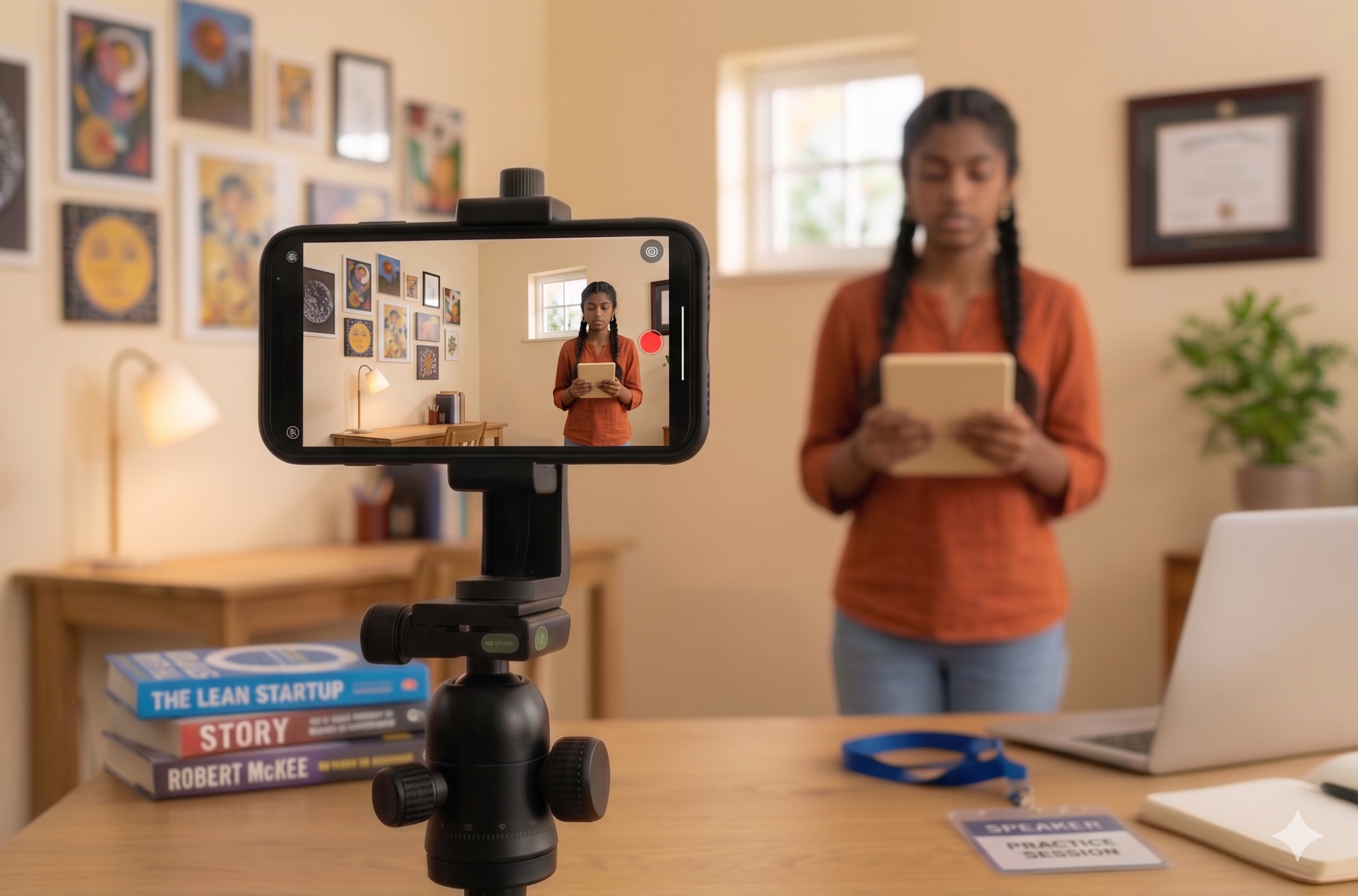
A window, a stack of textbooks to prop the phone, and a lens to talk to. That's the whole setup.
Your Setup (Takes 5 Minutes and Costs ₹0)
Prop your phone on a stack of textbooks so the lens is roughly at eye level. Sit near a window — natural light from the side is the most flattering and the most forgiving, and it costs nothing. You don't need a ring light. You don't need a mic. You don't need a clean room behind you, though a plain wall is better than visual clutter.
One rule about the screen: look at the lens, not at your face. Your face is on the screen. The lens is the small circle at the top. Those are two different things, and the camera records which one your eyes are pointed at. Looking at the lens is what makes you look like you're talking to someone. Looking at your face on screen is what makes you look like you're reading a teleprompter written entirely in self-consciousness.
Week 1 (Days 1–7): Two Minutes, Daily Prompts
Every day this week you'll record exactly one video, two minutes long, responding to a prompt. No script. Notes are fine — but not a script. The goal is to stay on camera for the full two minutes even when you run out of things to say, because learning to sit with the camera without panicking is 80% of what this week is about.
Day 1: Introduce yourself and answer this — what's one thing you learned this week? Not a lesson. Anything you learned. Day 2: Rant mildly about something that annoys you. Two minutes. Go. Day 3: Describe your day as if you're narrating a nature documentary. "And here, the student approaches the dining table for the third time today..." Day 4: Explain something you know really well to someone who knows nothing about it. Choose the topic yourself. Day 5: Tell the story of an embarrassing thing that happened to you — pick one you can laugh at now. Day 6: React to something you read, watched, or heard about this week. Just your honest reaction, two minutes. Day 7: Watch all six previous videos without skipping. Note what you see.
Day 7 is the uncomfortable one. Most people notice the same three things when they watch themselves: they speak faster than they realised, they say certain filler words repeatedly, and they look at the screen rather than the lens. Write those three things down. They are your Week 2 targets.
Week 2 (Days 8–14): Five Minutes, One Topic
Week 2 extends to five minutes and adds a structure requirement. Every video this week should have a beginning, a middle, and a point. Not a moral or a lesson — just a clear destination the viewer can feel you moving toward.
Days 8 through 10: pick one topic you genuinely know something about. Not a topic you've researched for this video — something you already understand. Teach it in five minutes to an imaginary person who knows nothing. The constraint of teaching forces structure automatically. You can't just talk at the camera; you have to take someone through something, which means you have to think about sequencing and clarity in ways that Week 1 never required.
Days 11 through 13: record a five-minute video on a topic you care about but haven't prepared. Just start talking. Use the first minute to find your footing, then commit to a direction. One take only from Day 11 onward — the editing impulse is the enemy. Real speaking — in class, in interviews, in conversations — doesn't have an undo button. Train accordingly.
Day 14: record the video you'd actually show someone. Same two-minute format as Week 1, same kind of prompt, but this is the version where you apply everything — lens eye contact, slower pace, no filler. Watch it next to Day 1. The difference is not subtle.
What changes by Week 2 — the things you'll actually notice:
Filler words drop — "basically," "so like," "um" reduce naturally as your brain gets more comfortable in the silence. You don't have to consciously eliminate them. Confidence does it for you.
Eye contact to the lens becomes instinctive — by Day 10, most people stop looking at their face on the screen without having to remind themselves.
Your pace slows down — nervous people speak fast. Comfortable people breathe between thoughts. You will notice yourself breathing more by the end of Week 2. That's not a breathing thing. That's a confidence thing.
Quick Tips
- Look at the lens, not your face — the difference on camera is immediate and significant. Practice this from Day 1.
- No scripts — notes at most. Scripted videos sound like scripted videos, and no amount of good eye contact fixes that.
- One take only from Day 8 — every retake trains you to rely on retakes. Real speaking has no retakes.
- Natural light from the side beats any ring light at this stage. Light behind you = silhouette. Light above you = unflattering. Light from the side = good.
- The 47-second comfort zone is real — two minutes will feel like a long time on Day 1. By Day 7, it will feel short. That's not you getting more confident. That's your nervous system recalibrating what "normal" feels like on camera.
Start Day 1 today — right now if you want.
Your phone camera, one window, two minutes, one question: what's something you learned this week? The worst version of this is still better than not starting. And the best version, fourteen days from now, is a you who looks at a camera the way you look at a friend.
The camera isn't the hard part. You already know how to talk. You just need fourteen days of evidence that you do.Comments 0
Keep reading
Similar blogs by topic

Video Editing Is the Teen Skill Everyone Suddenly Needs — Here’s the 30-Day Free Plan
A practical 30-day guide for Indian teens to learn video editing, build a portfolio, find clients, and make their first ₹10,000 with free tools.

Open Source: The Free Thing That Runs the Entire Internet
Your phone, the servers that sent you this page, and every supercomputer on earth run on software volunteers wrote and gave away. Here's how that happened, why it's fragile, and why it's the one industry that will let a sixteen-year-old touch real infrastructure.

I Asked ChatGPT to Do My Internship Search. Here's What It Got Wrong.
It gave me five perfect-sounding internships in ten seconds. Three didn't exist. Here's what AI is actually good for in a job search, and the one part it cannot do for you.