
The Night Before Any Exam — A 12-Hour Protocol That Actually Helps
Quick take
A calm, hour-by-hour night-before-exam routine for Indian students, covering revision limits, sleep, food, logistics, and what to do inside the exam hall.
Explore this topic
Article body
The Night Before Any Exam — A 12-Hour Protocol That Actually Helps
It's 8 PM the night before your exam. You've studied — some days well, some days barely — and now you're at that particular kind of panic that feels like anxiety and exhaustion at the same time, sitting in front of your notes wondering whether to go through everything one more time or whether that will somehow make things worse.
I've been there more times than I want to count. Here's what I've learned — and what the research actually says — about what to do with those 12 hours, hour by hour. Not the inspirational version. The one that actually works when your brain is already tired and the exam is tomorrow morning.
The Core Principle First
The night before an exam is not for learning. That window has closed. Everything you study tonight that you haven't studied before will not consolidate in your memory before tomorrow. What you can do — what genuinely moves the needle — is activate what you already know. Reduce anxiety so retrieval works better. Prepare your body so your brain performs. And do a targeted, limited revision of your highest-yield material.
Accepting this frees you from trying to cram an entire chapter at 11 PM. That frantic energy costs more than it gives. Here's a better use of those 12 hours.
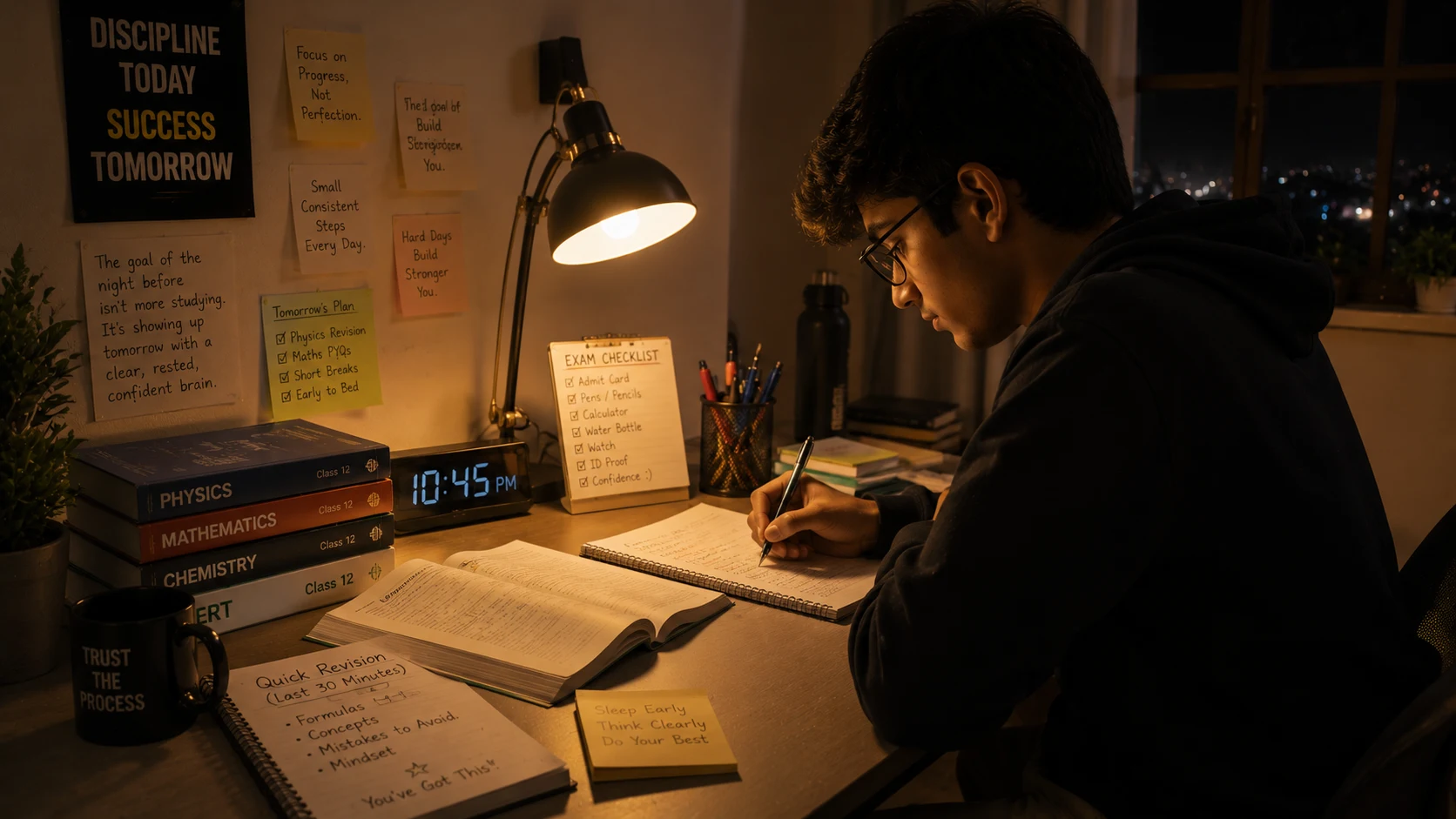
The goal of the night before isn't more studying. It's showing up tomorrow with a clear, rested, confident brain.
The 12-Hour Protocol — 8 PM to 8 AM
The Only Revision That Counts Tonight
Open only your own short notes or formula sheets — not the textbook, not past papers you haven't seen. Read through your notes calmly. The goal is to activate memory, not create new memory. For theory subjects, read headings and key terms and try to mentally recall what's under each before you read it. For Maths or Accounts, glance at formula sheets and do two or three solved examples you've already done before — not new problems. Stop at 9:30 PM no matter what. One and a half hours maximum. This is not negotiable.
The Logistics Check
Five minutes that prevent the worst exam-morning disasters. Physically check: admit card, pens (two blue, one extra), ruler if required, geometry box if required, calculator if allowed. Know your exam centre address and how long the journey takes. Set two alarms — one at your normal wake time, one 15 minutes earlier as backup. Tell someone in your house what time you need to leave. Do not skip this step. "I forgot my admit card" is a real thing that happens and is genuinely avoidable.
Dinner — Eat Something Real
Eat a proper meal. Not heavy, not experimental, not street food that might cause a problem tonight — just your normal home food. Dal chawal, roti sabzi, whatever is being made at home. Your brain runs on glucose and skipping dinner to study more is a trade that never pays off. If you're not hungry due to anxiety, eat something small anyway. Eat slowly. Don't look at your notes while you eat.
The Wind-Down Hour
One hour of something genuinely restful — not passively anxious. This means: a show you've already seen, a podcast, a walk around the house, a conversation with family. It does not mean Instagram, where you will see someone posting about how much they studied, which will immediately undo any calm you've built. The research on pre-sleep arousal is clear: anxiety activates the same brain regions as learning, which disrupts sleep architecture. You need your nervous system to downshift. Give it one hour to do that.
Sleep — The Most Important Study Session
In bed by 11:30 PM at the latest. Sleep is when your brain consolidates everything you've learned. Specifically, the hippocampus — where short-term memories live — replays and transfers information to long-term storage during deep sleep. A full 7–8 hours before an exam is not laziness. It is literally studying. Students who sleep well before exams outperform equally-prepared students who don't, consistently. If anxiety is making it hard to sleep: slow your breathing (4 counts in, 4 hold, 6 out), focus on physical sensations rather than tomorrow. Do not reach for your phone.
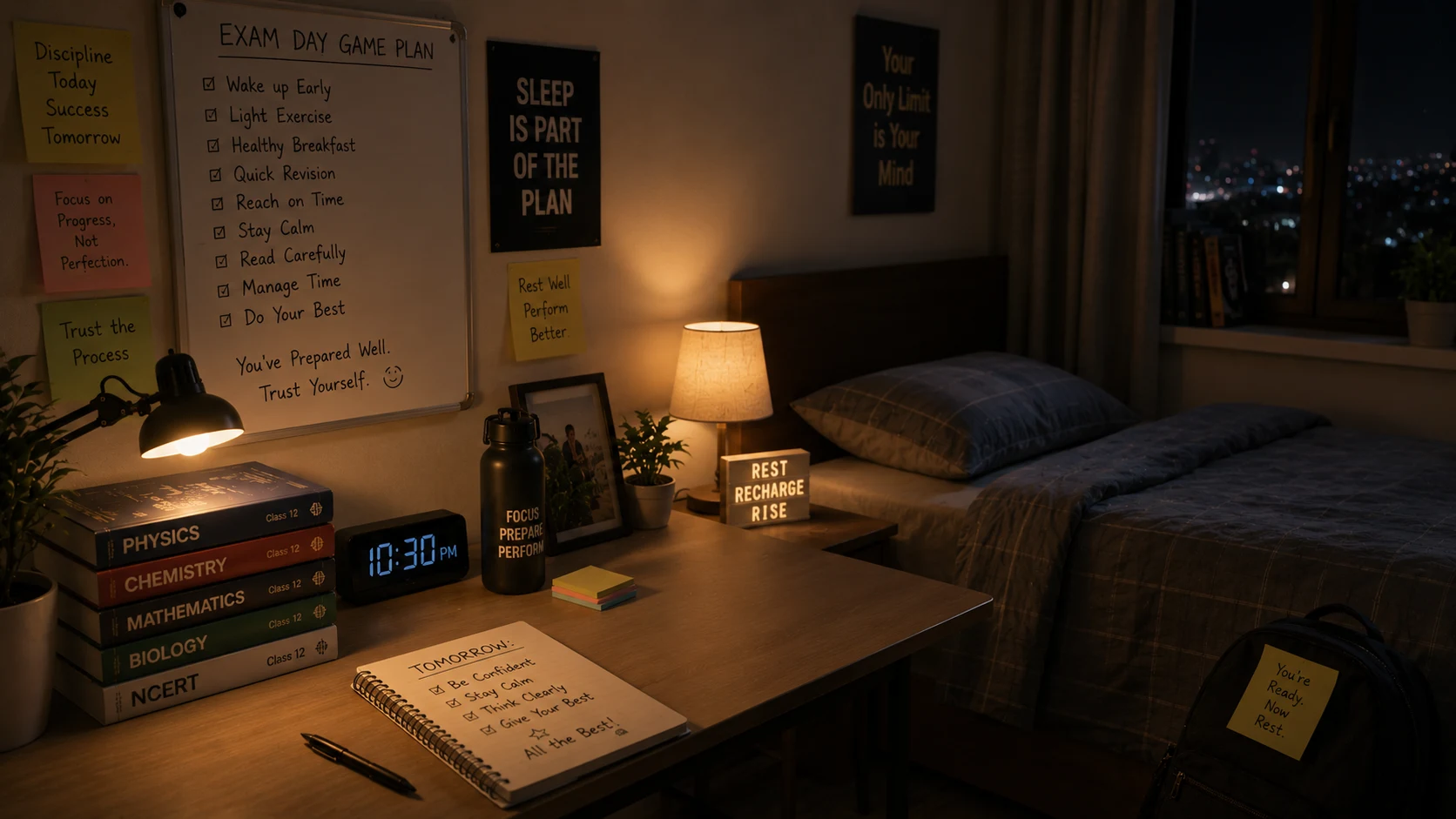
Sleep is not a reward you earn after studying. It is a study strategy — arguably the most effective one available to you tonight.
Wake Up — One Hour Before You Need to Leave
Get up without snoozing. Wash your face, eat a proper breakfast — something light and familiar, nothing new or rich. Parathas, idli, toast with chai. Your brain needs fuel. The gut-brain connection is real: going into an exam hungry or unsettled by something you ate creates a physiological stress response that competes with recall. Eat sitting down. Don't eat while reading notes.
Last Revision — Short Notes Only, 20 Minutes Maximum
Read your formula sheet or key-terms list one final time. Calm reading, not frantic checking. This is not the time to discover a topic you don't know — if you find one, accept it and move on. Do not open the textbook. Do not call a classmate and ask what they revised because that will panic you regardless of what they say. You know what you know. Today is about expressing that clearly under time pressure.
Leave Early
Leave with at least 25 minutes to spare before reporting time. Traffic in Indian cities is unpredictable. Arriving flustered and breathless is a provably bad way to start an exam — it raises cortisol, narrows focus, and costs you the first 10 minutes of settling time inside the hall. Leave early. Sit outside the centre for a few minutes if you arrive very early. Breathe. This is familiar territory — you've been preparing for this for months.
Inside the exam hall — three things that consistently help:
Read the paper fully first (5 minutes). Before writing a single word, read through the entire question paper. Mark the questions you're most confident about. Start with those. Momentum builds from answering well, not from answering in order.
Time budget your sections. Know how many marks each section is worth and allocate time proportionally. A 5-mark question should not get the same time as a 1-mark question. Write this on the top of your rough sheet.
Write for the examiner, not for yourself. CBSE examiners follow marking schemes. Answer in points where the question allows it. Write legibly in section beginnings where marks are highest. If you're running out of time, attempt every question briefly — partial marks exist and add up.
The Night-Before Rules — Short Version
- Maximum 90 minutes of revision — your own notes only, no new content, stop at 9:30 PM.
- Check your logistics before you sleep — admit card, pens, address, alarms. Five minutes now prevents disasters tomorrow.
- Eat dinner properly — your brain needs fuel to retrieve memories under pressure.
- Sleep by 11:30 PM — seriously. This is not optional. Sleep is consolidation.
- No phone after 10 PM — Instagram before exams is a stress multiplier with no upside.
- Leave 25 minutes early — arriving calm is a performance advantage, not a luxury.
You've Done the Work. Tonight Is About Protecting It.
Everything you studied over the past weeks is already stored somewhere in your brain. Tonight's job is not to add more — it's to make sure you can access what's already there tomorrow. Rest is the tool that does that. Trust the preparation. Trust the sleep. Show up tomorrow rested and ready.
Close the textbook. Eat dinner. Sleep. You're more prepared than you feel right now.Comments 0
Keep reading
Similar blogs by topic

The Global Korea Scholarship — Why South Korea Is the Most Underrated Destination for Indian STEM Students
A complete Global Korea Scholarship (GKS) guide for Indian teens covering the full package, top universities, application process, and how to apply.

MEXT Scholarship — The Japanese Government Pays for Your Entire Degree and Nobody in India Is Talking About It
A complete MEXT scholarship guide for Indian teens covering the application process, eligibility, stipend details, universities, and how to apply from India.

Self-Study CBSE Class 12 Without Coaching — A Realistic Plan for the 30% Who Can't Afford ₹2 Lakh a Year
A realistic CBSE Class 12 self-study guide for students without coaching, covering NCERT, free resources, subject strategy, and a month-by-month plan.