.webp?Expires=1791147102&Policy=eyJTdGF0ZW1lbnQiOlt7IlJlc291cmNlIjoiaHR0cHM6Ly9kMXk1ZWNwbnpkcWczeC5jbG91ZGZyb250Lm5ldC90ZWVuaWNvbi8qIiwiQ29uZGl0aW9uIjp7IkRhdGVMZXNzVGhhbiI6eyJBV1M6RXBvY2hUaW1lIjoxNzkxMTQ3MTAyfX19XX0_&Signature=jTnGbvUxw~8xXXYn-OCBFyoWTKjntP6bv52xbVcaeNixq4BFWtq43XEbPCDl3qhzv39cQsAhn2oskg~Xa5jI3rveppXEF79wKZN5qyJCpznu~GMraeFMuJU6UyMs-T2fXaIx2d2gLgBiGoBQDFhSoLwinegS6MWaeknCa6H8AoTRYxCNCJK9GqbKcAKoRmQppTOyaCm1VQbd9KnoPPxVtQ~IMWZWqqgx-jMjqZYqs8yEaMgT2m4IClpRUec2T02IVrjqImFdYx017xBbqV2Sh1gN0iC1VcF4fxycq6x2ijvZPoYnE3j2WLNHlxNC1NOgK5JYZMBMJaF7pmYCP84hOw__&Key-Pair-Id=K1B90DKUUQ2EIE)
How to Write a Class 12 Board Answer That Gets Full Marks - A Step-Up Method From Coaching Class Answers
Quick take
A Class 12 board exam guide for students who want full-mark answers using marking schemes, better structure, diagrams, terminology, and step-marking.
Explore this topic
Article body
How to Write a Class 12 Board Answer That Gets Full Marks — A Step-Up Method From Coaching Class Answers
My Class 11 unit test answer looked like this: three paragraphs, underlined keywords, no diagram, example from memory that didn't quite match the textbook's. I got 7 out of 10 and the teacher said "good attempt, needs more structure." I read that note four times and had no idea what it meant. My answer said the right things. It had the content. What was wrong with the structure?
The answer came from looking at a toppers' answer sheet from the previous year's CBSE boards. The content was not dramatically different from mine. What was different was everything surrounding the content — the way the answer was broken into point-form with precise labels, the diagram in the margin with arrows and a caption, the textbook example used word for word rather than paraphrased from memory, the step-marking structure that meant even a partially correct answer collected every available mark. Same knowledge. A different way of showing it. Fifteen marks instead of seven. Here is the method, broken down by question type.

The gap between an 80% answer and a 95% answer is almost never content. It's structure, terminology, and step-marking awareness.
The Core Principle: Board Examiners Use Marking Schemes
CBSE publishes official marking schemes for previous years' board papers — they're freely available at cbse.gov.in. The marking scheme is the examiner's instruction manual: it lists the exact points that earn marks, the specific terminology that must appear, and how marks are distributed across parts of a long-form answer. Understanding the marking scheme structure changes how you write answers fundamentally.
The most important thing the marking scheme reveals is that marks are attached to specific elements, not to general quality of explanation. An answer that is well-written but uses informal language for a key term — "cell membrane" instead of "plasma membrane," "blood circulation" instead of "systemic circulation" — loses those attached marks regardless of how well everything else is explained. Terminology is not a formality. It is where specific marks live.
The second thing it reveals is step-marking. For numerical questions in Physics, Chemistry, and Mathematics, marks are attached to each step of the working — not just the final answer. A student who gets the wrong final answer but shows correct working up to the last step can collect 3 out of 4 marks. A student who writes only the final answer, even correctly, risks collecting only 1 mark if the examiner cannot verify the method. Never skip steps. Never skip units.
The Structure for Each Question Type
1-Mark and 2-Mark Questions
These are the marks most students casually drop and don't track. The rule is simple: match the marks to your response length. A 1-mark question gets one precise sentence with the correct term. A 2-mark question gets two distinct points, each on a separate line. No paragraph. No introduction. No "according to the textbook." The examiner is checking for a specific answer in a specific form — give it to them directly.
1-Mark Question — Biology
Question: "What is the function of the corpus luteum?"
Weak answer: "The corpus luteum is a structure in the ovary that forms after ovulation and produces hormones that are important for pregnancy."
Full marks answer: "The corpus luteum secretes progesterone, which maintains the endometrium during pregnancy."
The full marks answer uses the exact NCERT terminology (progesterone, endometrium), names the specific function rather than describing the general role, and takes one sentence. The weak answer is not wrong — it just doesn't give the examiner the specific terms they're looking for.
3-Mark and 5-Mark Questions
These are where structured point-form earns significantly more than continuous prose. The examiner is scanning for marked points — not reading your answer the way your English teacher reads an essay. Use numbered or bulleted points with a bolded first word or phrase for each point. Never write a paragraph when a three-point list will do the same job more efficiently.
For Science subjects: every 3-mark answer should have three distinct, labelled points with the key term underlined or bolded. Every 5-mark answer should have five labelled points plus a labelled diagram where one is relevant. The diagram is not decoration — it frequently carries its own 1-mark allocation in the marking scheme. A correctly labelled diagram with arrows and a caption earns the mark whether or not the written explanation is perfect.
5-Mark Question — Chemistry (Structure Comparison)
Question: "Compare the structures of diamond and graphite. (5 marks)"
Weak approach: Two paragraphs discussing both materials, mentioning hardness and conductivity, no diagram.
Full marks approach:
1. Structure: Diamond — each C atom bonded to 4 others in tetrahedral arrangement. Graphite — each C atom bonded to 3 others in hexagonal layers.
2. Hybridisation: Diamond — sp³. Graphite — sp².
3. Bonding: Diamond — 3D covalent network. Graphite — layers held by weak van der Waals forces.
4. Properties: Diamond — hardest natural substance, non-conductor. Graphite — soft, good conductor (delocalised π electrons).
5. Diagram: [Labelled structural diagrams of both, showing bonding arrangement] — 1 mark for correctly labelled diagrams.
The point-form structure lets the examiner tick five boxes in 30 seconds. The diagram earns its dedicated mark. The specific terms (sp³, sp², van der Waals, delocalised π electrons) match the marking scheme's expected terminology precisely.
The Three Techniques That Add 10–15% to Any Answer
Underline key terms. CBSE examiners are trained to look for specific terms in an answer. Underlining your key terminology (or bolding it, if writing with a pen that allows distinction) draws the examiner's attention directly to the elements being checked. The marks follow the terms. Make the terms visible.
Label every diagram element. A diagram without labels earns no marks. A diagram where some elements are labelled earns partial marks. A diagram where every element has a label with a clean arrow earns full marks plus occasionally provides a safety net — if your written explanation misses a point, a correctly labelled diagram can demonstrate you knew the concept. Use a ruler for arrows. Write labels outside the diagram with clear lines pointing inward. A messy diagram signals an unclear understanding even when the knowledge is correct.
Use the textbook's exact example, not a paraphrased one. When a question asks for an example — of a chemical reaction, a biological phenomenon, an economic concept — use the specific example from the NCERT or prescribed textbook for your board. Examiners mark against the examples in the marking scheme. A correct alternative example may or may not be accepted depending on the examiner. The textbook example is always accepted. Know it precisely.
Subject-Specific Rules
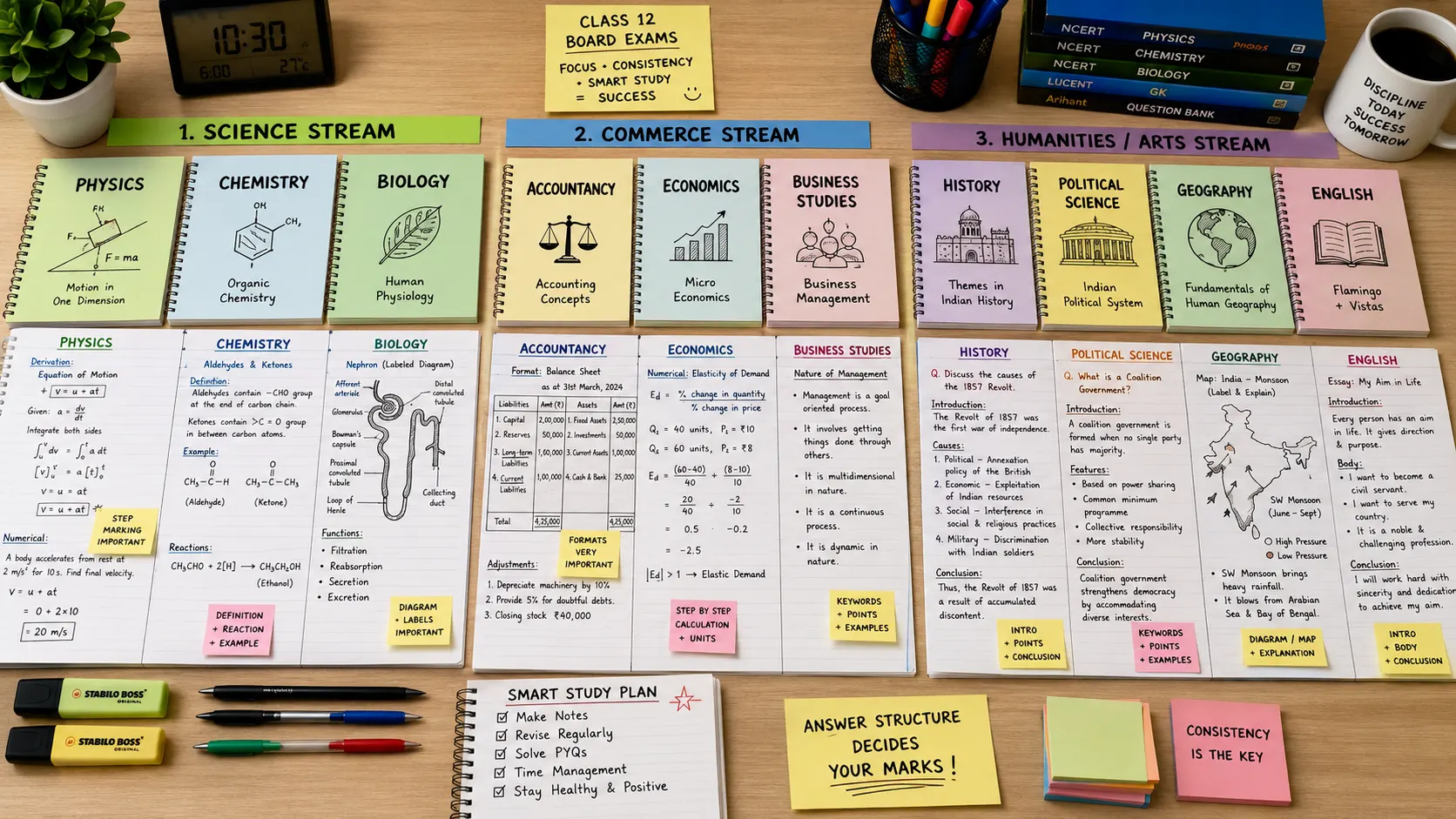
The answer structure priorities differ by subject. Physics rewards shown working. Biology rewards diagrams. Economics rewards structured points with real data.
Physics: Every numerical gets full working shown with units at every step. State the formula before substituting values. Circle or box your final answer. Even if the calculation goes wrong, correct formula + correct method = partial marks collected.
Chemistry: Organic reactions must show the full reaction equation with structural formulas, not just names. Conditions above the arrow (temperature, catalyst, pressure). Mechanism questions require arrows showing electron movement — curly arrows for bond making, straight arrows for bond breaking. These arrows carry marks.
Biology: Diagrams are mandatory for any question involving cell structure, organ systems, reproductive structures, or ecological relationships. Label more than you think necessary. Each labelled structure is a potential mark. The minimum standard: every diagram has a title and every visible part has a label.
Accountancy and Business Studies (Commerce): Format answers as Journal Entries and Ledger Accounts in the correct columnar format — not prose descriptions of accounting entries. The format itself carries marks. An incorrect calculation in the correct format earns more than a correct calculation in prose.
Economics: Diagrams for every concept that has one — demand and supply curves, production possibility curves, IS-LM curves for Macro. Label axes, label the curves, label the equilibrium point. A diagram without axis labels gets zero for the diagram regardless of how well-drawn it is.
How to use the CBSE marking scheme — the three things to check:
Download the marking scheme for the last 5 years from cbse.gov.in. For each question type in your weakest subjects, compare what the marking scheme shows as the full-marks answer against what you would have written. The gap between those two things is your specific improvement target.
Note which terms appear repeatedly in the marking scheme's expected answers. These are the words that carry marks. If "delocalised electrons" appears in three different Chemistry marking schemes for three different questions, you know that term earns marks regardless of how the question is phrased.
Check how marks are split in long-form answers — a 5-mark question that splits as 1+1+1+1+1 has a different answer structure than one that splits as 2+3 or 3+2. The split tells you how many distinct points you need to make. Match your answer structure to the mark split.
Quick Tips
- Write the question number and part clearly before each answer — CBSE examiners check papers page by page. An answer without a clear question number reference creates doubt about what is being answered. Never assume the examiner will infer the sequence.
- Attempt every question, even partially — step-marking means a partial attempt earns more than a blank. For numericals you can't complete: write the formula, state the known values, attempt the substitution. Three marks are frequently available before the calculation.
- Timing is structure — the students who run out of time in the last section typically spent too long on the first section. Allocate roughly 1 minute per mark and move on when time is up. A complete answer to an easy question earns more than a perfect answer to a hard one when the time trade-off leaves the easy question blank.
- Practice writing answers timed — not just solving the problem, but writing the full structured answer in the time budget. The structure knowledge is useless if exam conditions cause you to revert to prose because you're writing fast.
Download last year's CBSE marking scheme for your weakest subject tonight.
Compare the marking scheme's expected answer for one 5-mark question against what you would have written. Count how many specific terms appear in their version that don't appear in yours. That difference — in terminology, in diagram labels, in step structure — is exactly the gap between your current score and the score you could be getting with the same knowledge. Fix that gap before the boards. The knowledge is already there.
The boards don't reward knowing the most. They reward showing what you know in the specific structure the marking scheme expects. Now you know the structure.Comments 0
Keep reading
Similar blogs by topic

Self-Study CBSE Class 12 Without Coaching — A Realistic Plan for the 30% Who Can't Afford ₹2 Lakh a Year
A realistic CBSE Class 12 self-study guide for students without coaching, covering NCERT, free resources, subject strategy, and a month-by-month plan.

The Global Korea Scholarship — Why South Korea Is the Most Underrated Destination for Indian STEM Students
A complete Global Korea Scholarship (GKS) guide for Indian teens covering the full package, top universities, application process, and how to apply.

MEXT Scholarship — The Japanese Government Pays for Your Entire Degree and Nobody in India Is Talking About It
A complete MEXT scholarship guide for Indian teens covering the application process, eligibility, stipend details, universities, and how to apply from India.