
Self-Study CBSE Class 12 Without Coaching — A Realistic Plan for the 30% Who Can't Afford ₹2 Lakh a Year
Quick take
A realistic CBSE Class 12 self-study guide for students without coaching, covering NCERT, free resources, subject strategy, and a month-by-month plan.
Explore this topic
Article body
Self-Study CBSE Class 12 Without Coaching — A Realistic Plan for the 30% Who Can't Afford ₹2 Lakh a Year
The coaching industry will never tell you this, so I will: a significant portion of Class 12 CBSE toppers — including students scoring 90%+ in Science and Commerce — did not attend any coaching institute. Some couldn't afford it. Some chose not to. And some started coaching, found it wasn't helping, and quietly stopped going while continuing to study on their own.
This post is for the student who is going into Class 12 without coaching and is either quietly scared about it or quietly relieved — possibly both at the same time. The plan below is not a fantasy schedule made by someone who has never met a tired teenager. It is a realistic, subject-by-subject framework built on what actually works when you're navigating CBSE on your own.
First: Reset the Comparison
The biggest disadvantage of not having coaching isn't the content — CBSE content is very learnable without a teacher standing in a classroom. The actual disadvantage is psychological: you see your classmates going to coaching, coming back with printed notes and solved papers, and it feels like they know something you don't. They probably don't. But the feeling is real and it will eat into your study hours if you don't address it consciously.
The reset: coaching is a service that solves a scheduling and accountability problem. It structures your time and provides someone to ask questions to. Self-study, done properly, solves both of those things differently — and often more efficiently, because you're not sitting through explanations of things you already understand. Once you genuinely believe this, the plan below will work. If you don't believe it yet, keep reading and revisit it in two months.
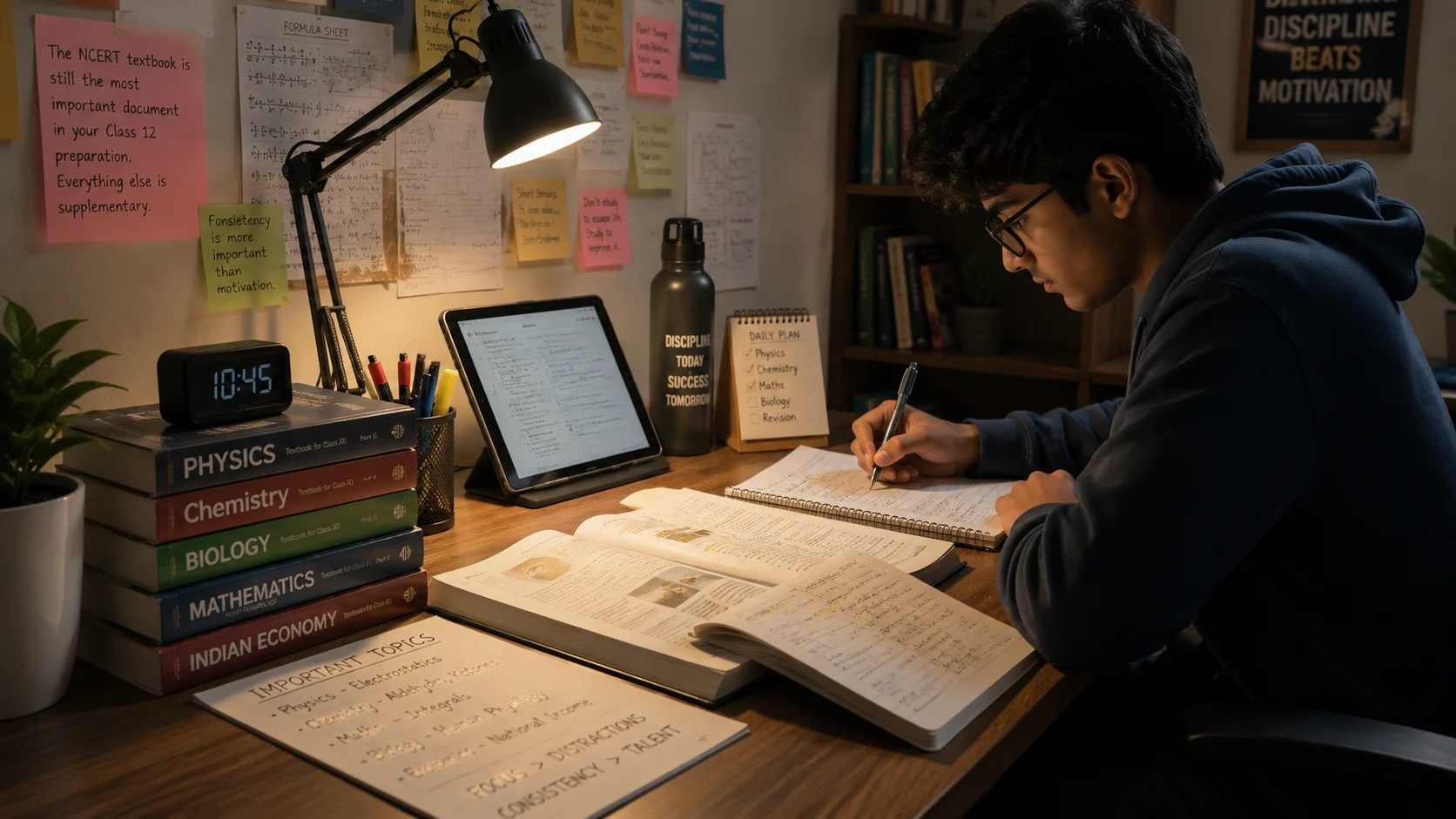
The NCERT textbook is still the most important document in your Class 12 preparation. Everything else is supplementary.
The Resource Stack — What You Actually Need (And What Costs Nothing)
The single most important thing you can do before anything else: download every NCERT textbook PDF from ncert.nic.in. Free, official, complete. The CBSE board exam is written by people who believe NCERT is the syllabus — because it is. Students who underdo NCERT and overdo reference books consistently underperform students who have mastered NCERT and used reference books sparingly.
Free resources that cover most of Class 12 CBSE:
Physics / Chemistry / Maths / Biology: NCERT textbooks (ncert.nic.in, free) + PW (Physics Wallah) YouTube — free lectures, chapter-by-chapter, genuinely excellent for Science stream.
Accountancy / Business Studies / Economics: T.S. Grewal for Accounts (standard reference, buy one copy — around ₹350), NCERT for BST and Economics. Padhle YouTube channel is strong for Commerce stream.
All subjects: CBSE Question Bank from previous years — freely available on cbse.gov.in and on Vedantu's free resources section.
Sample papers: Oswaal or Arihant sample paper books — around ₹200–250 per subject. The single paid resource worth buying for every self-study student.
A Subject-by-Subject Honest Assessment
Not every subject is equally manageable without coaching. Here's the honest breakdown:
| Subject | Self-study difficulty | Key resource | Where to get help free |
|---|---|---|---|
| Physics | Medium-Hard | NCERT + H.C. Verma (select chapters) | Physics Wallah YouTube, Vedantu free |
| Chemistry | Medium | NCERT (almost sufficient alone) | Chemistry Wallah YouTube, Khan Academy |
| Maths | Hard (needs practice volume) | NCERT Exemplar + RD Sharma | Vedantu, BYJU's free videos, Unacademy free tier |
| Biology | Low-Medium (mostly memory) | NCERT (sufficient for boards) | NEET Wallah YouTube for diagram-heavy topics |
| Accountancy | Medium (needs practice) | T.S. Grewal + NCERT | Padhle YouTube, Rajat Arora YouTube |
| Economics | Low (NCERT is thorough) | NCERT | Economics Wallah, Sandeep Garg free videos |
| English | Very Low | NCERT Flamingo + Vistas | Magnet Brains YouTube |
The Monthly Study Plan — July to March
This is not a day-by-day timetable. Those never survive contact with actual life — a sick day, a family function, a bad week — and then students feel guilty and spiral. Instead, this is a phase-based plan that tells you what your priority should be in each period and what done looks like.
July–September (4 hours/day, school days): New chapter → read NCERT once straight through, no notes. Second read: make minimal notes (one page per chapter maximum). Watch one YouTube lecture if something is still unclear. Do NCERT exercises, every single one, before moving to the next chapter. Do not chase shortcuts at this stage. The goal is genuine understanding, not coverage speed.
October–November (5 hours/day, with Diwali buffer built in): Revision of Chapters 1–8 in each subject. Start doing unit tests — create them yourself from CBSE previous year papers, subject by subject. Identify your three weakest topics per subject. These become your October focus. Do not attempt full syllabus revision yet; it's too early and creates false confidence.
December–January (6 hours/day): Full syllabus covered. This phase is all about past papers. Do a minimum of five full CBSE board papers per subject, timed, on paper (not on screen). Mark yourself honestly using the official marking scheme from cbse.gov.in. Your score in these tests is a better predictor of your board performance than any mock test a coaching centre gives you.
February–March (exam season protocol): One full paper per day in the relevant subject, three days before each exam. The day before: only revision of your own short notes and formula sheets, no new solving. Morning of the exam: eat something, read your notes once calmly, and stop studying two hours before you leave. Cramming the morning of a board exam is never effective and often counterproductive.
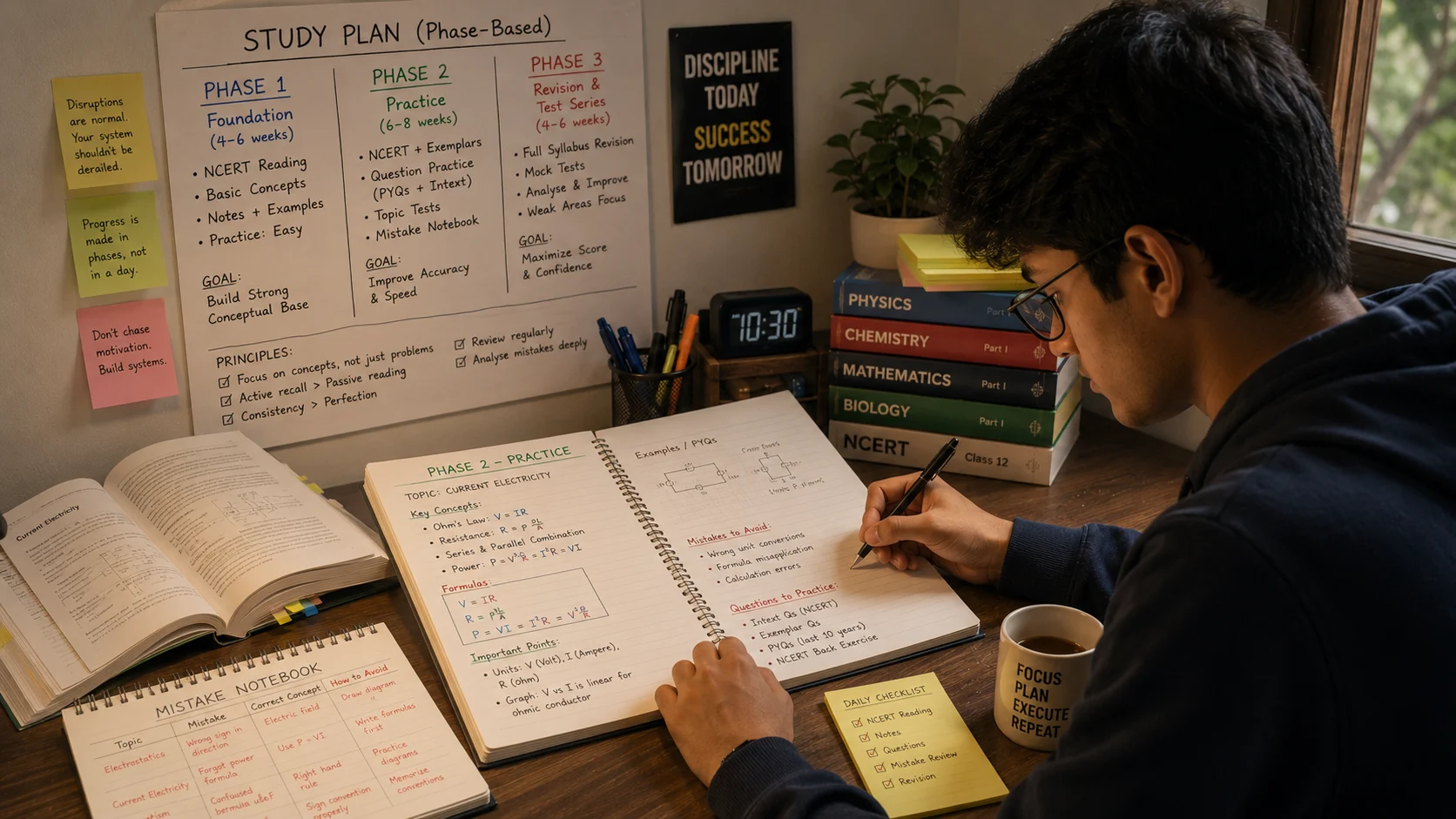
Phase-based planning beats day-by-day timetables for most self-study students — it absorbs disruptions without derailing the whole system.
When You're Stuck and Have Nobody to Ask
This is the real challenge of self-study: hitting a concept wall with nobody to turn to. The solutions, in order of effectiveness:
- YouTube first — search the exact concept name + "Class 12 CBSE." Physics Wallah, Vedantu, and Magnet Brains between them cover almost every Class 12 topic. This resolves 80% of doubts within 15 minutes.
- NCERT solutions second — ncert.nic.in has official solutions. For maths especially, understanding how NCERT approaches a problem is more valuable than finding the answer elsewhere.
- Classmates and school teachers — don't underestimate your school teacher because coaching culture made you feel like school isn't enough. Many school teachers are excellent and have more time for individual questions than coaching batch teachers do.
- Telegram study groups — most subjects have active CBSE Class 12 Telegram communities where students help each other. Quality varies but genuine help is available if you search for groups with clear rules and moderation.
The Six Rules That Actually Make Self-Study Work
- NCERT is non-negotiable — every line, every example, every exercise. No supplementary book replaces it; all of them supplement it.
- Past papers are your coaching — five papers per subject, timed, marked honestly. This is the single highest-ROI activity in Class 12 preparation.
- One subject per day is better than three subjects shallow — go deep, finish a chapter properly, then move. Context-switching between subjects kills retention.
- Your phone is the biggest variable — not lack of coaching. Put it in another room during study hours. This is not optional advice.
- Sleep is study time — consolidation happens during sleep. A rested brain retains more from four hours of good study than an exhausted brain does from eight.
- The CBSE marking scheme is your real syllabus — download it from cbse.gov.in and read it. It tells you exactly how marks are distributed and what examiners are looking for in answers.
You Don't Need ₹2 Lakh to Score 90%. You Need a Plan and a Consistent September.
Save this page. Come back to it at the start of July when Class 12 begins. Show your parents the resource list — everything on it either free or under ₹1,000 total. Then start Chapter 1 of your first NCERT and don't stop until it's done. That's day one. Do that for nine months and the results will follow.
The board exam doesn't know whether you went to coaching. It only reads what you write.Comments 0
Keep reading
Similar blogs by topic

The Global Korea Scholarship — Why South Korea Is the Most Underrated Destination for Indian STEM Students
A complete Global Korea Scholarship (GKS) guide for Indian teens covering the full package, top universities, application process, and how to apply.

MEXT Scholarship — The Japanese Government Pays for Your Entire Degree and Nobody in India Is Talking About It
A complete MEXT scholarship guide for Indian teens covering the application process, eligibility, stipend details, universities, and how to apply from India.

The Night Before Any Exam — A 12-Hour Protocol That Actually Helps
A calm, hour-by-hour night-before-exam routine for Indian students, covering revision limits, sleep, food, logistics, and what to do inside the exam hall.