
The Global Korea Scholarship — Why South Korea Is the Most Underrated Destination for Indian STEM Students
Quick take
A complete Global Korea Scholarship (GKS) guide for Indian teens covering the full package, top universities, application process, and how to apply.
Explore this topic
Article body
The Global Korea Scholarship — Why South Korea Is the Most Underrated Destination for Indian STEM Students
You know more about South Korea than any previous generation of Indian students did. You have watched the dramas. You know the music. You have read Solo Leveling and Omniscient Reader’s Viewpoint. You know who BTS and BLACKPINK are, what bibimbap is, and approximately what a chaebols is from context. None of this has stopped most Indian teens from completely overlooking the fact that the South Korean government runs one of the world’s most generous undergraduate scholarships — one that covers full tuition, pays you KRW 900,000 per month (approximately ₹55,000), teaches you Korean for free, and places you in universities that supply engineers to Samsung, Hyundai, and LG.
That scholarship is the Global Korea Scholarship — also known as KGSP. This is the complete guide.
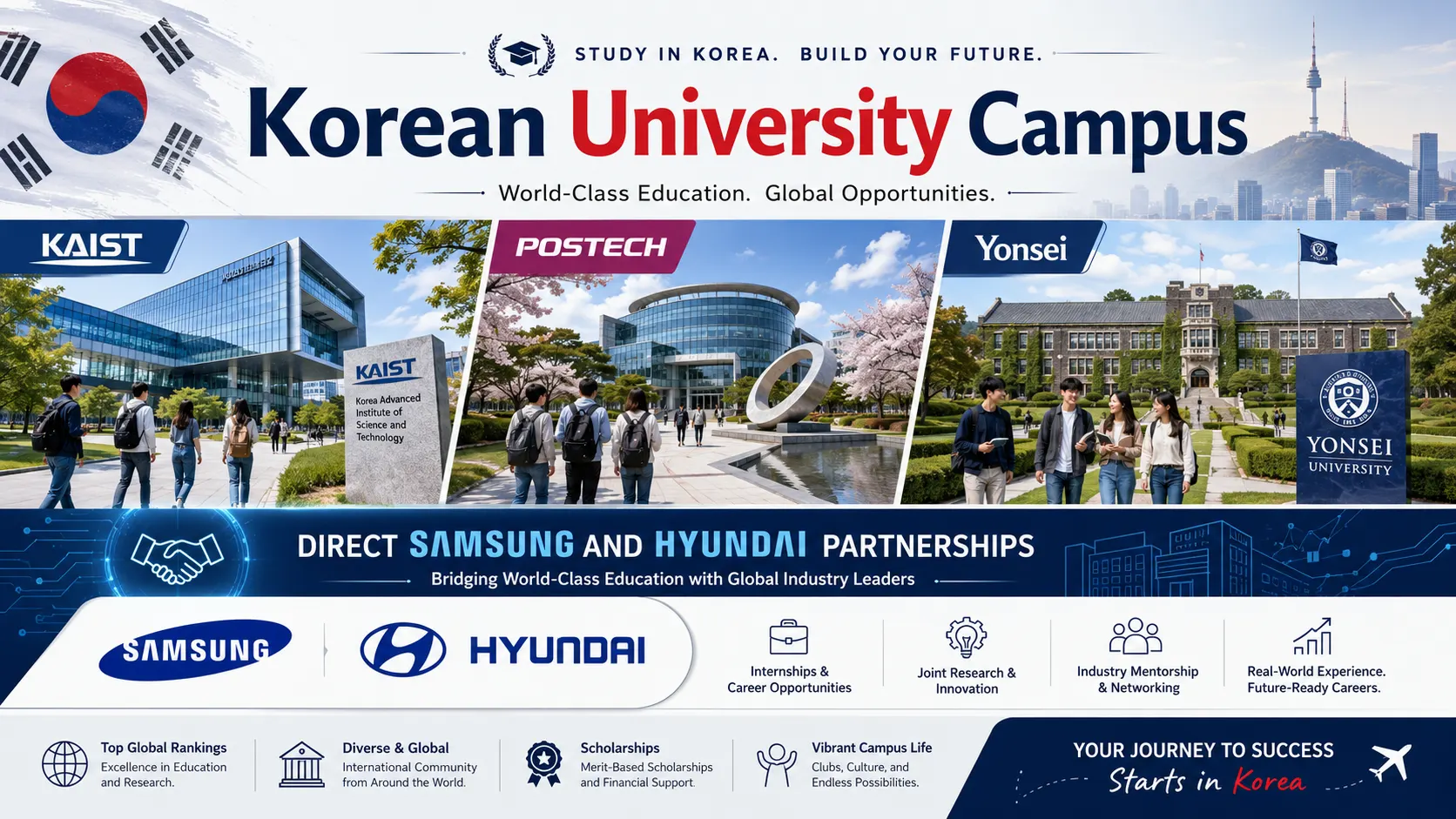
KAIST (Korea Advanced Institute of Science and Technology) ranks in the QS global top 50 and has direct research partnerships with Samsung, Hyundai, and LG. The GKS scholarship pays for all of it.
What GKS Covers — The Complete Package
| Benefit | Detail | Approximate ₹ Value |
|---|---|---|
| Tuition | 100% covered for entire degree (4–5 years) | ₹3–8L/year |
| Monthly living allowance | KRW 900,000/month | ₹55,000/month |
| Accommodation | University dormitory or housing allowance | Included |
| Korean language training | 1 full year before degree; KRW 800,000/month during language year | Fully covered |
| Settlement allowance | One-time arrival allowance: KRW 200,000 | ~₹12,000 |
| Return airfare | Economy class India to Korea (arrival) + Korea to India (graduation) | ₹50,000–80,000 |
| Medical insurance | National Health Insurance covered | ₹30,000–50,000/year |
| Total annual value (approx.) | ₹10–12 lakh/year | |
*Exchange rate: KRW 1 = ₹0.061 approximately. Monthly allowance = KRW 900,000 x 12 = KRW 10,800,000/year = ~₹6.6L/year stipend alone.
The Universities — What Korea’s Tech Ecosystem Actually Is
Indian students most familiar with Korea through entertainment often underestimate how serious its science and technology infrastructure is. Korea has produced a semiconductor industry (Samsung, SK Hynix) that competes globally with TSMC and Intel, an automotive sector (Hyundai, Kia) that now leads in EV technology, and a shipbuilding and heavy industry sector with no real parallel in India. The universities feeding this ecosystem:
- KAIST (Korea Advanced Institute of Science and Technology) — QS global #47. Korea’s MIT equivalent, founded specifically to train STEM talent for Korea’s industrial development. Direct research partnerships with Samsung and Hyundai. Full English-medium instruction for most graduate and many undergraduate programs.
- POSTECH (Pohang University of Science and Technology) — QS global top 100. Consistently ranked #1 in Korea for research output per faculty. Founded by POSCO (steel) and deeply connected to Korean heavy industry.
- Seoul National University (SNU) — QS global top 40. Korea’s most prestigious comprehensive university. Strong across all fields including medicine, law, business, and sciences.
- Yonsei University — QS global top 80. Strong in business, international studies, and engineering. Located in Seoul with a large international student community.
- UNIST (Ulsan National Institute of Science and Technology) — Newer but rapidly rising; located in Korea’s industrial capital, directly adjacent to Hyundai’s Ulsan manufacturing complex.
The Application Process — How Indian Students Apply
GKS undergraduate applications for Indian students are processed through two channels: Embassy Track (through the Korean Embassy in New Delhi) and University Track (directly to specific participating universities). Most Indian applicants use the Embassy Track, which has dedicated Indian quota seats — meaning you compete against Indian applicants for India-specific slots, not against the global pool.
Step 1: Collect documents. Required: Class 10 and Class 12 mark sheets and certificates, a letter of self-introduction (personal statement), a study plan, a letter of recommendation from your school principal or a teacher, and your passport. Some tracks require a medical certificate. The Korean Embassy India website (ind.mofa.go.kr) publishes the complete document checklist annually.
Step 2: Submit the application. Embassy Track applications are typically due in February for the following September intake. The application form is downloadable from the Embassy website. Documents are submitted physically to the Korean Embassy in New Delhi or through designated regional submission points announced in the application notice.
Step 3: Primary screening and interview. The Embassy evaluates applications based on academic record, personal statement, study plan, and recommendation letter quality. Shortlisted candidates are called for an interview at the Embassy. The interview is in English for STEM applicants.
Step 4: Government selection and placement. Embassy-recommended candidates are forwarded to Korea’s National Institute for International Education (NIIED) for final selection. University placement involves the student submitting preferences (3 universities ranked) — placement is based on NIIED’s assessment of academic record and preferences.
Step 5: Korean language training year. Selected scholars arrive in Korea in March for a 12-month Korean language intensive program at a designated language institute. Monthly allowance during this year is KRW 800,000. After the language year, scholars begin their degree program.
The India Advantage in 2026 — Why Now Is Specifically the Right Time

India’s Gen Z familiarity with Korean culture — drama, music, food, manhwa — means cultural adjustment to Korea is lower than for any non-English country. This is a genuine application advantage.
Korean scholarship committees explicitly value genuine interest in Korean culture and language as part of their selection. The study plan (a required application document) asks you to explain your motivation for studying in Korea specifically. Indian Gen Z in 2026 has a cultural familiarity with Korea that no previous generation had — and this is directly usable in the application.
A study plan that references your existing familiarity with Korean content, your interest in the Korean language through manhwa and drama, and a specific career goal connected to Korea’s tech sector (semiconductor engineering, EV technology, robotics) reads as genuinely motivated rather than scholarship-chasing. Korean Embassy interviewers notice the difference between Indian students who chose Korea because they heard about the scholarship and Indian students who chose Korea because they have built real familiarity with the country. Be the second kind.
GKS 2027 application timeline for Class 11 students:
Now: Bookmark ind.mofa.go.kr (Korean Embassy India). Follow the Embassy’s social media for scholarship announcements. Join the “GKS KGSP India” Facebook group — active community with past scholars who answer questions about the Embassy process specifically.
November–December 2026: GKS 2027 announcement typically released. Download forms and document checklist. Begin drafting letter of self-introduction and study plan.
January–February 2027: Collect all documents — mark sheets, certificates, passport, medical certificate. Get recommendation letter from school principal — give at least 3 weeks’ notice.
February–March 2027: Submit Embassy Track application by announced deadline. Physical submission to Korean Embassy New Delhi or designated regional point.
March–April 2027: Primary screening results. Interview calls for shortlisted candidates.
May–June 2027: Final NIIED selection announced. Visa processing and pre-departure orientation.
March 2028: Arrive in Korea for Korean language training year.
March 2029: Begin undergraduate degree at assigned Korean university.
Quick Tips for GKS Applicants
- The study plan is the most important document — it should be specific about which Korean university you want, which program, and why Korea specifically enables a career goal you cannot achieve elsewhere. Vague study plans are the most common rejection reason at the Embassy screening stage.
- Learn basic Korean before your application — even JLPT N5-equivalent Korean (Hangul reading + basic phrases) demonstrates genuine interest and gives you interview material. Duolingo Korean and the TTMIK (Talk To Me In Korean) free podcast are both excellent starting points.
- The language year is an advantage, not a delay — scholars who complete the Korean language year arrive at their degree program with a genuine social and professional network of other international GKS scholars. Many describe it as the most valuable year of the entire scholarship.
- University Track applications go directly to the university — if a specific Korean university is your goal (KAIST, for example), the University Track lets you apply directly. Deadlines and requirements differ from the Embassy Track. Check both options.
- KAIST admits GKS scholars into English-medium programs — if language anxiety is your hesitation, note that KAIST’s undergraduate science and engineering programs are fully English-medium and a significant portion of the student body is international.
Open studyinkorea.go.kr and read the GKS scholarship page tonight.
Full tuition. KRW 900,000 per month. Korean language taught to you. Direct pipeline to Samsung, Hyundai, LG through KAIST and POSTECH. Return flights covered. The application opens around November each year. You have months to prepare a study plan that is specific, motivated, and genuine — which is exactly what yours can be, because you are reading about this now rather than the week before the deadline.
The country you already know through dramas and manhwa and music will pay for your engineering degree. The only remaining question is whether you apply.Comments 0
Keep reading
Similar blogs by topic

MEXT Scholarship — The Japanese Government Pays for Your Entire Degree and Nobody in India Is Talking About It
A complete MEXT scholarship guide for Indian teens covering the application process, eligibility, stipend details, universities, and how to apply from India.

The Night Before Any Exam — A 12-Hour Protocol That Actually Helps
A calm, hour-by-hour night-before-exam routine for Indian students, covering revision limits, sleep, food, logistics, and what to do inside the exam hall.

Self-Study CBSE Class 12 Without Coaching — A Realistic Plan for the 30% Who Can't Afford ₹2 Lakh a Year
A realistic CBSE Class 12 self-study guide for students without coaching, covering NCERT, free resources, subject strategy, and a month-by-month plan.