
Start Boxing in 30 Days — A Teen Guide to the Sport That Builds Confidence Faster Than Anything Else
Quick take
A beginner-friendly boxing guide for Indian teens, covering first classes, hybrid vs dedicated gyms, starter gear, the 30-day skill map, and how boxing builds real confidence.
Explore this topic
Article body
Start Boxing in 30 Days — A Teen Guide to the Sport That Builds Confidence Faster Than Anything Else
I want to be clear about something upfront: boxing doesn't teach you to be aggressive. It teaches you the opposite. It teaches you that your body is precise, capable, and fully under your control — and that the version of you who walked into the gym three weeks ago underestimated themselves significantly.
The data already knows this. Boxing and MMA searches on Justdial jumped 45% across India in H1 2025. Mumbai alone was up 96%. Bengaluru 72%. Delhi 62%. Indian teens are walking into boxing gyms in numbers that are genuinely new — and when you ask why, almost none of them say "because I want to fight." They say: "I wanted to feel like I could handle myself." That's the real pitch for boxing. Here's how to start.
The Numbers Behind the Surge
These aren't adults discovering wellness. This is a teen sport trend — and the gyms are noticing. Most boxing gyms that have been running for years report their first significant influx of 15–20-year-old members in 2024 and 2025. The coaches in these gyms are very deliberately training teenagers differently from adult members — and understanding that difference is the first thing you need to know before you walk in.
Boxing Gym vs Martial Arts Hybrid — Which One You Actually Want
When you search "boxing gym near me" in any Indian city, you'll find two different things. Knowing the difference before you visit saves you a wasted session.
A dedicated boxing gym — pure boxing, typically associated with a state boxing federation or run by a former competitive boxer — focuses exclusively on boxing technique, ring work, and conditioning. These are the places where Indian boxing talent is developed. They're more disciplined, more structured, and the coaching lineage is clearer. Good for: teens who want to learn boxing specifically, potentially as a competitive sport.
A martial arts hybrid gym (Muay Thai, MMA, kickboxing, some boxing) — more flexible, typically has larger class sizes, better beginner infrastructure, and often friendlier for first-timers. The boxing component is solid but not exclusive. Good for: teens who want the fitness and confidence of striking sports without committing to pure boxing.
For most Indian teens starting out: go to the hybrid gym first. Dedicated boxing gyms are excellent but can be intimidating if you've never been in a striking gym before — they're built for people who've decided, not people who are deciding. Try a Muay Thai or boxing fundamentals class at a hybrid gym for the first month, then switch to a dedicated boxing gym once you know the environment is for you.
How to find both: Search "boxing [your city]" on Instagram — both types post regularly and their content tells you immediately what the atmosphere is like. Look for gyms where women are training (signals a genuinely inclusive environment) and where the beginner content is visible rather than just competition content.
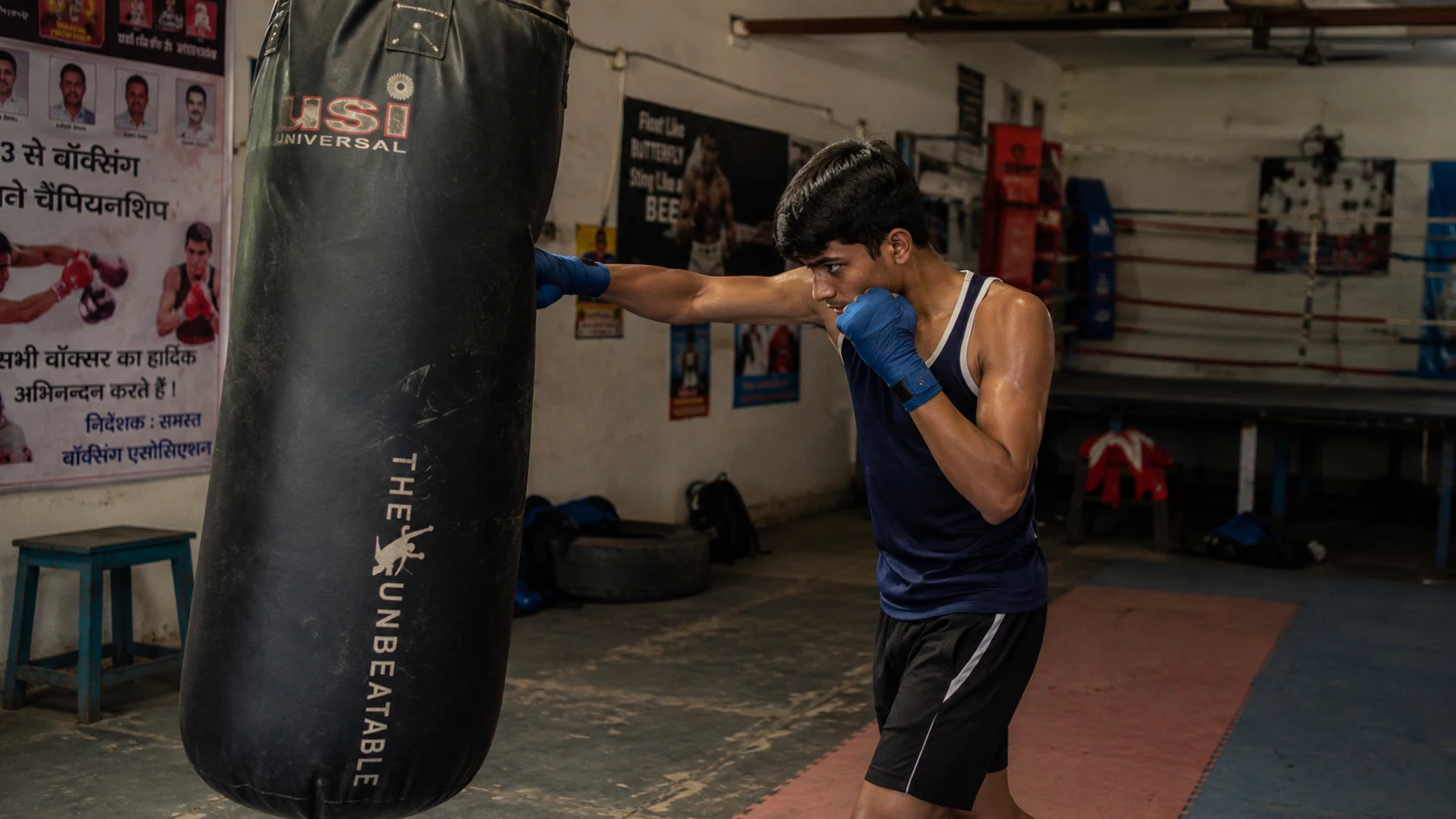
The heavy bag is where you'll spend 70% of your first month. Good technique on the bag makes everything else in boxing easier.
What Actually Happens in the First Class
The image in your head: two people going at it in a ring, sweat everywhere, intimidating. The reality of a beginner boxing class: you will skip rope for 10 minutes, do shadow boxing with a coach walking around correcting your stance, and hit a bag. That's it. That's the first class for most beginners at a decent gym.
No sparring for the first three months minimum. Any gym that puts beginners into sparring in the first few weeks is a gym to leave. Good boxing coaches know that sparring before basic technique is ingrained just teaches you bad habits and potentially hurts you. The bag, the pads, the rope, the shadow — that's where the first month lives entirely.
What you will feel after the first class: your forearms are tired in a way they've never been tired before (the bag absorbs more force than you expect). Your shoulders are burning slightly. And there's a specific kind of clarity in your head — the kind that comes from a full hour of your brain being entirely occupied with something physical and precise. Most people describe it as "I forgot about everything else the whole time." That's the hook.
The Gear — Under ₹2,000, Nothing Else Required
| Item | Why you need it | Cost |
|---|---|---|
| Boxing gloves (10 oz for bag work) | Protect your hands on the bag — without these you'll injure your knuckles in Week 1 | ₹700–₹1,200 |
| Hand wraps (4.5m) | Protect your wrists and knuckle bones under the gloves — non-negotiable | ₹150–₹250 |
| Skipping rope (speed rope or weighted) | Jump rope is 20% of every boxing session — buy your own once you're committed | ₹200–₹400 |
| Total starter gear | ₹1,050–₹1,850 | |
*Most gyms have spare gloves for first-timers — don't buy gear before your first two sessions. After that: Nivia, Everlast India, and Venum India are the three reliable brands available on Amazon India and Decathlon. Avoid no-brand boxing gloves — they don't protect correctly and the stitching fails fast.
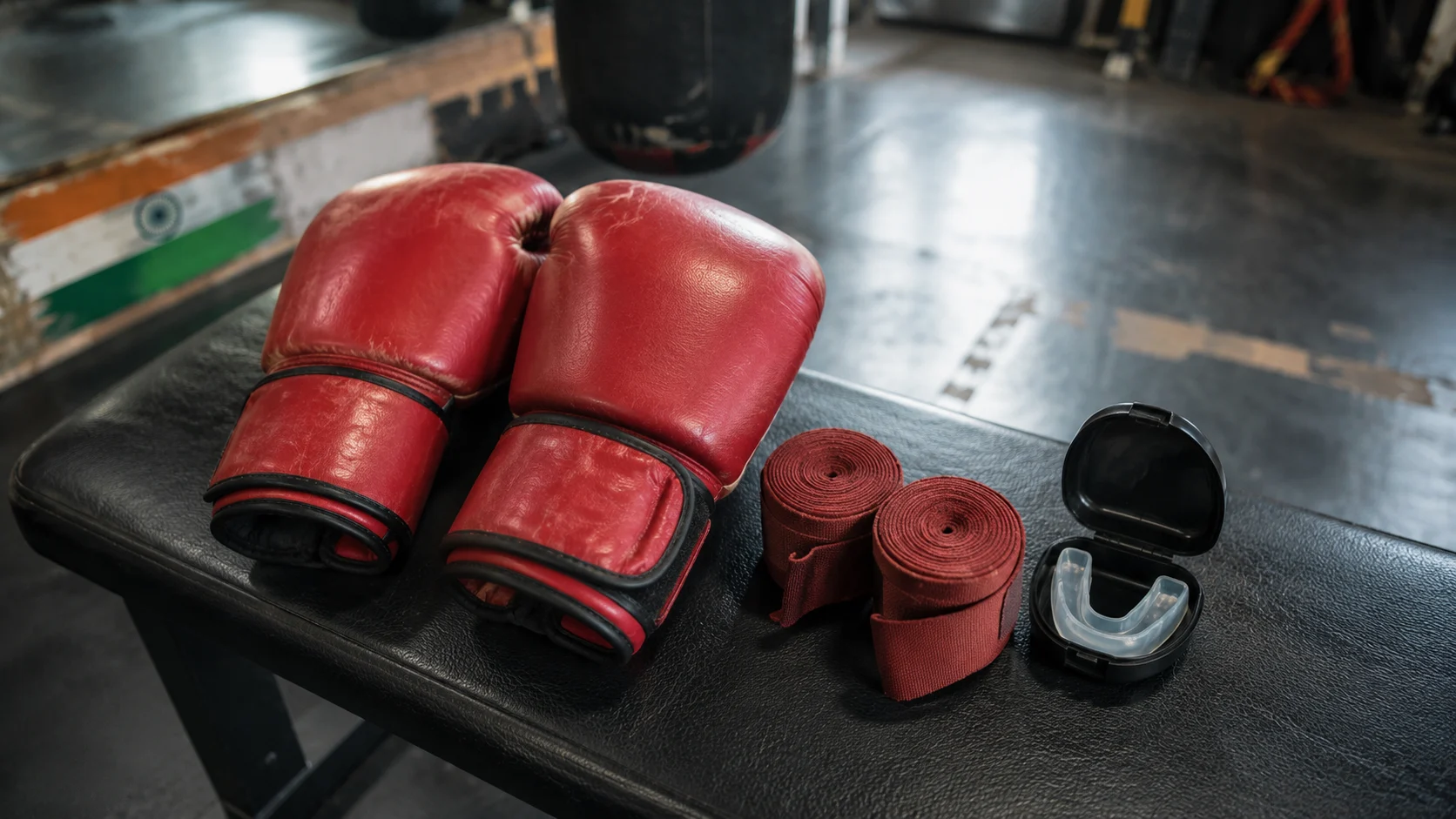
Three items. Under ₹2,000. That's the complete gear requirement for your first month of boxing — the gym provides everything else.
The 30-Day Skill Map — From Zero to Real Technique
Stance, guard, and the jab
Your entire first week is one punch: the jab. Orthodox stance (left foot forward for right-handed people), guard up (chin tucked, gloves at cheekbone level), and the jab — a straight left hand that snaps out and returns immediately. Boring? On paper, yes. In practice, getting a jab right is surprisingly hard and satisfying when it clicks. The coach will correct your guard constantly. That's correct. Your guard is wrong until it becomes habit, and habit takes a week.
Cross + jab-cross combination
The cross is a straight right hand (more powerful than the jab, involves hip rotation). Jab-cross (1-2) is the fundamental boxing combination — every fighter in history throws it thousands of times. Week 2 is about making this combination automatic: jab extends, cross follows immediately with the hip turning in, both hands back to guard. On the bag, this is when you start understanding that boxing is about rhythm, not brute force. The bag sounds different when the technique is right — sharper, cleaner.
Hooks + first 3-punch combinations
The hook is the most satisfying punch in boxing — a curved left hand at head height that uses shoulder rotation. It's also the technically hardest of the basic punches to do correctly. Week 3: jab-cross-hook (1-2-3), keeping the elbow level, rotating the shoulder correctly, not looping the punch. Shadow boxing in front of a mirror — every gym has one — becomes important here. You can see your guard dropping, your stance widening, your elbow rising. Fix it in the mirror before the bag.
Body shots + putting it together under pad work
Week 4 introduces body punches (the hook to the body, the cross to the body) and moves you from bag work to pad work with the coach. Pads are the moment boxing becomes genuinely exciting — the coach calls combinations, you execute them in real-time, and the feedback is instant. By the end of Week 4, you're running combinations fluently, your guard is starting to become automatic, and you have something real to show for 30 days. This is also the week most people realise they want to stay for month two.
Quick Takeaways
- No sparring for the first three months — any gym that rushes this is a gym that doesn't care about your development. Good coaches protect beginners from picking up bad habits under pressure.
- Three items, under ₹2,000 — gloves, hand wraps, skipping rope. The gym provides everything else. Don't buy gear before the first two sessions.
- The jab is your whole first week — it's one punch and it takes a week to do correctly. That's not slow progress, that's the foundation everything else is built on.
- Mirror work is not optional — shadow boxing in front of a mirror catches the guard drops and elbow lifts that you can't feel from inside the movement.
- The confidence is physical — it comes from knowing specifically how your body moves, where your guard is, and what your hands are capable of. It's not abstract. It's somatic.
- Try a hybrid gym first — better beginner infrastructure, less intimidating, and the boxing content is still real. Move to a dedicated boxing gym once you're committed.
Find a Boxing Gym on Instagram. Book a Trial Class. Show Up in Clothes You Can Move In.
Mumbai, Bengaluru, Delhi — the gyms are there, the trial classes are real, and the first session costs nothing before you decide this is for you. Every person who boxes will tell you the same thing: they didn't know they needed it until they tried it. The 96% search surge in Mumbai isn't hype. It's people who found something that changed what they think they're capable of. Your first class is one Instagram search away.
₹2,000 in gear. 30 days. A version of yourself you didn't know existed yet.Comments 0
Keep reading
Similar blogs by topic

I Tried Archery for the First Time and Now I Can't Stop — A Complete Beginner's Guide for Indian Teens
A beginner-friendly archery guide for Indian teens, covering first session expectations, city clubs, starter gear, flow state, and why the sport is suddenly trending in India.

Learn to Bowl Spin in 30 Days — The Cricket Skill That Can Actually Get You on a Team
A beginner-friendly spin bowling guide for Indian teens, covering the off-break grip, daily drills, pitch reading, variations, and a 30-day plan to become team-useful.

Learn Table Tennis in 21 Days — India's Most Underrated Sport Produced Manika Batra and Sharath Kamal
A beginner-friendly 21-day table tennis guide for Indian teens, covering where to find a table, what gear to buy, the three strokes to learn first, and how to build real rallying skills fast.