
Sing Better in 21 Days Without Lessons - A Daily Vocal Plan You Can Do in Your Bathroom
Quick take
Improve your singing in 21 days with breathing, lip trills, and one-song practice you can do at home, no lessons needed.
Explore this topic
Article body
Sing Better in 21 Days Without Lessons — A Daily Vocal Plan You Can Do in Your Bathroom
There's a version of me that exists only in the bathroom between 7:10 and 7:25 AM, while the shower is running. That version is a genuinely decent singer. The acoustics are forgiving, the tiles throw the voice back warm and full, and nobody is listening so there's no tightness anywhere — not in the throat, not in the chest, not in that specific muscle behind the ribs that clenches every time someone might be judging you. Then I step out, and the voice goes thin again.
I spent a long time thinking this gap was about talent. It isn't. It's about muscle memory, breath control, and the fact that most of us have never actually practised singing anywhere except in secret. Twenty-one days of deliberate daily practice — 15 minutes a day, bathroom optional — is enough to close that gap significantly. Here's exactly what to do.
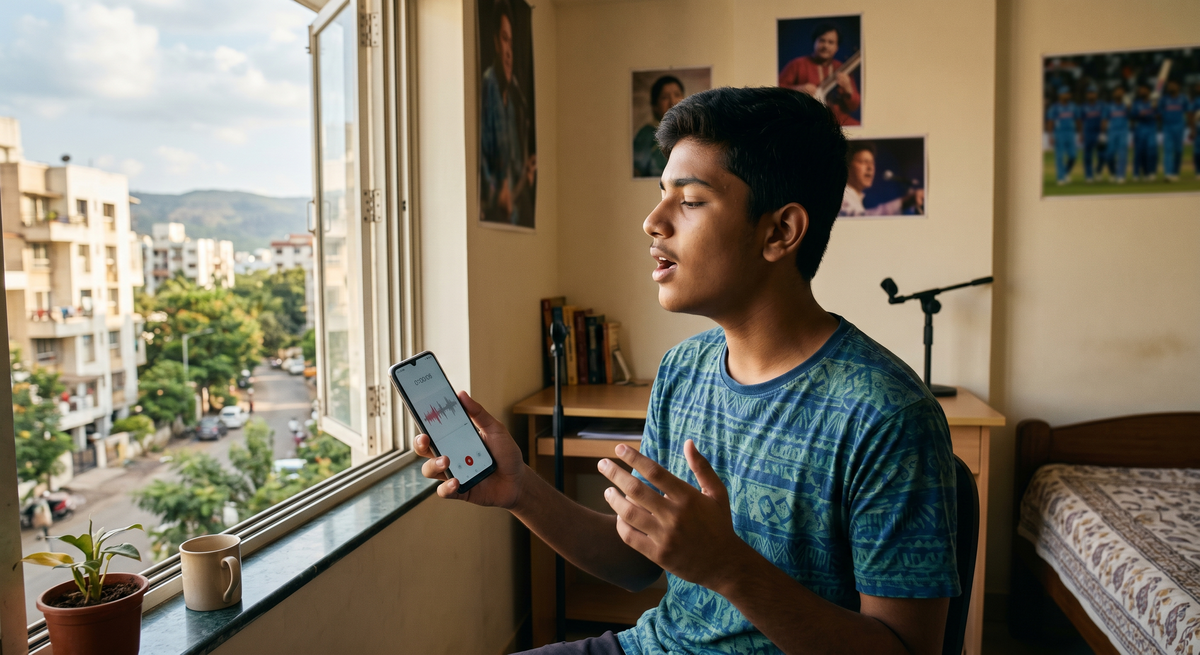
15 minutes a day. No lessons, no studio, no equipment beyond your voice and a timer.
Week 1 (Days 1–7): Breath First, Notes Later
The most common reason teenage voices crack, go thin, or run out of air mid-phrase has nothing to do with the voice itself. It's how you breathe. Most of us breathe into our chests — shoulders rise, chest expands, belly stays flat. That's the shallow kind. Singers breathe into their diaphragm — the belly pushes out, the shoulders stay completely still, and the lungs fill from the bottom up. This sounds like a small technical detail. It changes everything.
Days 1 and 2: lie flat on the floor. Put one hand on your chest and one on your stomach. Breathe in slowly. If your chest hand moves more than your stomach hand, you're chest-breathing. Focus until the stomach hand rises first and higher. It feels unnatural for about ten minutes. It becomes automatic in about three days. Do this for 5 minutes, twice a day. That's the entire task for Days 1 and 2.
Days 3 through 7 add two exercises. The lip trill: buzz your lips like a motorboat while humming a note up and down your range. Five minutes every morning. It warms the voice without straining it and trains breath support without you having to consciously think about breathing. The siren: slide from your lowest comfortable note to your highest and back down, smoothly, like a police siren. Three slow sirens each morning. This maps your range and loosens the transition between your chest voice and head voice — the rough patch that causes cracking.
Week 2 (Days 8–14): Find the Break and Get Comfortable There
Every voice has a passaggio — a bridge point where the chest voice gives out and the head voice takes over. In untrained singers, this transition cracks. In trained singers, it's seamless. Week 2 is about finding yours and spending daily time right at that boundary until the transition smooths out.
Open any free piano app on your phone — GarageBand, Real Piano, Piano Free. Play a note in your comfortable midrange. Match it with your voice and hold it for three counts. Move one note higher. Match. Hold. Continue upward, slowly, one note at a time. The moment you feel your voice wanting to flip or crack — that's your passaggio. Don't push through it. Sing gently, almost at a whisper, right at that point. Every morning this week, your siren exercise starts two notes below that spot. You're training the passage to be smooth rather than a cliff edge.
Day 11 is the one most people don't want to do: record yourself. Not to share anywhere — Voice Memo on iOS or Voice Recorder on Android, just for you. Sing something you know well, a full minute of it, and then listen back. It will be uncomfortable. Your recorded voice sounds different from your internal perception of it, and almost everyone's first reaction is that something has gone wrong. Nothing has gone wrong. That is simply what you sound like to other people. This recording is your Day 1 benchmark. You will compare it to a Day 21 recording and the difference will be audible and real.
Week 3 (Days 15–21): One Song, Worked Every Day
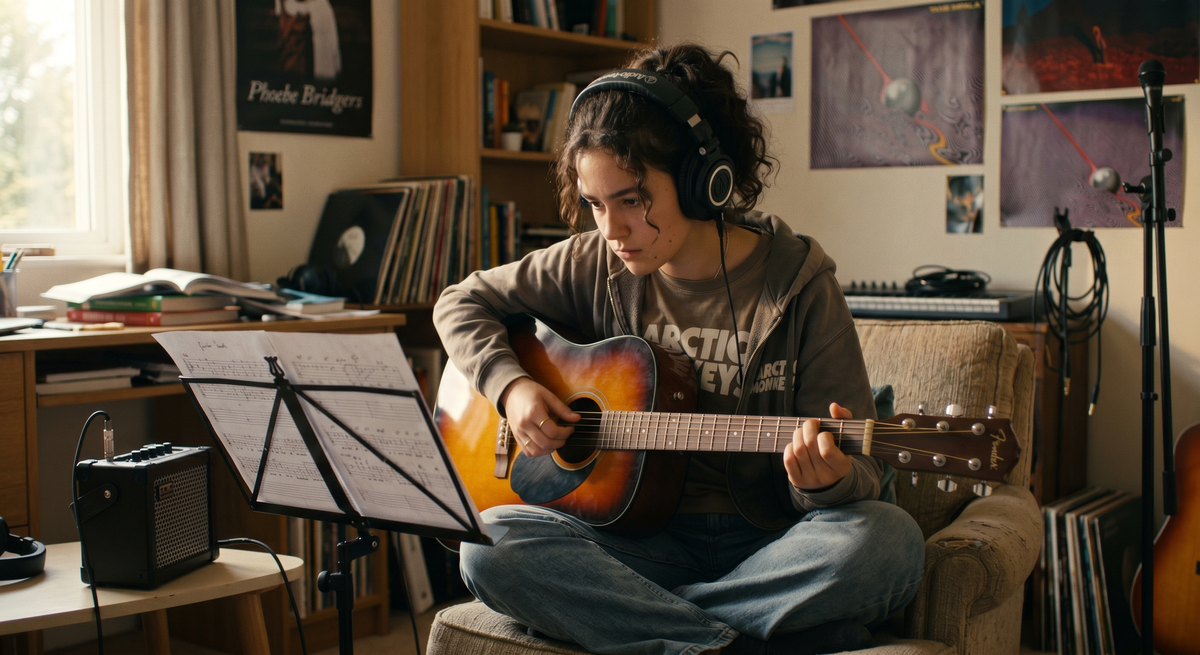
Week 3 is about one song — not variety. Depth beats breadth when you're building a new skill.
Pick one song. The rule is that it should be the song you can almost sing — the one where the verses work but the chorus beats you. Not too easy (no growth), not too hard (no payoff in 7 days). For most Indian teens the sweet spot is a Bollywood song with a mid-range melody — Kesariya, Raataan Lambiyan, or Tum Hi Ho all work. If you're more K-pop, Spring Day by BTS is consistently mentioned as a good vocal practice song. One song. Seven days. That's the whole Week 3 rule.
Days 15 through 17: sing the whole song through once, without stopping. Note the exact phrases where you strain, where the pitch drops, where you run out of breath. Then isolate those phrases — just that line, repeated five times slowly, before attempting the full song again. Slow practice fixes technical problems faster than running through the whole song and hoping they disappear.
Days 18 through 20: full run-throughs only. Start to finish, once a day. Mark your breath points intentionally before you sing — decide where you'll breathe, not where you'll gasp. A planned breath sounds like artistic phrasing. A desperate gasp sounds like what it is.
Day 21: record yourself singing the same benchmark you recorded on Day 11. Play both recordings back to back. The comparison will be uncomfortable in a different direction this time — because the progress is genuinely audible, and acknowledging real improvement at something takes some getting used to.
Free tools, all ₹0:
Voice Memo / Voice Recorder — Record Day 11 and Day 21 benchmarks. Your memory of how you sounded is never accurate. The recording is.
GarageBand / Piano Free — Pitch reference for finding your passaggio. No physical keyboard needed.
YouTube: Eric Arceneaux — Clearest free vocal coaching channel for beginners. No excessive music theory. Practical and fast.
Smule — For Day 21 celebration. The reverb is forgiving and the social aspect makes finishing feel like something worth marking.
Room temperature water throughout — cold water tightens the muscles around your larynx. Drink warm or room temp before and during practice sessions.
Quick Tips
- Warm up before every session, no exceptions — a cold voice cracks and strains. Five minutes of lip trills before any real singing is non-negotiable, not optional.
- Posture is not a bonus tip — slouched singing compresses the diaphragm and forces your voice to work harder for less output. Stand up straight or sit fully upright. You will hear the difference immediately.
- Don't chase range in Week 1 — range expands naturally as technique stabilises. Pushing for high notes before your breath support is solid just reinforces bad habits.
- The bathroom acoustic trick is intentional — tile reverb is genuinely flattering and makes early practice less discouraging. Use it for warmups. Record in a quieter, drier room so you hear yourself honestly.
- Consistency beats session length — 15 minutes daily for 21 days outperforms 3 hours on a Saturday every time. The voice is a muscle and muscles respond to frequency, not intensity alone.
Pick your benchmark song tonight and sing it once — terribly, fully, all the way through.
That recording is your Day 0. Days 1 through 7 are just breathing exercises and lip buzzing, which feel silly and work perfectly. By Day 21, your bathroom voice and your real voice will be much closer to the same person.
You already have the voice. You're just missing 21 days of letting it out of the bathroom.Comments 0
Keep reading
Similar blogs by topic

Open Source: The Free Thing That Runs the Entire Internet
Your phone, the servers that sent you this page, and every supercomputer on earth run on software volunteers wrote and gave away. Here's how that happened, why it's fragile, and why it's the one industry that will let a sixteen-year-old touch real infrastructure.

I Asked ChatGPT to Do My Internship Search. Here's What It Got Wrong.
It gave me five perfect-sounding internships in ten seconds. Three didn't exist. Here's what AI is actually good for in a job search, and the one part it cannot do for you.

Goku Isn't Talented. That's the Whole Point.
Goku loses constantly, and every time the show cuts to him training. We remember the Super Saiyan moment and delete the montage that earned it — and we do the exact same thing to ourselves.