
Sakamoto Days Is at the Peak of Its Powers in 2026 - Why This Underrated Manga Is the Best Action Series Running Right Now
Quick take
A reading guide to Sakamoto Days for Indian teens, covering why the manga beats the anime, where it gets great, and why 2026 is the perfect time to catch up.
Explore this topic
Article body
Sakamoto Days Is at the Peak of Its Powers in 2026 — Why This Underrated Manga Is the Best Action Series Running Right Now
I picked up Sakamoto Days because the premise made me laugh before I'd read a single panel. The world's greatest assassin retires, falls in love with a convenience store clerk, marries her, gains thirty kilograms, opens a convenience store, and now has to defend his quiet family life from his entire former professional network coming to collect. It sounds like a parody of the hitman genre. It reads like its best possible version.
The anime adaptation that launched in late 2025 brought millions of new readers to the manga, and what those readers found was a series that had been building for three years without the audience it deserved. As of 2026, Sakamoto Days is at the peak of its current arc — the most narratively dense and action-rich section the series has produced — and the manga is running ahead of everything the anime has covered. If you watched the show and thought it was good, the manga is considerably better. Here's why, and where to start.
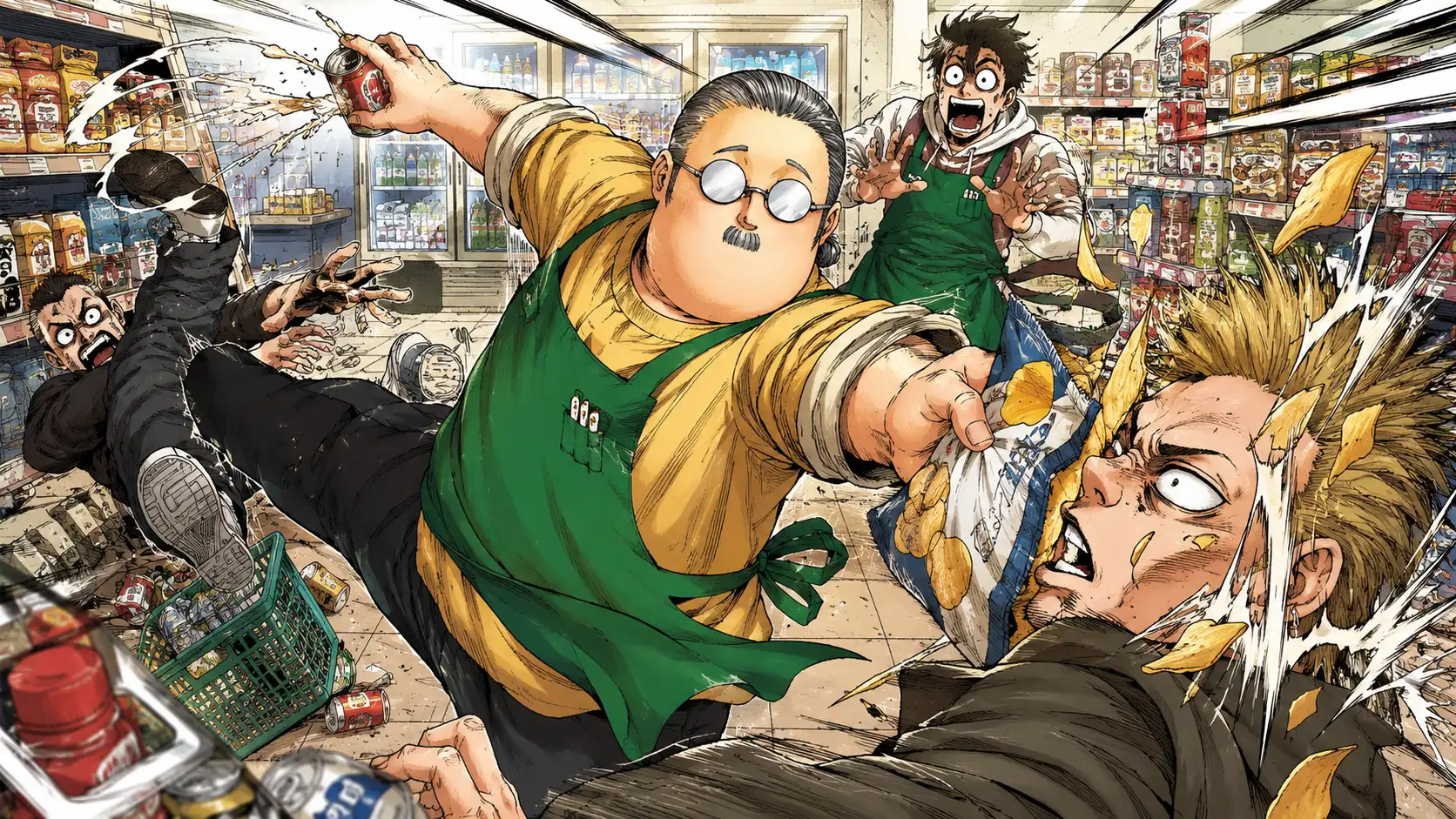
The convenience store setting is not ironic decoration. It's the tonal foundation that makes every fight scene land differently from a standard shonen battlefield.
What Separates It From Every Other Action Manga Running
Most action manga operate on one of two tonal modes: serious (Demon Slayer, JJK, Kagurabachi) or comedic-then-serious (early Naruto, One Piece's lighter arcs). Sakamoto Days operates in a third mode that is genuinely rare — both at the same time, within the same panel, without one undercutting the other. A fight scene where Sakamoto dispatches three trained assassins using items from the snack aisle while simultaneously being concerned about the store's inventory is funny and tense and physically credible all at once. The comedy doesn't drain the tension because author Yuto Suzuki understands that what makes Sakamoto formidable is specifically his calm — and calm, in a fight, can be played for comedy and danger simultaneously.
The action choreography is the other thing that separates it. Suzuki was clearly studying Jackie Chan films when he designed Sakamoto's fighting style — improvised, environmental, using whatever is available as both weapon and prop, with an economy of movement that reads as elegance rather than laziness. A fight in a parking lot uses every structural feature of the space. A fight in a hospital uses the layout as a navigation puzzle. The fights feel located in specific places rather than occurring in generic action-manga space, and that specificity is part of what makes them satisfying to reread.
The Chapter That Converts Skeptics
If someone you respect has told you to read Sakamoto Days and you've bounced once already, go directly to Chapter 56. This chapter — a fight between Sakamoto and a character who can predict the future — is the single best argument for the manga's technical quality. The fight is set in a shopping mall, uses two characters with completely different relationship to time and movement, and is resolved in a way that is simultaneously logical, surprising, and funny. It's the chapter that manga critics pointed to when the series started getting serious comparative attention.
Before Chapter 56, read Chapters 1 through 10 for the foundation. After Chapter 56, the manga doesn't drop back down — it keeps building. The multi-faction arc currently running in 2026 has expanded the cast significantly and added political complexity that makes the fights feel higher-stakes than the earlier single-target missions. New readers who catch up to the current chapter will find the series in the middle of something genuinely exciting rather than in a lull between arcs.
Why the Manga Beats the Anime

The fight choreography in Sakamoto Days is designed for the manga page. The panel cropping and sequence logic reads differently from motion — better, in many chapters.
The anime adaptation is good. The animation quality is above average, the voice acting is strong, and the comedy translates well to motion. But two things make the manga the better version for readers who want the full experience.
The first is pacing. Suzuki's fight chapters are constructed for the manga page — the way panels are cropped, the specific moments chosen to freeze rather than animate, the use of sound effects as visual elements rather than sound design. When the anime adapts these sequences, it smooths them into conventional motion that loses the specific beat of the manga's timing. The parking lot fight from early in the series is a good test case: in the manga, the sequence has a staccato rhythm that comes from the panel cuts. In the anime, it flows more conventionally. Both are good. The manga version is a more specific experience.
The second is volume. The anime has covered the early arcs. The manga is currently more than a hundred chapters ahead of where the anime has reached, in the middle of the most complex narrative the series has attempted. Reading the manga now means being in the conversation that weekly readers are having — which is always a different relationship with a story than watching an adaptation of material that's already completed.
Where to read Sakamoto Days — free and paid options:
Manga Plus by Shueisha (mangaplus.shueisha.com) — Free access to the first three and the most recent three chapters. Full archive available on subscription at ₹130/month. Weekly chapter drops on Sundays.
Viz Media app — Similar access structure. Full subscription unlocks the entire back catalogue. Both platforms simulpublish in English alongside the Japanese release.
Where to watch the anime — Netflix India has the season 1 adaptation. Season 2 status as of May 2026 has not been confirmed but is expected given viewership numbers.
Current chapter — The manga is at Chapter 190+ as of May 2026. A reader starting now and reading 4–5 chapters a day catches up in approximately five to six weeks.
Quick Tips
- Read the fight chapters twice — once for story, once tracking only the spatial logic of the choreography. The second read reveals what Suzuki is doing with panel placement in a way the first doesn't.
- The early chapters underrepresent the series quality — the first ten chapters are competent setup. The quality difference between Chapter 10 and Chapter 56 is dramatic. Give it at least to Chapter 25 before forming a verdict.
- The supporting cast is worth investing in — Shin's ability to read minds, Nagumo's character arc, the various Hitman Order members who become recurring figures. These characters have their own motivations that make the multi-faction arcs significantly richer.
- Don't skip the comedy chapters — the domestic chapters between major arcs are doing character work that pays off in fights. Sakamoto's relationship with his daughter, the convenience store regulars, the absurd normalcy of his domestic life — these chapters are what make the action meaningful.
Start with Chapter 1 and read to Chapter 25 before forming any opinion.
The premise sounds like a joke. The manga knows this. It uses that expectation against you, and by Chapter 56, the fight that converts skeptics, you won't remember why you needed convincing. The anime adaptation is good. The manga is currently running the most ambitious arc the series has attempted. Start both, keep reading the manga, and watch the conversation shift as the next season of the anime catches up to where you already are.
The best action manga running in 2026 is set in a convenience store. This is not a joke. Read it.Comments 0
Keep reading
Similar blogs by topic

Omniscient Reader's Viewpoint Season 1 Just Ended and the Anime Is Coming — Read It Before the Hype Explodes and You're Locked Out of the Conversation
ORV Season 1 just ended and the anime is coming. Here's why Indian fans should read the manhwa now before spoilers and hype take over.

Gachiakuta Won Best New Anime at Crunchyroll 2026 and Indian Fans Haven't Even Started Watching It Yet — Fix That Right Now
Gachiakuta swept Best New Series, Best Character Design, and Best Background Art at Crunchyroll 2026. Here's why Indian anime fans should start watching it now.

Chainsaw Man Just Ended — What the Final Chapter Meant and Why You Should Start Reading It Right Now If You Never Did
A spoiler-light guide to Chainsaw Man's ending, what Part 1 and Part 2 cover, why the fandom split, and where Indian readers can read the complete manga free.