
AI-Proofing Your Career Without Becoming a Coder: 6 Hybrid Skills That Will Matter in 2030
Quick take
Learn 6 hybrid skill combinations that can future-proof your career in India without coding. From finance + AI to law + tech, this guide shows Class 11-12 students how to build a T-shaped skill stack and start in 30 days.
Explore this topic
Article body
AI-Proofing Your Career Without Becoming a Coder: 6 Hybrid Skills That Will Matter in 2030
Somewhere in the last year, a cousin or a teacher or a very concerned uncle told you that AI is going to take all the jobs — and that the only people who'll survive are the ones who know how to code. So now half of Class 11 is panic-installing Python on their laptops and feeling vaguely guilty every time they watch a Reel instead.
Here is the thing nobody's saying out loud: coding alone won't save you either. There are already AI tools that write code better than most junior developers. What AI genuinely cannot do — at least not yet, and possibly not by 2030 — is think across two different fields at once. Connect finance to human behaviour. Connect a scientific finding to a story a 14-year-old would actually read. Connect a legal constraint to a product decision.
That crossover thinking is what this piece is about. Six combinations. Real Indian job market context. And no, you don't need to code to build any of them.
The Problem With Being Just One Thing

The most valuable people in 2030 won't be pure specialists. They'll be translators between worlds.
India's hiring market shifted in a way that feels sudden but has been building for years. The India Skills Report 2026 is blunt about it: skills-based hiring has overtaken degree-based hiring across BFSI, tech, healthcare, and media. Companies aren't asking "what did you study?" anymore. They're asking "what can you actually connect?"
Think of it this way. An AI tool can write a financial report. But it can't walk into a client meeting, read the room, figure out that the CFO is nervous about one specific number, and reframe the story in real-time. That last part — the translation, the judgment, the human read — is what a hybrid-skilled person does. The AI handles the data. You handle what it means.
Economists call this the T-shape: deep in one skill, but wide enough to connect it to another world. Companies in India are increasingly paying a premium for exactly this shape. Here are the six combinations worth building now, while you still have the time and the low stakes to experiment.
The Six Hybrid Skills
Finance + AI Tools
Unlocks → Banking · Consulting · Startup Ops · FintechThis isn't about becoming a CA or an investment banker. It's about being the person who can interpret financial data — read a P&L, understand what an EBITDA dip actually signals, track a company's cash flow — and use AI tools to do the analysis faster than anyone around you.
India's BFSI sector is the fastest AI-adopter in the country right now. Banks and fintechs like Zerodha, Groww, and HDFC's digital arm are actively hiring people who can sit between the data team and the business team — not to replace either, but to translate. That translator role is wide open, underpaid, and about to stop being underpaid very quickly.
You don't need a finance degree to start. Read one financial news article a day — Mint or Economic Times is fine. Learn Excel seriously (not just SUM formulas — pivot tables, VLOOKUP, conditional formatting). Then layer in one AI tool: ChatGPT or Claude for summarising annual reports and generating financial commentary. That combination, at 17, is genuinely unusual.
Start with: Excel free on Google Sheets · CFI free financial modelling intro · ET Markets for daily reading · Claude or ChatGPT for report summarisation practice
Design + Storytelling
Unlocks → Brand Strategy · UX Writing · Content Design · D2C MarketingMost designers can make things look good. Most writers can make things sound good. Very few people can do both — and the ones who can are the ones that India's D2C brands, edtech companies, and startups are desperate for.
The combination matters because design without narrative is just decoration. A beautiful app that confuses its users at the first button is a beautiful failure. The people who are genuinely valuable are the ones who can write the brief, design the solution, and explain why it works in human terms. That's not a designer who writes a bit. That's a specific, rare skill stack.
Learn Canva first — it's free and fast and will get you your first client work within a month. Then move to Figma's free tier and spend time on UX fundamentals (interaction design, user flow, what makes people click). Simultaneously, write. Not essays. Microcopy — button labels, error messages, onboarding text. The two skills feed each other in a way that's hard to explain until you've felt it.
Start with: Canva free tier · Figma free tier · "Don't Make Me Think" by Steve Krug (the classic UX book, worth every page) · Uxcel for structured UX learning

Design tells people where to look. Storytelling tells them why it matters. You need both.
Science + Plain Language Communication
Unlocks → Science Journalism · Health-tech Content · Biotech Startups · Policy ResearchIndia has a growing, serious problem: most scientific research never reaches the people it could help because there aren't enough people who understand the science and can write for a general audience. That gap is a job. A surprisingly well-paying one.
Health-tech startups like MediBuddy and Practo need people who understand medical concepts enough to write accurate patient-facing content. Government-funded science communication programmes are expanding. The National Science Academy and CSIR both run fellowships specifically for science communicators. And in the global freelance market, medical/science writing rates are among the highest non-code skills you can develop.
If you're in PCB or even PCM and you can write clearly in English, you have a head start most people don't. The practice is simple and costs nothing: take one research finding from a journal abstract — start with Nature India or Down To Earth — and explain it in 150 words to someone who last studied science in Class 8. Do this weekly. That muscle is worth more than it looks.
Start with: Down To Earth magazine · Science The Wire India · Coursera's "Science Communication" free courses · The Open Notebook (global science writing resource)
Psychology + UX / Product Thinking
Unlocks → Product Management · UX Research · Behavioural Design · Edtech · FintechEvery app you've felt inexplicably compelled to scroll for forty minutes was designed by someone who understood why humans do what they do. That's not an accident. It's applied psychology — and the people who build digital products in India desperately need more of it.
India's edtech sector alone — BYJU'S, Unacademy, PhysicsWallah — has spent the last three years learning the hard way that beautiful technology with bad behavioural design doesn't retain students. The companies that figure out how to actually change study habits, reduce dropout, and build motivation loops are the ones that will survive. That work needs people who understand cognitive load, habit formation, and what makes something feel rewarding versus exhausting.
You don't need a psychology degree. Read "Thinking, Fast and Slow" by Daniel Kahneman — it's dense but worth it. Then read "Hooked" by Nir Eyal for the product application. Then download five apps you use regularly and spend one hour asking: why did they make that button that colour? Why is the notification worded that way? Who decided that? That kind of analysis, written up, is already a portfolio piece.
Start with: "Hooked" by Nir Eyal · Nielsen Norman Group's free UX articles · Product School India free webinars · r/ProductManagement on Reddit for real industry context
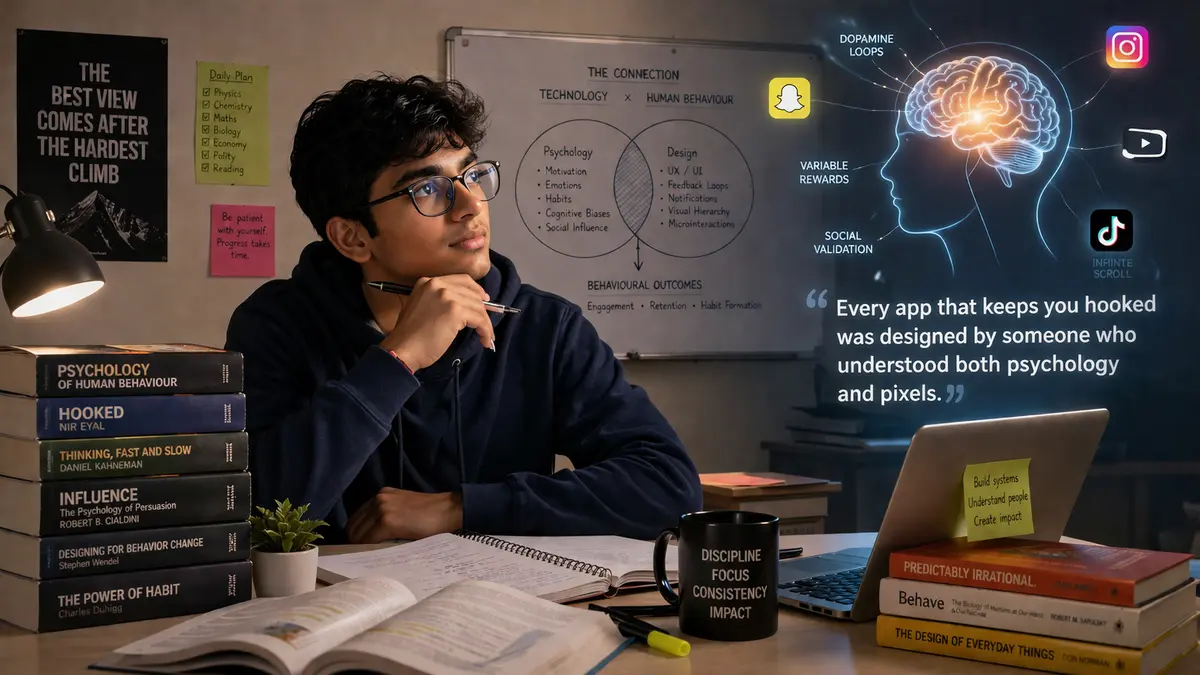
Every app that keeps you hooked was designed by someone who understood both psychology and pixels.
Marketing + Data Analytics
Unlocks → Growth Marketing · Performance Marketing · D2C Brands · Startup Growth TeamsMarketing used to be about gut instinct and good ideas. It still is — but now every gut instinct is immediately testable, and if you can't read the results of your own test, you're flying blind. The marketers who are genuinely hireable in 2026 are the ones who can write the campaign brief and pull the numbers to know if it worked.
India's D2C brand explosion — Mamaearth, boAt, The Whole Truth Foods, and hundreds of smaller direct-to-consumer brands — has created a massive demand for growth marketers. People who can run a Meta Ads campaign, check the ROAS in the dashboard, hypothesise why one ad creative outperformed another, and then brief a designer on what to change. That loop — creative to data to insight to brief — is the job. And it's a job that pays well and can be done remotely, which matters if you're not in a metro.
Start with Google Analytics 4 — free, has a certification, and gives you real data literacy vocabulary. Layer on Meta Ads Manager basics (you can run test campaigns for as little as ₹100 a day). Then practice writing the "why" for what you see in the numbers. That translation from data to English is where most people fall apart, and where your value sits.
Start with: Google Analytics 4 (free certification) · Meta Blueprint free courses · "Hacking Growth" by Sean Ellis · Internshala for growth marketing internships with real brand data
Law / Policy + Technology
Unlocks → Legal Tech · AI Policy · Data Privacy Compliance · Corporate Governance · Govt ConsultingThis one is the most underrated combination on this list, and by 2030 it will be the most sought-after. Here's why: India's Digital Personal Data Protection Act (DPDP) came into force in 2023. AI regulation frameworks are being drafted right now across the government. Every startup, every bank, every hospital that handles digital data is going to need people who understand both the technical reality of what's happening with that data and the legal boundaries around it.
That person — the one who can sit in a room with engineers and lawyers and understand both conversations — is genuinely rare in India. Most lawyers don't understand how an API works. Most engineers don't understand what constitutes a data breach under Indian law. The person in the middle is not yet a common job title, but the hiring is already starting. Tata Consultancy Services, Wipro, and every major BFSI company running digital products is quietly building compliance and AI ethics teams.
You don't need to be pre-law. Start by reading one article a week from The Vidhi Centre for Legal Policy or the Internet Freedom Foundation — both publish plain-language explanations of Indian tech law. Then read about what GDPR did to European companies (India's DPDP follows a similar framework). Understanding the shape of the regulation, even if you're not a lawyer, is the skill. The legal detail you can always look up.
Start with: Vidhi Centre for Legal Policy blog · Internet Freedom Foundation (IFF.in) · NASSCOM's AI policy resources · Coursera "AI, Law & Policy" free course from University of Edinburgh
How to Actually Build a Hybrid Skill (Not Just Read About One)
Pick two fields. Spend 90 days going deep. Then make one thing that needs both.
Reading about hybrid skills and building one are very different activities. Nahi yaar, you can't just finish this blog and write "AI + Finance" on your resume. Here's what actually works:
Pick two fields from the six combinations above that overlap with something you already know or already care about. If you took commerce, Finance + AI is a natural start. If you're PCB and can write, Science + Communication is yours. If you've been curious about why apps feel the way they do, Psychology + UX is the combination to chase.
Then do one project that genuinely needs both. Not two separate things. One thing where you can't do half of it without the other half. A science communication piece for a real publication. A marketing analytics report for a local business. A one-page brief to a startup explaining a DPDP compliance risk they haven't thought about. That single output — made badly the first time, better the second — is worth more than any certification course.
The 30-day start plan: Week 1 — pick your combination and read one foundational resource from each side. Week 2 — find one real-world problem that sits at the intersection (a local business's marketing numbers, a news story that needs science explained). Week 3 — make one rough thing. Week 4 — share it with one person who works in that field and ask what's wrong with it. Their feedback is the actual lesson.
Where to find mentors and real feedback in India: LinkedIn (message people directly — a 70% reply rate if your message is specific and under 100 words) · YourStory startup community · NASSCOM for tech-policy people · Research papers on ResearchGate for science communicators to study.
The last thing worth saying: these combinations feel uncomfortable at first because you're used to being told to specialise. Every board exam, every coaching institute, every college entrance exam tells you to go narrow and go deep. Hybrid thinking asks you to be wide enough to feel a little uncertain in both directions at once. That uncertainty is not a sign you're doing it wrong. It's the signal that you're doing something most people won't.
The 6 Hybrid Skills — Quick Reference
- Finance + AI Tools — Be the translator between data and business decisions. Start with Excel and one AI summarisation workflow.
- Design + Storytelling — Make things look right and make them mean something. Canva → Figma + regular microcopy writing.
- Science + Plain Language — Explain research to people who gave up on science in Class 9. Read journal abstracts; rewrite them for a general audience weekly.
- Psychology + UX / Product — Understand why people do what they do on apps. Read "Hooked"; then audit five apps you use daily.
- Marketing + Data Analytics — Run the campaign and read the results. Start with Google Analytics 4 certification; run a ₹100/day Meta test.
- Law / Policy + Technology — Sit between engineers and lawyers. Read IFF and Vidhi weekly; understand what DPDP actually requires.

The most AI-proof person in any room is the one who can think across two worlds. That skill is buildable. Now.
Pick Your Combination Today — Before the Next Class Starts
You don't need to master six hybrid skills. You need to pick one combination that sits at the intersection of something you're already curious about and something India actually needs. Spend 30 days going deep into both sides. Make one thing that needs both. That's the whole plan.
AI replaces executors. It can't replace the person who connects the dots.Comments 0
Keep reading
Similar blogs by topic

I Thought My English Was Fine Until I Sat a Full IELTS Mock Test
IELTS isn't an English test the way school taught you English — it's a test of doing specific things under a clock. Here's the format, the real costs, and an 8-week plan that actually works for Indian teens.

The 5 Platforms Where Indian Teens Are Actually Learning Real Skills in 2026 — Ranked Honestly
An honest ranked list of the 5 best free skill-learning platforms for Indian teens in 2026, including TeenIcon, Khan Academy, freeCodeCamp, and more.

Video Editing Is the Teen Skill Everyone Suddenly Needs — Here’s the 30-Day Free Plan
A practical 30-day guide for Indian teens to learn video editing, build a portfolio, find clients, and make their first ₹10,000 with free tools.