
Learn K-Pop Choreography in 14 Days — A Beginner's Daily Practice Plan With Zero Dance Background
Quick take
Learn K-pop choreography in 14 days with a beginner daily practice plan. Build rhythm, isolation, sharpness, and confidence using tutorials, filming, and one chosen song.
Explore this topic
Article body
Learn K-Pop Choreography in 14 Days — A Beginner's Daily Practice Plan With Zero Dance Background
I'm going to tell you exactly where I was when I decided to learn K-pop choreography, because it matters.
I was sitting cross-legged on my bed watching a fancam of LE SSERAFIM performing at a concert. Specifically the part in EASY where the whole group moves in sync, arms sharp, feet precise, expressions locked — it looks like they were engineered to do this and nothing else. And I remember thinking: I genuinely cannot imagine ever being able to do that. I don't mean "I can't do it as well." I mean it seemed like a different category of human activity, available to people with a different kind of body or brain than mine.
Then I did some research. Chaewon from LE SSERAFIM started training at 14 with no prior dance background. Wonyoung from IVE was scouted at 12 for her height, not her dance skills. Most K-pop idols are not born dancers — they become dancers, through an extremely structured practice system that breaks choreography into small, repeatable segments and drills them until they're automatic.
That system is learnable. It's what this plan is based on. And you don't need a practice room, a mirror wall, or six hours a day. You need thirty minutes, a cleared floor, and fourteen consecutive days of not quitting.
Why K-Pop Choreo Is Different From Other Dance

K-pop choreography is a system. Once you understand the system, any choreo becomes learnable.
Bollywood dance is expressive — hips, arms, emotion, improvisation within a structure. K-pop choreography is architectural. Everything is precise. The angle of your arm matters. Where your eyes look matters. The distance between your feet matters. It's closer to a martial art than a freestyle dance form.
This makes it actually easier for beginners in one specific way: there's a right answer. You're not trying to feel the music and express something — you're trying to replicate a sequence accurately. That's a skill, not a talent. Skills are learnable. Talents you either have or you don't.
The other thing K-pop choreography does is use eight-count structures extremely consistently. Almost every K-pop song has choreo that breaks cleanly into sets of eight. Learn eight counts. Then the next eight. Then connect them. That's the entire method, and it works whether you're learning a BTS song or an aespa song or anything in between.
What you need (cost: ₹0): A cleared floor space 2m × 2m. Your phone propped at eye level — use a stack of books, a chair, anything stable. A YouTube playlist of your chosen song's tutorial. A mirror is helpful but not required — your phone's front camera works as a mirror.
Daily structure: 5 min warmup (roll your neck, shoulders, wrists; basic marching in place) + 20 min choreo practice + 5 min filming and review. The filming is not optional — you cannot fix what you cannot see.
Pick Your Song Before Day 1
This is the decision that matters most before you start. The wrong song will kill your motivation before Day 5. The right song will carry you through days when your legs hurt and you feel like you're getting worse instead of better.
Cupid
FIFTY FIFTY
Slower tempo, minimal footwork, arms-forward choreo. The most learnable K-pop choreo for someone who has never danced. Excellent tutorial coverage on YouTube.
Hype Boy
NewJeans
Simple, rhythmic, satisfying. The chorus is only 16 counts and extremely learnable. Good first song if Cupid feels too slow for your taste.
Anti-Fragile
LE SSERAFIM
Moderate tempo, clean structure, iconic hook. Attempt only after Day 10 when you have rhythm and eight-count discipline. Extremely satisfying once it clicks.
EASY
LE SSERAFIM
The viral challenge dance. Fast, sharp, requires precision. Save it for your Day 14 attempt or your Week 3 if you continue. The crowd-pleaser on Reels.
The rule: pick one song and stick to it for the full 14 days. Do not switch songs mid-plan because a new one looks more exciting. You will progress on zero songs. Consistency on one song beats variety across many.
Phase 1 doesn't touch your chosen choreography at all. This surprises people, but it's intentional. K-pop dance requires you to control individual body parts independently — head moves separately from shoulders, shoulders move separately from hips. If you try to learn a full sequence before your body knows how to isolate, you'll move everything at once and it'll look like you're shaking yourself dry. Phase 1 fixes this.
Isolation drill — head and shoulders
Move your head left and right without your shoulders moving. Then move your shoulders up and forward without your head moving. Sounds easy. It isn't. Do this for 20 minutes to your song on repeat. This is the foundation of K-pop's clean, sharp look.
Isolation drill — chest and hips
Chest pop forward without your hips moving. Hip sway without your chest following. Then alternate: chest, hip, chest, hip to a beat. This is body roll preparation — the move that appears in roughly 80% of K-pop choreography.
Eight-count training — clap and step
Count out loud: 1-2-3-4-5-6-7-8. Step on each count. Clap on beats 2, 4, 6, 8 (the off-beat — where most K-pop accents land). Do this to your chosen song. Find where the eight counts begin. This is your map for the entire choreo.
Arm sharpness drill
K-pop arms are sharp, not soft. Extend your right arm fully — elbow locked, fingers together, wrist flat. Now pull it back in one count. Do this left, right, left, right to a beat. Flabby arms are the number-one thing that makes K-pop choreo look wrong. This drill fixes that.
Watch your chosen tutorial — map the eight counts
Watch the full tutorial of your song twice. On the second watch, pause every eight counts and name what's happening: "counts 1-8: step right, arm up, hold." Write it if you have to. You're building the blueprint before the construction starts.
Why isolation matters more than you think: Watch any K-pop performance in slow motion. The reason it looks clean is because different body parts are doing different things at precisely different moments. Your shoulder drops on count 3 while your arms are still on count 2. Your head turns on count 7 while your hips hold from count 5. A beginner moves everything together. Isolation training is how you stop doing that.
Music rule for Phase 1: Listen to your chosen song on repeat while doing these drills — not for the choreography, but to absorb the tempo and structure into your body. By Day 5, you should feel where the chorus starts before you hear it.
Phase 2 is where the actual choreography goes in, eight counts at a time. The pace is deliberately slow — one new segment every day with the previous segments reviewed first. Resist the urge to jump ahead. The point isn't to know the whole routine by Day 8. The point is to have the routine in your body — automatic, not recalled — by Day 11.
Counts 1–8: the intro/hook
Open your tutorial. Watch counts 1-8 five times, pausing to examine arm position and foot placement. Then close your eyes and try to feel it. Then do it with the video. Repeat for 20 minutes. Do not move to counts 9-16 today no matter how tempted you are.
Counts 9–16 + connect to 1–8
Spend 10 min on counts 9-16 alone. Then run counts 1-16 back to back. The connection point between 8 and 9 is usually the hardest part of any choreography. Drill that transition specifically — not the full sequence, just the join.
Counts 17–24 + run 1–24
Third segment in. Run 1-24 without stopping. When you forget a count, don't stop — keep moving, even if you're just stepping in place, and re-enter at the next count. Stopping mid-sequence is a worse habit than forgetting a move.
Review day — no new counts
Run 1-24 fifteen times. Not to perfect it — to make it automatic. Choreography you have to think about is choreography that will fall apart the moment you add music at full speed or have one person watching you.
Counts 25–32 + complete sequence
Final segment. Run the full 32-count sequence. This is the complete choreography. The first full run will feel chaotic. Do it ten times. By the tenth run it will feel different — you'll stop feeling like you're doing a sequence and start feeling like you're doing a dance.
Run it to the actual song — full speed
No tutorial audio. Your actual song. Full tempo. Run the full choreo twice, film the second attempt. Watch it back. You now have footage of yourself dancing K-pop choreography. Whatever it looks like, it exists.
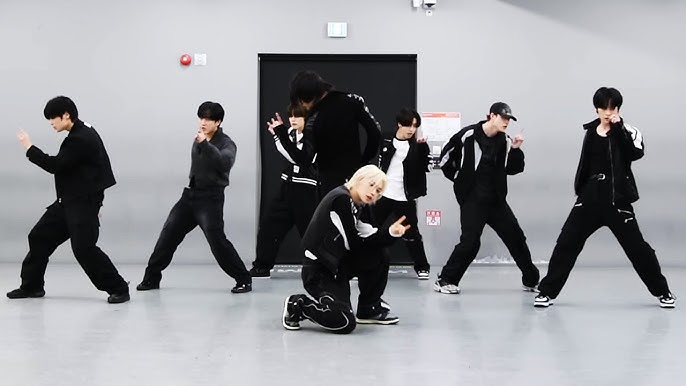
Day 11: the first time you do it to the real song. Remember it feels messy. That's still progress.
You have the sequence. Phase 3 is about the details that move something from "I learned this" to "I can perform this." In K-pop specifically, the difference between a beginner and an intermediate dancer is almost entirely in Phase 3 — sharpness, timing, where the eyes go, what the fingers are doing. These three days are where the gap closes.
Sharpness pass — every arm has an end position
Run the choreo at half speed. For every arm movement, make sure it reaches its full extension and stops — no drifting, no trailing off. K-pop arms should look like they hit a wall at the end of each move. This single change will make your footage look significantly more professional.
Expression and eyes — where are you looking?
Film yourself doing the choreo with your eyes down or unfocused. Watch it. Now do it again looking straight at the camera (or a point above it). The second version will look like a different performance by a different person. In K-pop, confidence is mostly eye contact.
Your final performance clip
Favourite outfit. Good lighting (face the window, not away from it). One warm-up run. One performance run — that's the clip. Post it on Reels, TikTok, or your class group. Compare it to any footage from Day 1 or Day 6. That distance is 14 days.
The lighting tip for Day 14: Face a window during daylight. Natural light facing you = free ring light. Phone propped at eye level or slightly above. Landscape orientation for Reels. If you have a second phone or someone willing to hold a phone — use both angles and choose the better one.
The outfit tip: Wear something that moves with you — not restrictive, not too loose. Darker colours hide awkward lines. Whatever makes you feel least self-conscious is the right choice. The dance is what matters, not the clothes.
The YouTube Tutorials That Actually Teach This Right
These channels break choreo into counted segments — the right method for beginners
1MILLION Dance Studio — Professional breakdowns, often has slow-motion tutorial versions of trending K-pop songs. Search "[song name] 1MILLION tutorial."
Goldenest Hoshi — Beginner-focused K-pop tutorials. Extremely patient, counts everything out loud, explains footwork separately from arm work.
Ellen and Brian — K-pop tutorial couple. They mirror the choreo (so you can follow directly without flipping), which is genuinely helpful for beginners.
Search "[song name] dance tutorial mirrored slow." The words "mirrored" and "slow" will save you hours. Mirrored means their right is your right. Slow means it's at 50-75% speed.
Kpop With Meenu — Indian K-pop dance channel with tutorials explained in Hindi and Hinglish. Some songs overlapping with this plan's recommendations.
Your 14-Day Progress Tracker
Log your streak daily on TeenIcon. The gap between people who finish 14 days and people who quit at Day 7 is not talent — it's the streak log. Having the streak visible makes skipping feel wrong in a specific, useful way.
Film on Day 5, Day 11, Day 14. Three clips. Three stages. Put them side by side on Day 14. This is your proof — not to anyone else, to yourself.
One fix per day from Day 12. Watch your clip. Find the single most obvious thing to improve. Fix that one thing. Not ten things — one. This is faster than it sounds.
Join a pod on TeenIcon with 2-3 others doing this challenge. Share your Day 11 clip with your pod. Having someone actually see your progress removes the loneliness that kills practice streaks around Day 8.
Post your Day 14 clip. Instagram Reels, TikTok, or the TeenIcon community. Use the tags #KpopDance #14DayChallenge. The Indian K-pop dance community on Reels is genuinely encouraging — post it.
What This Plan Actually Proves
There's a specific moment that happens around Day 10 or 11 for almost everyone who finishes this plan. You're running the choreo and you stop thinking about what comes next — and for a few counts, maybe half the chorus, you're just dancing. Not recalling. Not executing. Just moving.
It lasts maybe three seconds the first time. But it happens. And when it does, you understand something about dance that nobody can explain to you beforehand: the goal was never to learn the steps. The steps are just how you get there.
The part that's hard to admit: most people who want to learn K-pop dance don't start because they believe they're "not that kind of person." Coordinated people. Flexible people. People who grew up in dance classes.
The K-pop training system was specifically designed to take people who had none of those advantages and build dancers out of them. Most of your favourite idols were told at some point that their dancing was too stiff, too slow, not sharp enough. They practiced anyway — in structured, counted, repetitive segments — until it wasn't.
Fourteen days is not enough to become an idol. It's enough to prove to yourself that you're not the kind of person who can't dance. Those are different things. The first changes nothing. The second changes everything.
Pick your song. Clear your floor. That's Day 1.
If you're choosing between Cupid and Hype Boy — pick Cupid. It's the right difficulty for Day 1 with zero background. Log your streak on TeenIcon. Start a pod with anyone else who's been putting this off. Share your Day 14 clip when you're done — we genuinely want to see it.
You are not a person who can't dance. You're a person who hasn't yet practised enough to know that.Comments 0
Keep reading
Similar blogs by topic

I Thought My English Was Fine Until I Sat a Full IELTS Mock Test
IELTS isn't an English test the way school taught you English — it's a test of doing specific things under a clock. Here's the format, the real costs, and an 8-week plan that actually works for Indian teens.

The 5 Platforms Where Indian Teens Are Actually Learning Real Skills in 2026 — Ranked Honestly
An honest ranked list of the 5 best free skill-learning platforms for Indian teens in 2026, including TeenIcon, Khan Academy, freeCodeCamp, and more.

Video Editing Is the Teen Skill Everyone Suddenly Needs — Here’s the 30-Day Free Plan
A practical 30-day guide for Indian teens to learn video editing, build a portfolio, find clients, and make their first ₹10,000 with free tools.