
Why Dandadan Became One of the Most Important Anime of the Decade
Quick take
A manga-first Dandadan guide for Indian teens: why the story hits harder in print, where to start, and what to read or watch first.
Explore this topic
Article body
Why Dandadan Quietly Became the Most Important Anime of the Decade — A Manga-First Watch Guide for Indian Teens
Most anime of the decade get remembered for their fight sequences. The way Demon Slayer's animation made the Water Breathing forms look like something from a different medium entirely. The unforgettable choreography of JJK's Shibuya arc. Even Chainsaw Man's opening sequence — that unsettling, expensive, deliberate weirdness every single week. Dandadan is going to be remembered for something else. It's going to be remembered for writing two teenagers more honestly than almost anything in mainstream anime has managed since Toradora.
That's a big claim for a show that opens with a ghost possessing someone's genitals. But that's the thing about Dandadan — the premise is aggressively unhinged, and the emotional writing underneath it is completely sincere. Here's why it matters, and where to start if you've been seeing it everywhere and aren't sure what to do with it.
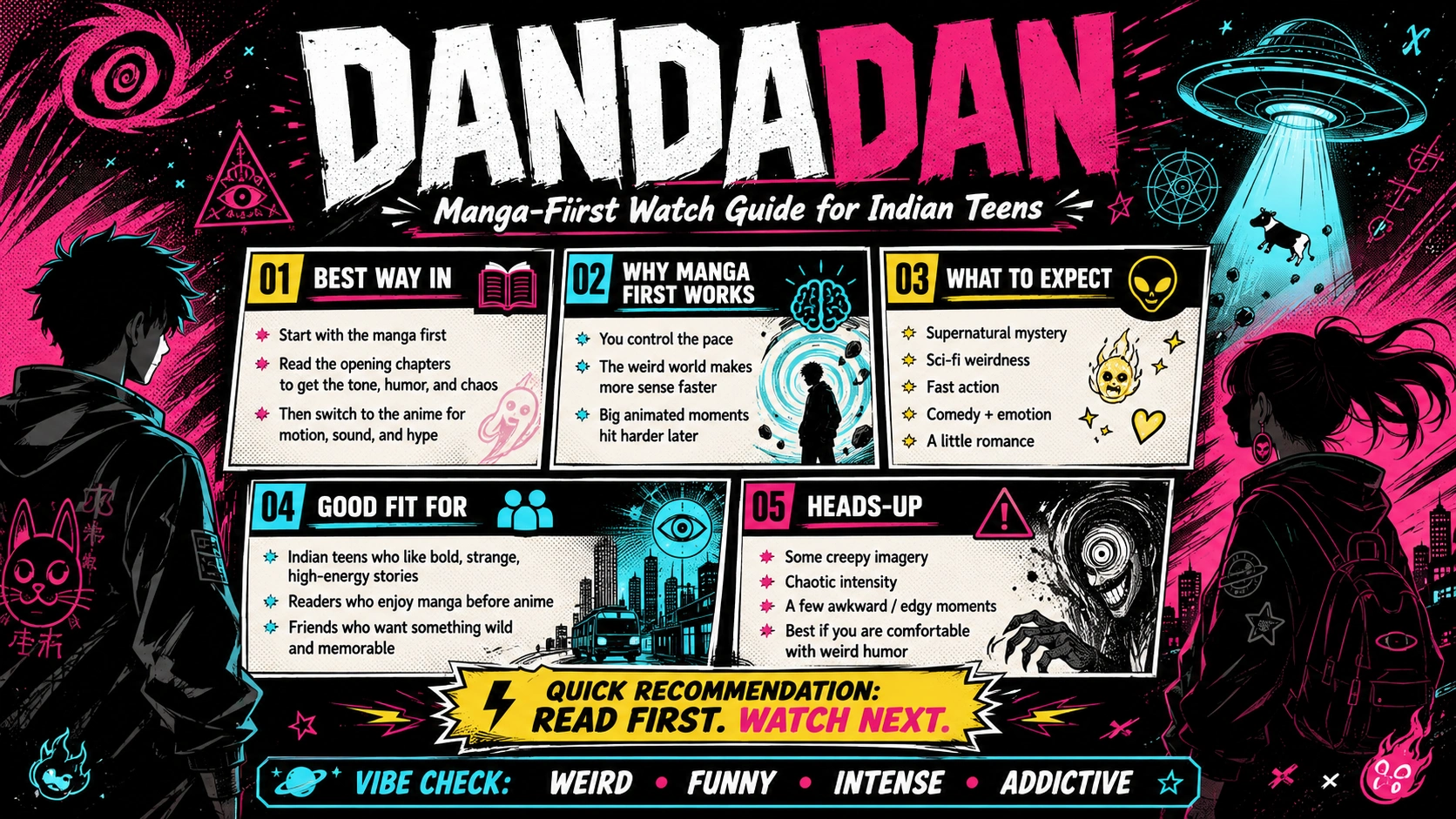
Dandadan's art style by Yukinobu Tatsu is kinetic in a way that demands manga over anime — panels that move even when you're standing still.
What Dandadan Actually Is — Before the Hype Gets in the Way
Okoto Okarun is a boy who believes in aliens. Momo Ayase is a girl who believes in ghosts. They make a bet — each will try to prove the other's supernatural belief exists — and within three chapters both are proven catastrophically right. The story is written and illustrated by Yukinobu Tatsu, who was an assistant to Tatsuki Fujimoto (Chainsaw Man) before going solo, and you can feel the Fujimoto influence in the willingness to go completely unhinged with a premise while keeping the emotional core completely grounded.
What separates Dandadan from other supernatural shounen is the specific quality of attention it gives to its two leads. Momo is not written as a device for Okarun's growth. She has her own wants, her own fears, her own arc that runs parallel to his and occasionally intersects and occasionally doesn't. The relationship between them develops with the awkward specificity of two people who are genuinely confused about each other — not the cleaned-up, dramatic-declaration version of teen romance that anime usually delivers. They're embarrassed. They're bad at communicating. They keep almost saying the thing and then not saying it. It's accurate in a way that sticks.
Why the Manga Hits Differently Than the Anime
Science SARU's anime adaptation is excellent — one of the most visually ambitious productions of 2024–2025, with an opening sequence that was immediately considered among the best in recent years. Watch it. But read the manga first, or alongside it, and here's why: Tatsu's panel composition is doing things that motion smooths over. The manga is chaotic in a structural way that the anime tidies into a more conventional flow. Faces that in the manga are genuinely ugly-expressive — the kind of face someone actually makes when they're scared or embarrassed or furious — get slightly softened in the anime's cleaner character models.
More importantly, the manga is currently far ahead of the anime and the later arcs are where Dandadan becomes something considerably more than what it appeared to be in the opening chapters. There is a section somewhere around Chapter 50 that reframes something you've been reading as comedy and makes it devastating. That section has not been animated yet. It is the reason people who've read ahead describe Dandadan as the most emotionally serious manga currently running disguised as a comedy.
The Indian Teen Watch and Read Order
Option 1 — Anime first, manga after. Start with the Netflix anime (Season 1 covers roughly Chapters 1–30). Let the animation and opening sequence do their job — they're worth experiencing cold, without knowing what's coming. Once you've finished the season, pick up the manga from Chapter 1 and read forward. You'll notice things the anime glossed over, and you'll reach the current chapters faster than waiting for Season 2.
Option 2 — Manga only, anime as bonus content. The manga is available on Manga Plus (free, legal, weekly updates) and Viz Media's app. If you read 5–8 chapters a day you can catch up to the current release schedule in under two weeks. Then watch the anime for the animation of the sequences you already know — Tatsu's action chapters translate especially well to motion — rather than for story information.
Option 3 — Chapter 1 manga, Episode 1 anime, alternate. Read a chapter, watch the corresponding episode, compare what changed. This is slower but builds the most specific understanding of what adaptation choices the anime made and why. Recommended if you're already a fairly serious manga reader who finds the "did they change it" question interesting.
Where to read and watch Dandadan for free (legally):
Manga: Manga Plus by Shueisha (mangaplus.shueisha.com) — free, legal, weekly updates, first and last three chapters always free, older chapters require a subscription or one-time unlock. Viz Media app has similar access.
Anime: Netflix India — Season 1 is 12 episodes. Check if it's in your plan. If not, Crunchyroll has the simulcast rights in some regions.
Current status: Season 2 announced, release window 2025–2026. Manga is ongoing with roughly 160+ chapters as of mid-2026 — significant unanimated content available right now.
The Episodes and Chapters That Prove the Hype Is Earned
Episode 5 is where most casual viewers stopped being casual. Chapter 50 is where manga readers stopped calling it a comedy.
Episode 3 is when most people get past the premise and commit. The Serpoian arc resolves in a way that reveals what the show is actually doing underneath all the supernatural noise — it's a story about two people choosing each other in small, stubborn ways before they understand what the choice means.
Episode 7 is the one that gets screenshot and reposted. If you loved Spy × Family for the way it balanced chaos and genuine warmth, Episode 7 is the moment Dandadan earns its place in the same conversation. If you cried at Episode 7, read Chapter 50 at your own risk.
In the manga, Chapters 40–65 are the arc that separates readers who like Dandadan from readers who think about it for weeks after. Turbo Granny's storyline, which starts as comic relief, becomes something the manga handles with a specificity about memory and loneliness that almost nothing in mainstream shounen attempts.
Quick Tips for First-Timers
- Give it three episodes or three chapters before judging — the premise is intentionally absurd and the first episode leans into that. The show earns its emotional moments by spending time in the chaos first.
- Okarun and Momo's relationship develops slowly and honestly — don't expect a confession arc by Episode 4. The restraint is the point. The show is building something that takes time to feel real.
- The comedy and the drama are not separate layers — Tatsu writes them intertwined. A chapter that makes you laugh in the first half will frequently do something sharp in the second. Read without skipping.
- Turbo Granny is not comic relief — she appears to be, especially in the anime. She is not. Pay attention to everything she says about the past.
- The art in the manga is worth slowing down for — Tatsu's faces are extraordinary. Don't skim the action chapters — there are panel compositions that would be famous if they were oil paintings.
Open Manga Plus tonight and read the first three chapters.
They're free, they're around 20 pages each, and they'll tell you within an hour whether Dandadan is your kind of thing. If you've already watched the anime and liked it, go straight to Chapter 31 in the manga and keep going. Season 2 is coming. You have the whole lead-up to experience before it arrives.
Most anime gets remembered for how it looked. Dandadan is going to get remembered for how it felt. Start before everyone's talking about it.Comments 0
Keep reading
Similar blogs by topic

Gachiakuta Won Best New Anime at Crunchyroll 2026 and Indian Fans Haven't Even Started Watching It Yet — Fix That Right Now
Gachiakuta swept Best New Series, Best Character Design, and Best Background Art at Crunchyroll 2026. Here's why Indian anime fans should start watching it now.

Chainsaw Man Just Ended — What the Final Chapter Meant and Why You Should Start Reading It Right Now If You Never Did
A spoiler-light guide to Chainsaw Man's ending, what Part 1 and Part 2 cover, why the fandom split, and where Indian readers can read the complete manga free.