
The Indian Teen's Guide to a 7-Day Social Media Detox — What Happens to Your Brain, Your Sleep and Your Mood When You Actually Try It
Quick take
A seven-day social media detox experiment for Indian teens, showing how sleep, mood, attention, and phone habits change when the apps are deleted.
Explore this topic
Article body
The Indian Teen's Guide to a 7-Day Social Media Detox — What Happens to Your Brain, Your Sleep and Your Mood When You Actually Try It
I deleted Instagram for seven days sometime around last October, a week after my pre-boards, mostly on a dare from my cousin who claimed she'd done it for a month and felt "like a different person." I rolled my eyes. I also had nothing else to do that week and my screen time was sitting at six hours a day, which felt uncomfortable to look at, so I thought: fine, week off, let's see.
What I expected: boredom, FOMO, and a triumphant return at Day 8. What I actually got was stranger and more interesting than either of those things. Here's everything that happened, hour by hour in the first two days and day by day after that — and the science behind why your brain does what it does when you remove the apps from your phone.
Before We Start: The Numbers That Made Me Do This
None of those statistics are surprising. If anything, you're probably nodding at the 47 number and thinking it sounds about right. The thing is — no one is forcing you to look. The apps are designed to make looking feel like something you chose, when actually you're just responding to a pull that was engineered by people who spent a lot of money figuring out exactly how to create it. Understanding that doesn't make the pull disappear. But it does make the experiment worth running.
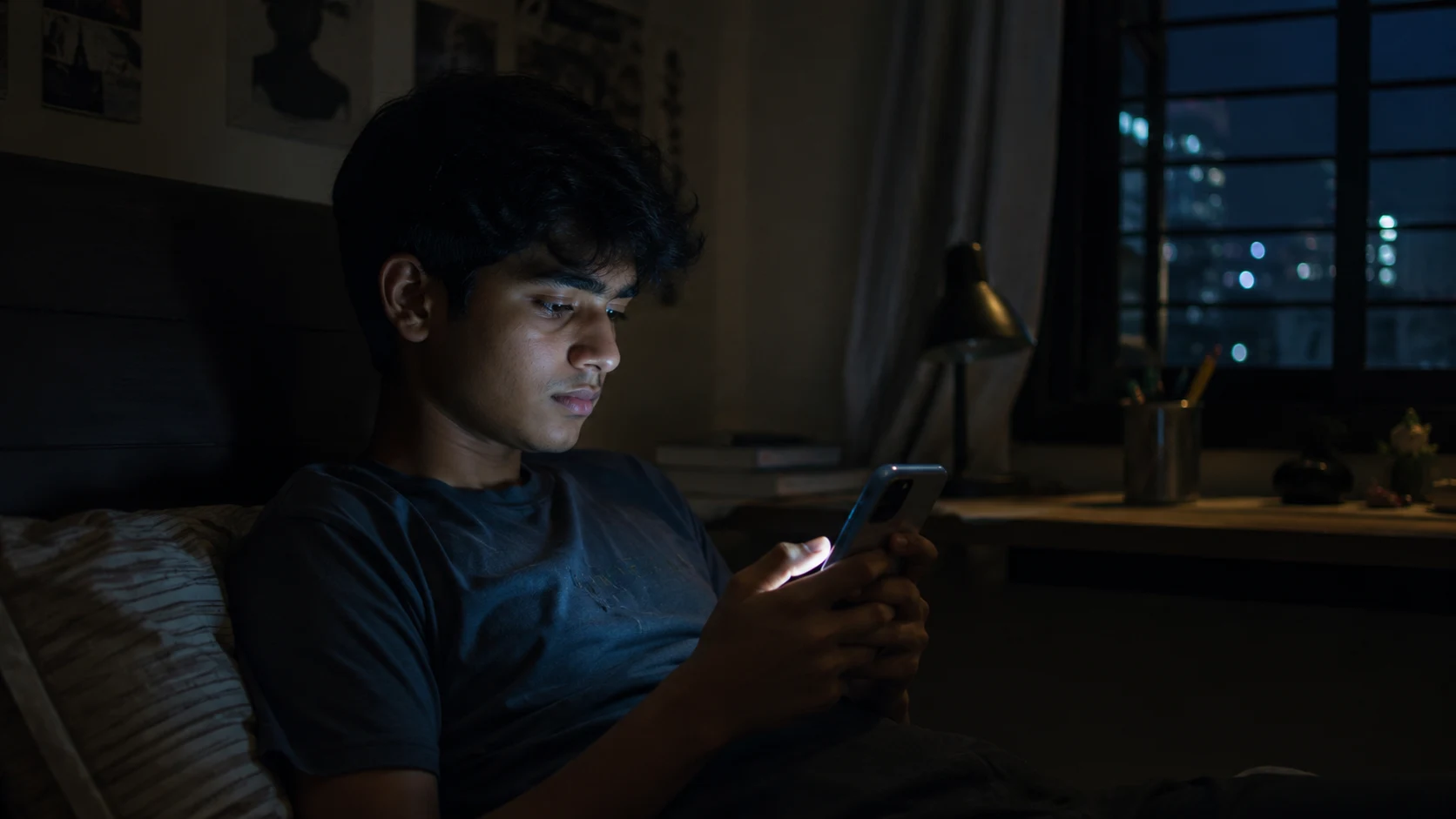
The average Indian teen checks their phone 47 times a day — most of those checks are habitual rather than intentional.
The Rules (Keep Them Simple or You'll Quit on Day Two)
The detox I did had three rules. I'd recommend the same ones. More rules than this and you'll spend your energy managing the rules instead of actually experiencing the detox.
- Delete the apps, don't just log out. Logging out creates a one-tap barrier. Deleting creates enough friction that you'll catch the reflex before you act on it. You keep the accounts — you're not quitting forever, just pausing for seven days. The apps reinstall in thirty seconds when you're done.
- Exceptions must be decided in advance. Mine were: WhatsApp for family communication (not friend groups), Google Maps, and Spotify. Not YouTube. Not Reddit. If it's a scroll, it's out.
- Tell two people you're doing it. Not for accountability in a serious way — just so someone knows, so the detox exists in a social reality outside your own head. It's surprisingly helpful.
Before you delete the apps, do this first:
Go to Settings → Screen Time (iPhone) or Digital Wellbeing (Android) and screenshot your current weekly average. You'll want this at the end of Day 7 for comparison. The number will be humbling before the detox and satisfying after it.
Also: mute your friend groups on WhatsApp for the week if you're leaving it. The detox is about intentional use, not total silence — but group notifications create the same reflex loop as social media.
Day by Day — What Actually Happens
The phantom reach
Your hand will reach for your phone approximately every twelve minutes. Not exaggerating. You'll pick it up, open the home screen, hover where Instagram or YouTube used to be, and then put it down again. This is pure muscle memory — you've trained your hand to do this without a thought. It's genuinely startling to notice how automatic it is. Don't feel bad about it. The reflex is the data point.
The boredom peak
This is the hardest day for most people and the day most detoxes fail. You'll feel genuinely bored in a way that feels unpleasant and purposeless. This is not a sign that you need social media back — it's a sign that your brain's reward system is recalibrating. The apps had been supplying a constant trickle of dopamine. Removing them creates a gap. That gap is uncomfortable. It is also temporary.
Sleep gets weird (in a good way)
By Day 3, most people notice their sleep has changed. Falling asleep is faster. The half-awake state that used to be filled with replaying Reels at the back of your eyelids is quieter. This is because blue light from screens suppresses melatonin — the hormone that signals sleep — and the scrolling itself keeps your nervous system activated right up until you put the phone down. Remove both and your body remembers how to wind down on its own. You'll probably wake up on Day 3 feeling rested in a way that's slightly unfamiliar.
The quiet sets in
This is the part nobody talks about because it's hard to describe without sounding like you're describing something spiritual. By Day 4, the reflex slows down. You'll go significant stretches — an hour, two hours, eventually an afternoon — without thinking about your phone. You'll notice things. The specific way chai smells from two rooms away. A conversation where you're genuinely present rather than half-thinking about what you'll post about it later. A book chapter you finish without putting the book down to check something. These aren't dramatic revelations. They're just the normal experience of your own attention, which you hadn't fully had access to in a while.
The weird part: you don't want to go back
At some point in Day 6 or 7, you'll have the thought: I could reinstall these right now and nothing would stop me. And then you won't. Not because of willpower — just because the apps have stopped feeling urgent. You know they'll be there. You know what they contain. The FOMO has a much quieter voice by Day 7. This is the most useful information the detox gives you: the pull of social media is not fixed. It changes based on how long you've been away from it. You are more in control than the first 24 hours made it seem.
By Day 4, most people report doing things they'd been "meaning to get around to" for months — the attention was always there, just occupied elsewhere.
What the Science Actually Says
This is not just anecdote. The research on social media and teenage mental health is extensive and consistent. Instagram and TikTok use patterns activate the same dopamine reward pathways as slot machines — intermittent, variable rewards (a like, a comment, a new video) are specifically more addictive than predictable ones. This is not a metaphor. This is neuroscience.
Short-term social media detoxes in teens and young adults consistently show improvements in self-reported mood and life satisfaction within three to five days, reduced anxiety scores within a week, and measurable improvements in sleep quality within 48–72 hours of stopping late-night screen use. The sleep effect is the most immediate and most reliable — and for Indian teens who average under 7 hours of sleep per night during the school year, it's also the most directly consequential for academic performance.
When You Come Back (And How to Come Back Differently)
Here's the part that matters more than the detox itself: reinstalling with intention rather than reflex. The goal is not to permanently quit social media. The goal is to break the automatic relationship and replace it with a chosen one. Some things that actually stick:
- Set a daily time window — not a time limit, which is easy to override — but specific hours. "Instagram from 7–8 PM only" is cleaner than "two hours per day" because it prevents the drip-drip of 10 minutes here, 15 minutes there that adds up to four hours without you noticing.
- Leave the phone outside your bedroom at night. Charge it in the kitchen. Get an alarm clock if you use your phone as one. This single change has more impact on sleep than almost anything else and costs nothing.
- First 30 minutes of your morning: no phone. This was the most lasting change I made after my detox. Starting the morning with your own thoughts rather than someone else's content changes how the first hour of your day feels in a way that's hard to explain until you've done it for a week.
- Delete the apps when exam season starts. Not as a punishment — as a tool. You know they're still there. You can reinstall after results. The friction is useful precisely when it's hardest.
The 7-Day Detox Quick Rules
- Delete the apps, don't just log out — the friction of reinstalling is the entire point; you need enough pause to catch the reflex.
- Day 2 is the hardest — plan something physical specifically for that day so boredom doesn't win by default.
- Sleep will improve by Day 3 — the melatonin effect is real and fast; most people feel it within 48–72 hours of stopping late-night scrolling.
- Do it with one other person if possible — not for accountability pressure but because comparing notes at Day 4 and Day 7 is genuinely interesting.
- On Day 7, write three things down before reinstalling anything — what changed, what surprised you, what you want to keep.
- Leave your phone outside your bedroom — the single highest-ROI habit change from the whole experience, and the one most worth keeping after the week ends.
Pick a Start Date. Tell One Person. Delete the Apps.
Seven days is genuinely not long. You've done harder things before your boards prep. The apps will be there on Day 8, exactly as you left them, and the algorithm will have saved your feed. What you'll have on Day 8 that you didn't have before: evidence that the pull is not fixed, your attention is recoverable, and the quiet is something your brain actually wanted. Start this weekend. Send this to whoever you'd do it with.
Seven days. Your brain on the other side of them will thank you.Comments 0
Keep reading
Similar blogs by topic

The 5 Platforms Where Indian Teens Are Actually Learning Real Skills in 2026 — Ranked Honestly
An honest ranked list of the 5 best free skill-learning platforms for Indian teens in 2026, including TeenIcon, Khan Academy, freeCodeCamp, and more.

Learn to Bowl Spin in 30 Days — The Cricket Skill That Can Actually Get You on a Team
A beginner-friendly spin bowling guide for Indian teens, covering the off-break grip, daily drills, pitch reading, variations, and a 30-day plan to become team-useful.

Learn Table Tennis in 21 Days — India's Most Underrated Sport Produced Manika Batra and Sharath Kamal
A beginner-friendly 21-day table tennis guide for Indian teens, covering where to find a table, what gear to buy, the three strokes to learn first, and how to build real rallying skills fast.