
Meditate 10 Minutes a Day for 30 Days — A Sceptic's Honest Review
Quick take
Try 30 days of 10-minute meditation with free apps and simple breathing. See how daily practice can reduce stress and sharpen focus for teens.
Explore this topic
Article body
Meditate 10 Minutes a Day for 30 Days — A Sceptic's Honest Review
I had three problems with meditation before I tried it. First, every person who recommended it to me spoke about it in a voice that made me want to leave the conversation. Second, the marketing language — "calm your anxiety," "unlock clarity," "transform your life" — sounded like something printed on a detox tea packet. Third, sitting still and doing nothing felt like a waste of ten minutes that could have gone toward the backlog of Physics chapters I was pretending didn't exist.
I started anyway, because board exam stress had reached the point where something needed to change and the something I'd been avoiding was the obvious one. Thirty days. Ten minutes a day. Free apps only. Here's the completely unglamorous truth of what happened — including the two weeks where I was convinced it wasn't working, and what shifted in Week 3 that made me understand why people keep doing this.
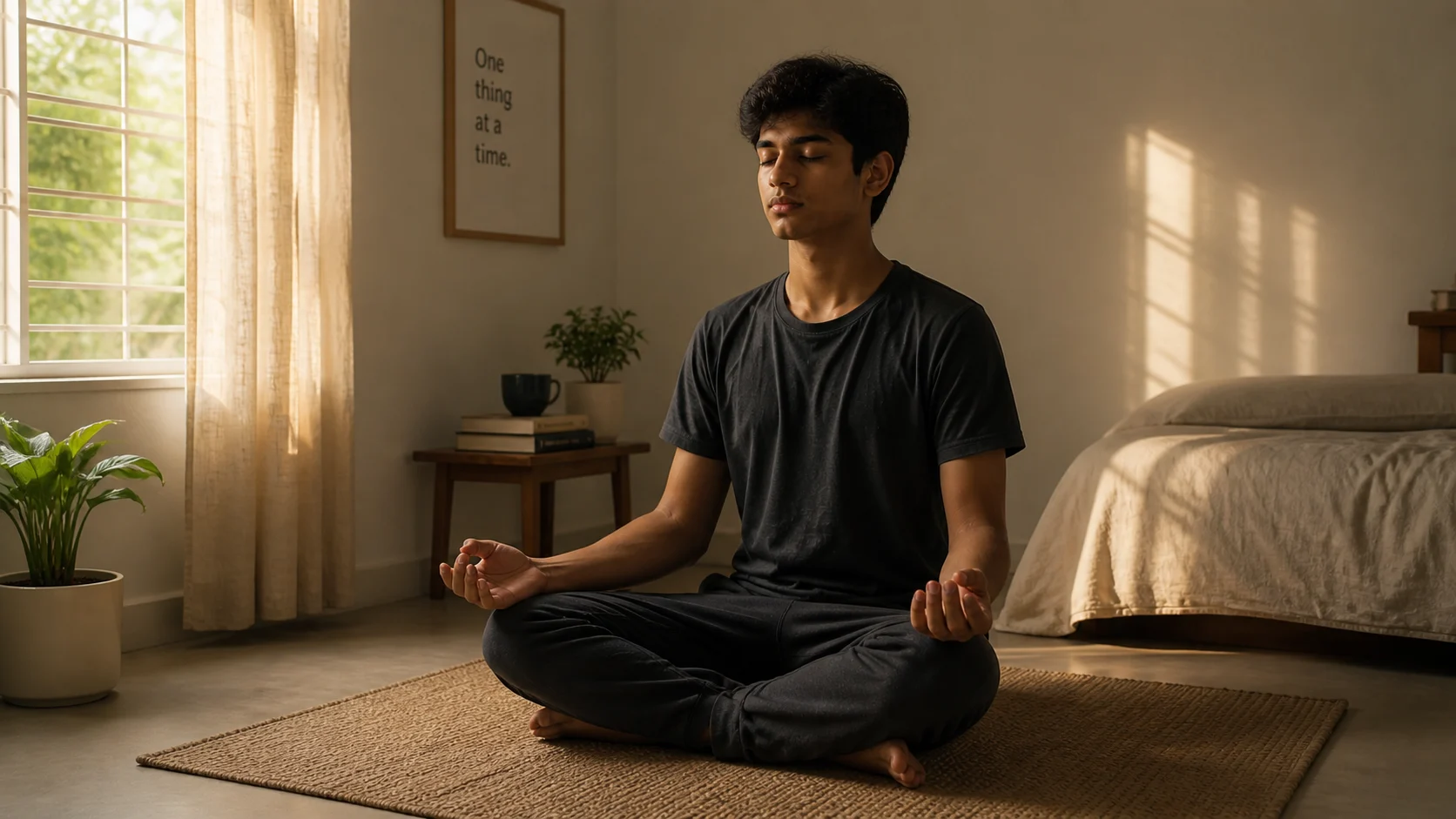
The setup is simpler than any app will tell you. Floor, closed door, ten minutes, eyes shut.
Week 1: This Is Just Sitting With Noise
The first session lasted four minutes before I gave up. Not because I got distracted — because I got so aggressively distracted that continuing felt dishonest. I sat with my eyes closed, breathing slowly, and within ninety seconds I was mentally composing a reply to a WhatsApp message I hadn't sent yet, worrying about a Maths test that was three days away, and wondering if the sound outside was a crow or something larger. Then I was thinking about whether crows are intelligent. Then I was thinking about a documentary I'd watched about corvids. Then I realised I was supposed to be meditating.
This is what most beginners don't know: that is meditation. The noticing — "I've gone somewhere else again" — followed by returning to the breath is the whole practice. Not achieving a thoughtless state, not reaching some serene plateau. Just noticing you've drifted and returning. Thousands of times across thirty days. The drifting isn't failure. The returning is the exercise.
I used the Insight Timer app — free, no paywall, Indian users in the community — and started with their 10-minute beginner guided sessions. The guided voice was the difference between Week 1 working and not. Without someone periodically saying "when you notice your mind has wandered, gently return to the breath," I would have spent each session either failing to stop thinking or successfully stopping the timer at six minutes and calling it done.
Week 2: Nothing Is Happening and I'm Annoyed About It
Week 2 was the low point. I was consistent — ten minutes every morning before breakfast, sitting on the floor of my room with my back against the bed — but I couldn't report any meaningful change. My anxiety around the boards felt identical. My ability to focus during study sessions felt the same. I was sleeping at the same time and waking at the same time. If anything, the ten minutes felt slightly more frustrating than Week 1 because I now knew what I was supposed to be doing and was doing it without any visible return.
I kept going for a reason that had nothing to do with faith in the practice — I'd told a friend I was trying it, and stopping felt like a conversation I didn't want to have. Accountability by mild social obligation. Not glamorous, but effective.
On Day 14 something small happened. I was in a coaching class, a teacher said something mildly unfair about a student near me, and I felt the usual irritation rise — and then, for the first time I could consciously remember, I noticed the irritation as a thing happening rather than immediately becoming it. A half-second gap between feeling and reaction that hadn't existed before. I didn't do anything with it. I just noticed. It was over in seconds. But it felt significant in a way I couldn't quite explain.
Week 3 and 4: Small Changes, Consistently There
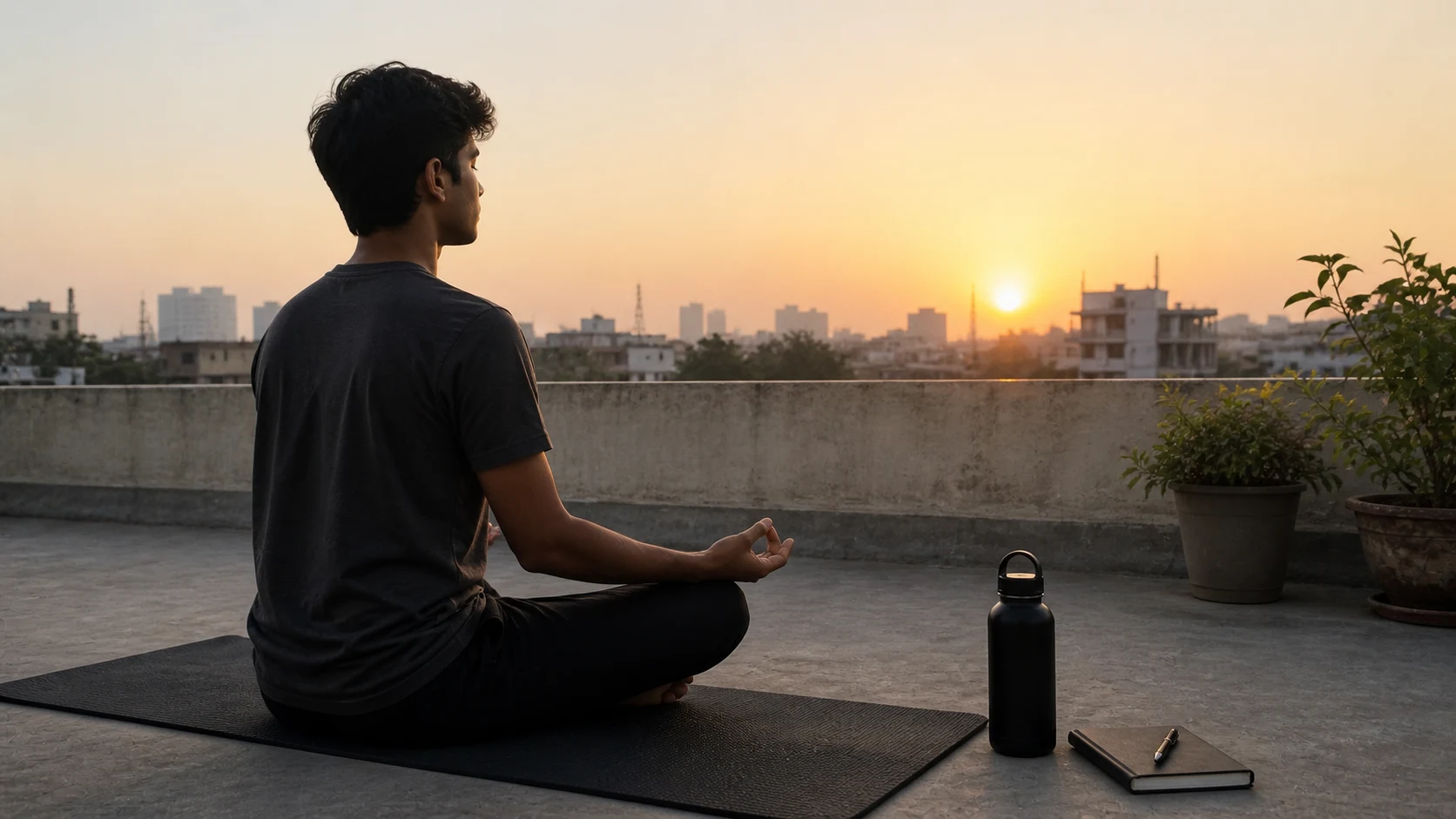
The changes in Week 3 are small and real. Nothing dramatic — just a slightly longer fuse and a slightly clearer head.
The gap I noticed on Day 14 widened over Weeks 3 and 4. Not dramatically — I wasn't levitating or experiencing inner peace at the bus stop. But the particular exhaustion of being at the mercy of every irritant, every anxious thought, every minor frustration, got slightly less total. I started sleeping earlier without intending to. My study sessions had marginally longer clean stretches before I reached for my phone. I got into two fewer pointless arguments with my younger brother, which he noticed and commented on, which was either a sign of genuine change or that I was simply too tired to fight.
By Day 25 I switched from guided sessions to a simple timer — ten minutes, soft bell at the start and end, nothing else. I didn't need someone to remind me to return to the breath anymore. The returning had become fast enough that the drift wasn't the problem it had been in Week 1. Not gone — still constant — just handled differently.
Free apps that actually work — no paywall, no upsell pressure:
Insight Timer — Best free meditation library available. Thousands of guided sessions, a simple timer, and a community of meditators worldwide. Start with the 10-minute beginner courses. Free forever for the core features.
Medito — Completely free, no subscription, no ads. Built by a non-profit. Clean interface, solid beginner course, works on any Android or iOS phone including older models.
YouTube: Michael Sealey — Free guided meditations, 10–20 minutes, sleep-focused versions available. Works without an account. Good for nights when anxiety spikes before an exam.
Simple timer option — From Week 3 onward: set a phone timer for 10 minutes, put the phone face-down, sit. No app needed. This is what most long-term practitioners actually do.
Quick Tips
- Distraction is not failure — the mind wandering is expected, universal, and not a sign you're doing it wrong. The return is the practice. A session with 200 distractions and 200 returns is a better session than one where you fell asleep.
- Same time, same spot, every day — habit stacking works. Morning before breakfast is the lowest-friction slot for most teens. Evening before sleep works too, especially if anxiety peaks at night.
- Don't meditate lying down in Week 1 — you will sleep. The body associates horizontal positions with unconsciousness. Sit upright, back supported if needed, until the practice is established enough to handle the drowsiness cue.
- The boards-specific version — if exam anxiety is the reason you're starting, add a 60-second breathing technique before any test: inhale 4 counts, hold 4, exhale 6. This physiologically slows the heart rate within 90 seconds. It's not meditation — it's a fast-acting tool that meditation makes you better at using.
- Expect nothing for two weeks — the research on meditation suggests benefits compound after 8 weeks of consistent practice. Thirty days is the foundation, not the destination. Go in expecting slow, quiet returns, not transformation.
Download Insight Timer tonight. Set a 10-minute beginner session for tomorrow morning.
Sit on the floor with your back against the bed. Press start. When you drift — and you will, immediately — return to the breath without judgment. That's the entire instruction set for Day 1. The thirty days will tell you more about your own mind than any amount of reading about meditation ever could.
You don't need to believe it works. You just need to sit down for ten minutes and see what happens.Comments 0
Keep reading
