
I Journaled 5 Minutes Every Morning for 30 Days — Here's What Actually Showed Up on the Page
Quick take
Try a 30-day journaling habit with just 5 minutes every morning. Learn what to write, spot patterns, and use journaling to think more clearly.
Explore this topic
Article body
I Journaled 5 Minutes Every Morning for 30 Days — Here's What Actually Showed Up on the Page
I always assumed journaling was for people who had interesting things to say. Deep thinkers. Writers. People whose brains produced insights worth writing down. My brain, most mornings, produces: "I'm tired. I have Chemistry today. The ceiling fan is louder than usual." Not exactly memoir material. So I dismissed it — the way you dismiss something that makes you quietly nervous about what you'd find if you actually tried it.
Then a teacher mentioned that she'd journaled every morning for eleven years and that it had changed how she thought about problems more than anything else she'd ever done. Something about the specificity of eleven years made me take it seriously. I gave it 30 days and five minutes — an amount of time so small that refusing would have felt embarrassing. Here's exactly what showed up on the page.
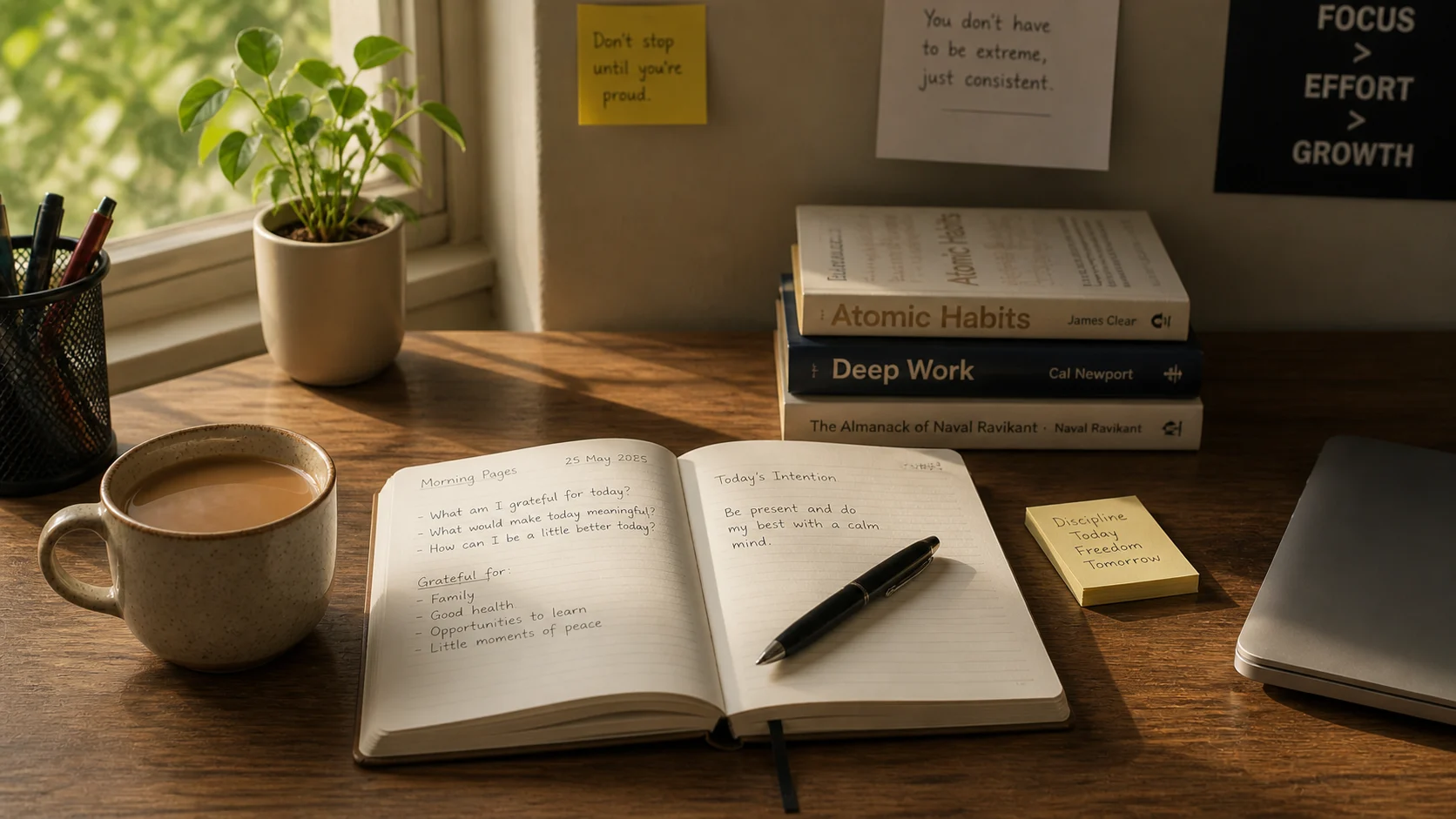
Five minutes. One notebook. Any pen. The bar is genuinely this low — and that's the whole point.
Week 1: Writing Nothing Sentences
The first three mornings I wrote things like: "Today I have a Physics test. I didn't sleep well. It's cold." Three sentences. Put down the pen. Done. I felt stupid. This was journaling the way drawing stick figures is painting — technically the same activity, obviously not.
Day 4 I tried a different approach after reading that most journaling guides suggest writing whatever is loudest in your head rather than what you think you're supposed to write. So I wrote about how much I was dreading the test — not just that I was dreading it, but why. The fear of being asked a derivation I'd half-studied. The specific embarrassment of getting it wrong in front of my bench-mate who always gets it right. The way that embarrassment connects to something older that I'd never quite named. I wrote for eight minutes without noticing I'd gone past five.
That was Week 1's discovery: nothing sentences are fine as a warmup. But the real material appears the moment you stop trying to write something worth reading and start writing whatever's actually sitting in your chest.
Week 2: Patterns I Hadn't Noticed
By Day 10 something started happening that I hadn't expected. When I read back through the previous nine entries, I noticed the same names appearing repeatedly in the context of frustration. The same kinds of situations triggering the same kinds of responses. The same worry — about a specific relationship, about a specific gap in how I was studying — resurfacing every two or three days in slightly different clothes.
The journal wasn't creating these patterns. They were already there, running below the surface of daily life, influencing my mood and decisions without me being able to see them. Writing them down made them visible. And visible problems are meaningfully different from invisible ones — not easier, necessarily, but no longer able to operate entirely on their own terms in the dark.
Week 2 is also when I stopped setting a timer. The five-minute target became an average rather than a limit. Some mornings were three minutes of genuine exhaustion. Some were twelve minutes of something I couldn't stop mid-sentence. Both felt right.
Week 3 and 4: The Most Useful Five Minutes of the Day

By Week 3, the five minutes before school became the clearest part of the whole day.
Something shifted around Day 17 that I noticed by its absence on the one morning I skipped. That day felt slightly more reactive — I snapped at something minor, felt irritated for longer than made sense, went into an afternoon test without having discharged whatever was sitting in me from the morning. The journal had become a kind of pressure valve I hadn't consciously realised I was using.
The entries changed quality too. Less reporting, more thinking. Less "this happened and I felt bad" and more "when this kind of thing happens, here's what I think is actually going on." The five minutes started producing ideas — actual, usable ideas — for conversations I'd been avoiding, for study problems I'd been circling, for things I wanted to try. Not because journaling is magic but because giving a problem five uninterrupted written minutes without a phone, without a friend, without any audience, is one of the cleaner thinking environments available to a teen in 2026.
By Day 30, I had a notebook with entries across thirty mornings. Reading through the full arc — the Physics test fear on Day 4 that turned out to be manageable, the friendship tension in Week 2 that resolved differently than I'd imagined, the idea in Week 3 that became something real — felt like reading a story I hadn't known I was living while I was in it.
The prompt sequence I used — week by week:
Week 1 — "What's loudest right now?" Not the most interesting thing. The loudest thing. The thing already taking up space before you've even had chai. Write it down without filtering it.
Week 2 — "What am I avoiding and why?" This is uncomfortable and reveals more in five minutes than a month of vague worry. Write the first answer, then ask "why" again, then once more.
Week 3 — "What would I do if I weren't afraid of getting it wrong?" Decision-making prompt. Good for career anxiety, relationship friction, creative projects that keep not starting.
Week 4 — No prompt. Just write. By Week 4 you don't need a starting question. The habit carries you to the page and the page takes it from there.
Quick Tips
- Physical notebook beats phone notes — not because of nostalgia, but because a phone in your hands before 8 AM leads to notifications before you've written a word. Keep the notebook beside your bed, not in a drawer.
- Don't reread while you write — reading your own sentences mid-entry triggers the editing impulse, which kills honesty. Write forward only. Reread later, separately.
- Write badly on purpose in Week 1 — the goal is not good writing. The goal is honest writing. These are almost opposite things at the start.
- Date every entry — the date is what makes the pattern-spotting in Week 2 possible. An undated journal is just a collection of disconnected thoughts.
- If you miss a day, don't write double the next morning — missing one day is fine. Writing about why you missed it the next morning is actually one of the most useful entries you'll produce.
Get a notebook — any notebook — and write tomorrow morning before you open any app.
Five minutes. One prompt: what's loudest in your head right now? The entry doesn't need to be good. It doesn't need to go anywhere. It just needs to exist on the page, which is more than most of what you're carrying has ever been given the chance to do.
You don't need interesting thoughts to start journaling. Journaling is how interesting thoughts find you.Comments 0
Keep reading
Similar blogs by topic

The Indian Teen's Guide to a 7-Day Social Media Detox — What Happens to Your Brain, Your Sleep and Your Mood When You Actually Try It
A seven-day social media detox experiment for Indian teens, showing how sleep, mood, attention, and phone habits change when the apps are deleted.

Goku Isn't Talented. That's the Whole Point.
Goku loses constantly, and every time the show cuts to him training. We remember the Super Saiyan moment and delete the montage that earned it — and we do the exact same thing to ourselves.