
Detect a Deepfake in 60 Seconds Before You Trust It
Quick take
Learn a 60-second deepfake check for audio and video scams. Spot fake voices, fake faces, and protect your family from fraud.
Explore this topic
Article body
Detect a Deepfake in Under 60 Seconds — A Survival Skill Every Indian Teen Needs in 2026
My uncle received a voice note in April. His cousin's voice — familiar, urgent, unmistakably her — asking him to transfer ₹45,000 immediately for a medical emergency. The phrasing was slightly off. The urgency was slightly too high. He transferred anyway, because when you hear someone's voice, your brain skips the verification step. The voice was fake. The money was gone. The cousin was completely fine, sitting in her house in Pune, knowing nothing about it.
This is not a story about an elderly person being tricked by advanced technology. My uncle is 41, uses UPI daily, and considered himself tech-aware. Deepfake audio is now sophisticated enough to fool people who should know better — because the skill of detecting it is something nobody taught us. Until now. Here's exactly what to look for, in under 60 seconds, before you trust anything your eyes or ears are telling you.
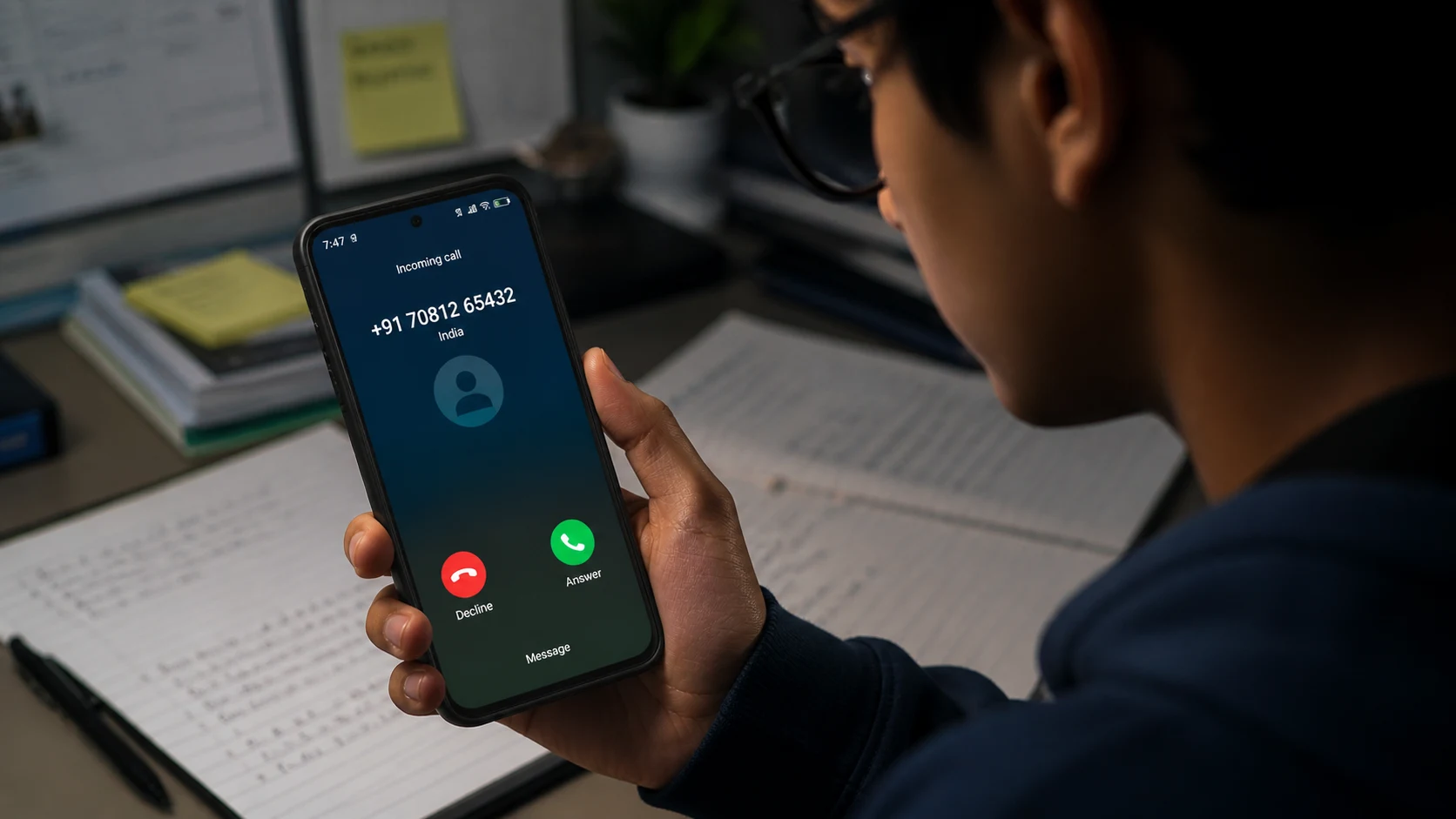
The fake voice note is no longer science fiction. India's deepfake scam cases tripled in 2025. Detection is now a survival skill.
The 60-Second Audio Deepfake Check
Audio deepfakes are currently the most common scam vector in India because they require less compute to generate than video, travel easily through WhatsApp, and trigger emotional responses faster than text. When you receive an urgent voice message from someone you know — especially one involving money, an accident, or a legal problem — run this check before doing anything.
Step 1 — Listen to the hard consonants (10 seconds). Letters like B, P, T, K, and D require specific lip and tongue positions. Current AI voice models handle vowels almost perfectly but still produce subtle artifacts on hard consonants — tiny pops, micro-stutters, or slightly over-clean sounds where a real human voice would have natural imperfection. Listen to a section with several of these sounds and notice whether they feel slightly too smooth.
Step 2 — Notice the breathing patterns (10 seconds). Real humans breathe while they talk. A real voice note has audible breaths between sentences, breath sounds that change when someone is genuinely distressed, and small swallowing sounds. AI-generated voice is often unnaturally consistent — no breath variations, no dry-throat sounds, no real-world environmental noise in the pauses. Silence between sentences in a fake is often cleaner than in a real recording.
Step 3 — Ask a personal verification question (20 seconds). Call the person back immediately on the number you already have for them — not any number given in the suspicious message. Ask something only they would know: a shared memory, an inside reference, the name of something specific to your relationship. AI cloning a voice cannot answer questions the real person would answer. This step alone stops almost every deepfake scam.
Step 4 — Check the metadata (10 seconds). Forwarded WhatsApp messages show a double-arrow forwarding icon. Voice notes from unknown numbers are automatically suspect. Any message that opens with urgency and ends with a payment request — regardless of how familiar the voice sounds — should trigger this entire checklist before any action.
Never transfer money based on a voice note or video call alone, regardless of how convincing. Call back on a known number first. Always.
The 60-Second Video Deepfake Check
Video deepfakes are harder to generate than audio but are increasingly used in job scam interviews, fake celebrity endorsements, and what are called "virtual kidnapping" scams. When you see a video that claims to be someone specific doing or saying something surprising — a politician making a shocking statement, a celebrity endorsing a product, a friend or family member in distress — run this check.
Watch the eyes (15 seconds). Human eyes blink roughly 15 to 20 times per minute. Deepfake faces blink less frequently or at unnatural intervals — a common artifact of early-generation models that 2026 tools haven't fully solved. Watch for a full 15 seconds and count blinks. Fewer than 6 blinks, or blinks that seem mechanical rather than reflexive, is a significant red flag.
Watch the face edges (10 seconds). The boundary between the deepfaked face and the original subject's hair, neck, and ears is where most detection is visible. Pause the video and look at these edges carefully — slight blurring, unnatural colour gradients, or areas where the skin texture changes abruptly. In low-resolution video this is harder to see, but in video clear enough to watch on a phone screen, it's almost always visible on close inspection.
Listen while watching (15 seconds). Audio-visual synchronisation is the deepfake's weakest point. Watch the speaker's lips closely and listen to whether the sounds they're producing precisely match the lip movement. A half-second delay, or consonants that don't match the lip shape, is detectable by eye and ear even in well-made fakes.
Reverse image search the frame (10 seconds). Screenshot a clear frame of the face, upload it to Google Images or TinEye. If the face is a real person's likeness applied over a stock video or existing footage, the reverse search will often return the original source. This catches fake endorsement videos and fake news clips more reliably than any visual check.
The India-Specific Scams Using Deepfakes Right Now
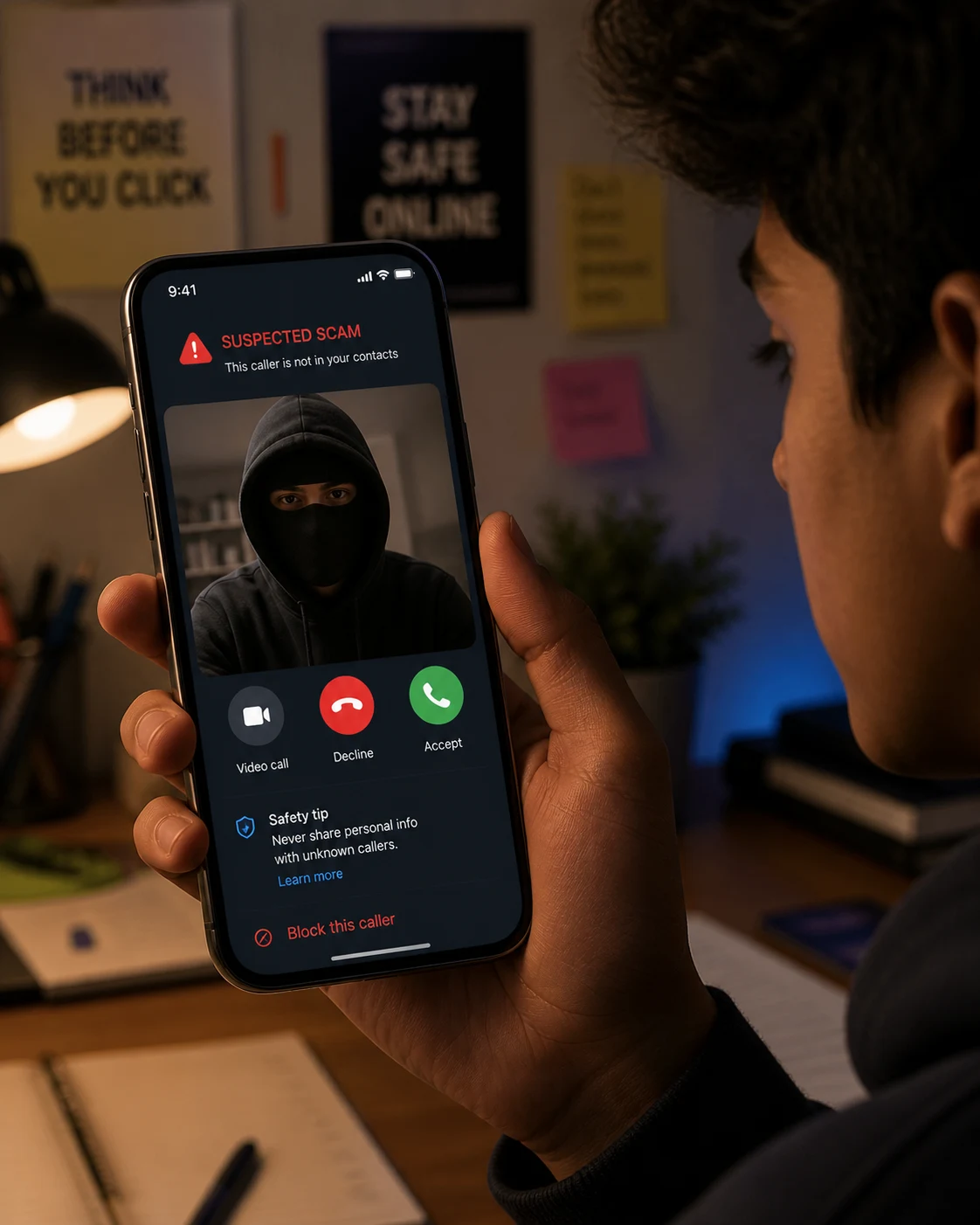
India-specific deepfake scams are running right now. Knowing the formats protects you and your family.
The Family Emergency Voice Note. A cloned voice of a family member, usually a sibling or child, asking for emergency money via UPI. Sent from an unknown number with a story about a lost phone. The urgency is deliberately extreme to prevent the recipient from thinking clearly. Always call back on a saved number before sending anything.
The Fake KYC Video Call. A scammer calls on WhatsApp video, playing a deepfaked face of a "bank official" while asking you to share your screen or read out OTPs. Banks do not request KYC over WhatsApp video calls. Ever. End the call immediately.
The Celebrity Investment Endorsement. A deepfaked video of a known Indian entrepreneur or celebrity endorsing a specific stock, crypto scheme, or investment platform. These circulate on WhatsApp and Telegram, often with professional-quality production. If a celebrity appears to be endorsing a specific financial product, verify directly on their official verified social media account before considering the product.
The Student Scholarship Scam. Targeted at Class 12 students — a deepfaked government official or college representative confirming a scholarship and asking for a "processing fee." No legitimate scholarship ever requires an advance fee payment.
The three rules that stop almost every deepfake scam
- Never transfer money based on a voice note, video message, or video call alone — regardless of how familiar the voice or face appears. Call back on a number you already have.
- Urgency is the manipulation mechanism — every deepfake scam creates time pressure specifically to prevent you from pausing to verify. The moment someone says "do it right now or something terrible happens," pause and verify. Real emergencies can wait 90 seconds for a verification call.
- OTPs belong to no one else — no bank official, government officer, scholarship board, or company representative has any legitimate reason to ask for an OTP. Ever. Any request for an OTP is a scam, regardless of who appears to be asking.
Share This With Your Parents and Grandparents
- Forward this checklist to your family WhatsApp group — older family members are specifically targeted by deepfake audio scams because they are less likely to question a familiar voice.
- Set up a family code word — agree on a word or phrase that a real family member in a real emergency would use to confirm their identity in a phone call. Something private, not guessable, not on social media.
- Report suspicious calls — India's cybercrime helpline is 1930. Report immediately if you've been targeted, even if you haven't lost money. Reports help track patterns and warn others.
- Trusted deepfake detection tools — Microsoft's Video Authenticator (free), Sensity AI's detection tool, and Hive Moderation's free tier all work on uploaded video. Use these when something looks wrong but you can't pinpoint why.
Share this with your family group right now — not tomorrow.
The scam that reached my uncle reached someone else's family last week and will reach another this week. The 60-second check costs nothing. The verification call before any money transfer takes 90 seconds. Both cost significantly less than ₹45,000 and the specific kind of helplessness that comes with being deceived by something that used someone you trust's voice.
Detection is a skill. It takes 60 seconds to use and one forwarded article to teach someone else.Comments 0
Keep reading
Similar blogs by topic

The 5 Platforms Where Indian Teens Are Actually Learning Real Skills in 2026 — Ranked Honestly
An honest ranked list of the 5 best free skill-learning platforms for Indian teens in 2026, including TeenIcon, Khan Academy, freeCodeCamp, and more.

Learn to Bowl Spin in 30 Days — The Cricket Skill That Can Actually Get You on a Team
A beginner-friendly spin bowling guide for Indian teens, covering the off-break grip, daily drills, pitch reading, variations, and a 30-day plan to become team-useful.

Learn Table Tennis in 21 Days — India's Most Underrated Sport Produced Manika Batra and Sharath Kamal
A beginner-friendly 21-day table tennis guide for Indian teens, covering where to find a table, what gear to buy, the three strokes to learn first, and how to build real rallying skills fast.