
Study in Europe After Class 12 — How Indian Teens Are Getting Bachelor's Degrees Abroad for Less Than a Private Engineering College
Quick take
A practical guide for Indian Class 12 students exploring Europe, with tuition-free countries, admission steps, language tests, costs, and a realistic comparison with Indian private colleges.
Explore this topic
Article body

My cousin got into a private engineering college in Pune last year. Four years, all in, comes to around ₹14–18 lakh. She's studying IT. And then there's her classmate — equally good at boards, no JEE rank to speak of — who just started a computer science bachelor's at a public university in Germany. Total tuition per semester: zero rupees. Living expenses included, she spends around ₹7–8 lakh a year.
I'm not saying one path is better than the other. I'm saying that the second option exists, is real, is increasingly chosen by Indian teens, and is almost completely absent from the conversations happening in Indian school corridors. So let's have it.
The Thing Nobody Told You: Several European Countries Charge No Tuition
Germany is the one everyone eventually hears about — its public universities charge no tuition fees for international students, including Indians, for bachelor's programmes. But Germany is actually the tip of a larger iceberg. Norway, Finland, and Iceland also have zero or near-zero tuition at public universities. France charges a nominal fee — around ₹12,000–₹15,000 per year equivalent — which is essentially rounding error compared to Indian private college fees.
The catch — and there is one, because there always is — is that many of these programmes are in the local language at the undergraduate level. Germany has been rapidly expanding its English-taught bachelor's programmes, but you need to either learn German to B2 level or specifically apply to an English-medium programme. The Netherlands skips this problem entirely: almost all Dutch bachelor's programmes in science, technology, business, and engineering are taught in English, and tuition is around ₹1.8–2.5 lakh per year. That's still dramatically cheaper than most Indian private colleges.
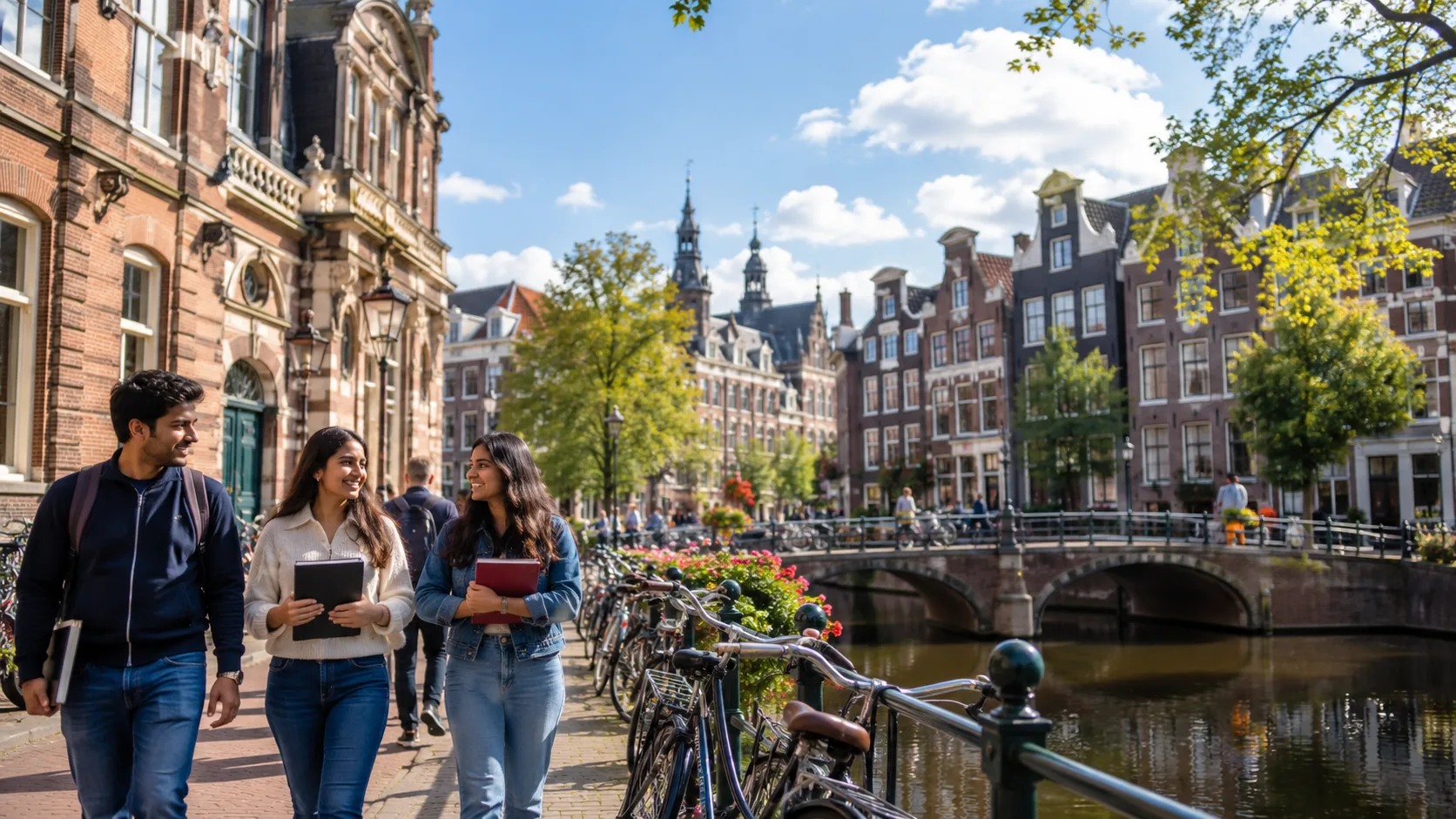
The Netherlands is one of the most popular European destinations for Indian undergraduates — almost everything is taught in English and the visa process is straightforward.
Country by Country — Where to Actually Apply
Germany
Public universities charge no tuition fees for all students regardless of nationality. You pay a semester contribution of around €350 (~₹32,000) per semester — this covers a public transport pass and admin costs. Bachelor's programmes in English are growing: RWTH Aachen, TU Munich, and University of Hamburg offer several. Language requirement: German B2 for German-medium programmes; IELTS/TOEFL for English programmes. Living costs: ₹60,000–₹80,000 per month in Munich (expensive) to ₹45,000–₹55,000 per month in smaller cities like Freiburg or Dortmund.
Netherlands
English-medium bachelor's everywhere. Tuition for non-EU students is around €8,000–€12,000 per year — still far less than Indian private fees for most programmes. Eindhoven University of Technology, University of Groningen, and Delft are strong for STEM. Admission: IELTS 6.5+ and strong Class 12 marks (typically 75–80%+). Living costs: Amsterdam is expensive (₹90,000–₹1.1L/month) — smaller cities like Groningen or Enschede are around ₹55,000–₹70,000/month.
Norway
All public university programmes are tuition-free, including for international students. NTNU (Norwegian University of Science and Technology) has many English bachelor's. The trade-off: living costs in Norway are among Europe's highest — budget ₹1–1.2L per month. Strong for engineering and marine sciences. Language: Some programmes require Norwegian; English-medium ones clearly listed on NTNU's website.
France
Public universities charge around €170 per year — essentially free. Paris is expensive but Toulouse, Bordeaux, and Lyon are far more manageable. French language required for most undergraduate programmes. However, Sciences Po, ESPCI, and several grandes écoles offer English-medium master's and some bachelor's tracks. For French-speaking teens or those willing to spend a gap year learning French: excellent option.
What the Admission Process Actually Looks Like
This is where most Indian teens get stuck, because the process looks nothing like JEE or CUET. There is no single entrance exam. There is no rank. There is no counselling round. What there is: a direct application to each university, evaluated on your Class 12 marks, language test scores, a motivation letter, and sometimes a portfolio or interview.
What you need for most European bachelor's applications:
Academic: Class 12 marksheet (minimum 70–80% depending on university and programme). Some German universities require you to pass a preliminary year called Studienkolleg if your 12th doesn't directly satisfy their entry requirements — check university-specific rules.
Language: IELTS 6.0–6.5 overall for English-medium programmes. German A2/B1 for some German programmes (B2 for full German-medium). Start preparing at least 6 months before application deadlines.
Motivation letter: 500–800 words explaining why this programme, at this university, for you specifically. This matters more than most Indian applicants expect. Do not write a generic one.
Timeline: Most European universities have application deadlines in January–April for autumn intake. Start researching in Class 11. Apply in Class 12, months before your boards results — results are typically submitted once they're declared.
The Honest Cost Comparison — Europe vs Indian Private College
| Cost item | Indian Private Eng. College (4yr) | Germany (4yr, public) | Netherlands (3yr, public) |
|---|---|---|---|
| Tuition total | ₹8–14L | ₹0 | ₹5.5–7.5L |
| Hostel/accommodation | ₹4–6L | ₹16–22L | ₹14–18L |
| Food & living | ₹3–5L | ₹10–14L | ₹8–12L |
| Flights (return/year) | — | ₹1.2–2L per year | ₹1–1.8L per year |
| 4-year total | ₹15–25L | ₹28–38L | ₹29–39L (3yr) |
*Germany and Netherlands living costs are higher than India — but German graduates start at €40,000–€60,000/year, and many Indian students work 20 hours/week on a student visa (legally) to offset costs by ₹25,000–₹40,000/month. The gap shrinks significantly with part-time work.
The Part Nobody Talks About — What Happens After
A German or Dutch engineering or CS degree is recognised by top global employers. Post-study work permits in Germany allow you to stay for 18 months after graduation to find a job — and Germany's skilled worker shortage means Indian STEM graduates are actively recruited, not tolerated. The average starting salary for a CS graduate in Germany is around €45,000–€55,000 per year (roughly ₹40–50L). The Netherlands has a similar post-study work permit structure.
Yaar, that's not a guarantee — no degree is — but the pathway from a German public university to European employment is well-paved and actively walked by Indian graduates every year. The alumni networks are growing. The Indian community in Berlin and Amsterdam is large and genuinely helpful to newcomers.
Quick Takeaways
- Germany's public universities are tuition-free — pay only a semester contribution (~₹32,000) that includes a local transport pass. Real.
- Netherlands is the easiest English-medium entry point — nearly all bachelor's programmes are in English, visa process is clear, Indian community is large.
- Start in Class 11 — application deadlines in Europe are January–April, and language tests need months of preparation. Class 12 is too late to start from zero.
- IELTS is non-negotiable — aim for 6.5 overall. Start prep alongside your boards, not after them.
- Motivation letter matters more than Indian applicants expect — it's not a formality. Write one that explains your actual reasons, not generic career goals.
- Part-time work offsets living costs significantly — legally, 20 hours per week on a student visa. This is a real and common part of how Indian students in Europe manage expenses.
Save This. Read It Again When Your Class 12 Results Come Out.
The conversation about what happens after boards in India is very loud and very narrow — it's basically JEE, NEET, or CUET, and if those don't work out, private college. This is a reminder that there's a third path being quietly taken by a growing number of Indian teens, and it costs less than the alternative in more ways than one. Start your IELTS prep this month. Research three programmes. Make one shortlist. That's all it takes to begin.
Zero tuition. English taught. 18-month post-study work permit. Europe is closer than it looks.Comments 0
Keep reading
Similar blogs by topic

Study in Europe or Singapore for Less Than a Private Indian College — The Guide Nobody Showed You
A practical guide for Indian students comparing the real costs of studying in Germany, Norway, France, the Netherlands, and Singapore against private colleges in India.

MEXT Scholarship — The Japanese Government Pays for Your Entire Degree and Nobody in India Is Talking About It
A complete MEXT scholarship guide for Indian teens covering the application process, eligibility, stipend details, universities, and how to apply from India.