
Skateboarding in India: Beginner First-Month Guide
Quick take
Learn skateboarding in India with a beginner-friendly first-month guide for teens on gear, balance, tricks, skateparks, and safety.
Explore this topic
Article body
Skateboarding in India in 2026 — A Beginner's First-Month Guide for Teens Who Don't Want to Look Like a Tourist
The first time I went to the skatepark I stood at the edge for twenty-two minutes and watched. Didn't skate. Just stood there holding my board like a prop, watching people who clearly knew what they were doing, and trying to figure out the unwritten rules of a space I'd never entered before. Is there a queue for the bowl? Do you ask before dropping into something someone else is using? Can you just sit on the bench and not be weird about it? Nobody tells you any of this.
I eventually got on the board, rolled six feet, and fell sideways. Two people looked. One asked if I was okay. That was the whole interaction. The fear I'd built up over twenty-two minutes dissolved in about ninety seconds of just being there. Here's everything I wish I'd known before month one — the gear, the spots, the culture, and the specific moves to learn in order.

India now has over 15 skateparks across cities. The scene is small enough to be welcoming and real enough to be worth entering.
The Gear — What to Buy and What to Skip
The most common beginner mistake is buying a cheap plastic board from a toy store or a random Amazon listing because the price seems reasonable. These boards — usually sold as "skateboards" in the ₹800 to ₹1,500 range — have plastic decks that flex under weight, wheels that stop the moment they hit a pebble, and trucks so stiff they make turning feel like steering a truck. You will learn nothing on these boards except frustration. Spend more once and avoid spending again for two years.
A real beginner setup costs between ₹2,800 and ₹4,000 in India in 2026. The best single source is Sk8Bharat (sk8bharat.com) — an Indian skate shop that ships nationwide and stocks brands that actually work. Alternatively, Decathlon carries a starter complete board at around ₹3,200 that is genuinely suitable for learning. If you're in Bengaluru, The Skate Room on Church Street lets you try before you buy and the staff will help you set up correctly.
| Item | Where to get it | Cost |
|---|---|---|
| Complete beginner board | Sk8Bharat / Decathlon | ₹2,800–₹3,500 |
| Helmet (non-negotiable) | Decathlon | ₹599–₹999 |
| Knee pads | Decathlon / Amazon | ₹399–₹699 |
| Wrist guards | Decathlon | ₹349–₹499 |
| Skate shoes (flat sole) | Decathlon Kipsta / old canvas | ₹799–₹1,499 |
| Total first-month budget | ₹4,946–₹7,196 | |
*A helmet is not optional. Wrist fractures are the most common skateboarding injury in beginners — wrist guards prevent the majority of them. Buy both before you ride.
Week 1 — Don't Try to Ollie. Learn to Stand and Roll.
Every beginner wants to ollie by Day 3. Every beginner who tries to ollie by Day 3 falls repeatedly, gets frustrated, and sometimes quits. The ollie is not Week 1 material. Week 1 has exactly four objectives: find your stance, learn to push, learn to stop, and get comfortable with the board moving under you.
Stance first. Stand on the board — one foot over the front bolts, one over the back bolts. If you instinctively put your left foot forward, you're regular stance. Right foot forward is goofy. Neither is better. Just figure out which feels more natural by standing on the board in socks on a carpet or grass before you go anywhere with it.
Pushing next. Take your back foot off, push once with it against the ground, put it back. That's pushing. Practice it on flat ground until it feels like one smooth motion rather than three separate thoughts. Most beginners look awkward on a board for the first two weeks because they're thinking about every step consciously. By Week 3, the pushing sequence becomes automatic and you start looking like you belong there.
Stopping. The simplest method is foot braking — drag your back foot along the ground lightly. Practice stopping in control before you let yourself pick up speed. Being unable to stop predictably is the cause of most beginner injuries that aren't falling sideways.
Weeks 2 and 3 — Turning, Kicking, Getting Up From Falls Properly
By Week 2 you should be pushing and rolling comfortably enough to start turning. Skateboard turns happen by leaning — press your heels to turn one direction, press your toes to turn the other. This sounds simple and feels deeply unnatural for the first several sessions. Your body will want to steer with your shoulders like you're on a bicycle. Resist this. The lean comes from your ankles and the pressure through your feet, not from twisting at the waist.
Week 3 introduces the kick turn — picking up the front wheels slightly while rolling and using your back foot to pivot the board in a new direction. This is the first skill that looks like skateboarding to outsiders watching you. Practice it standing still first: back foot on the tail, press down slightly, front wheels come up, twist, set them down. Then try it while rolling slowly. The transition from standing-still kick turns to rolling kick turns takes most beginners about four to six sessions.
Falls are guaranteed across all four weeks. The technique that reduces injury dramatically: when you feel yourself losing balance, fall to the side rather than reaching back with your hands. The instinct is to put your hands out — this is how wrists break. Tuck your elbows, turn slightly sideways, and let the pads take the impact. This takes practice to make instinctive but your wrists will thank you by Week 4.
Week 4 — The Ollie, and the Skatepark Culture
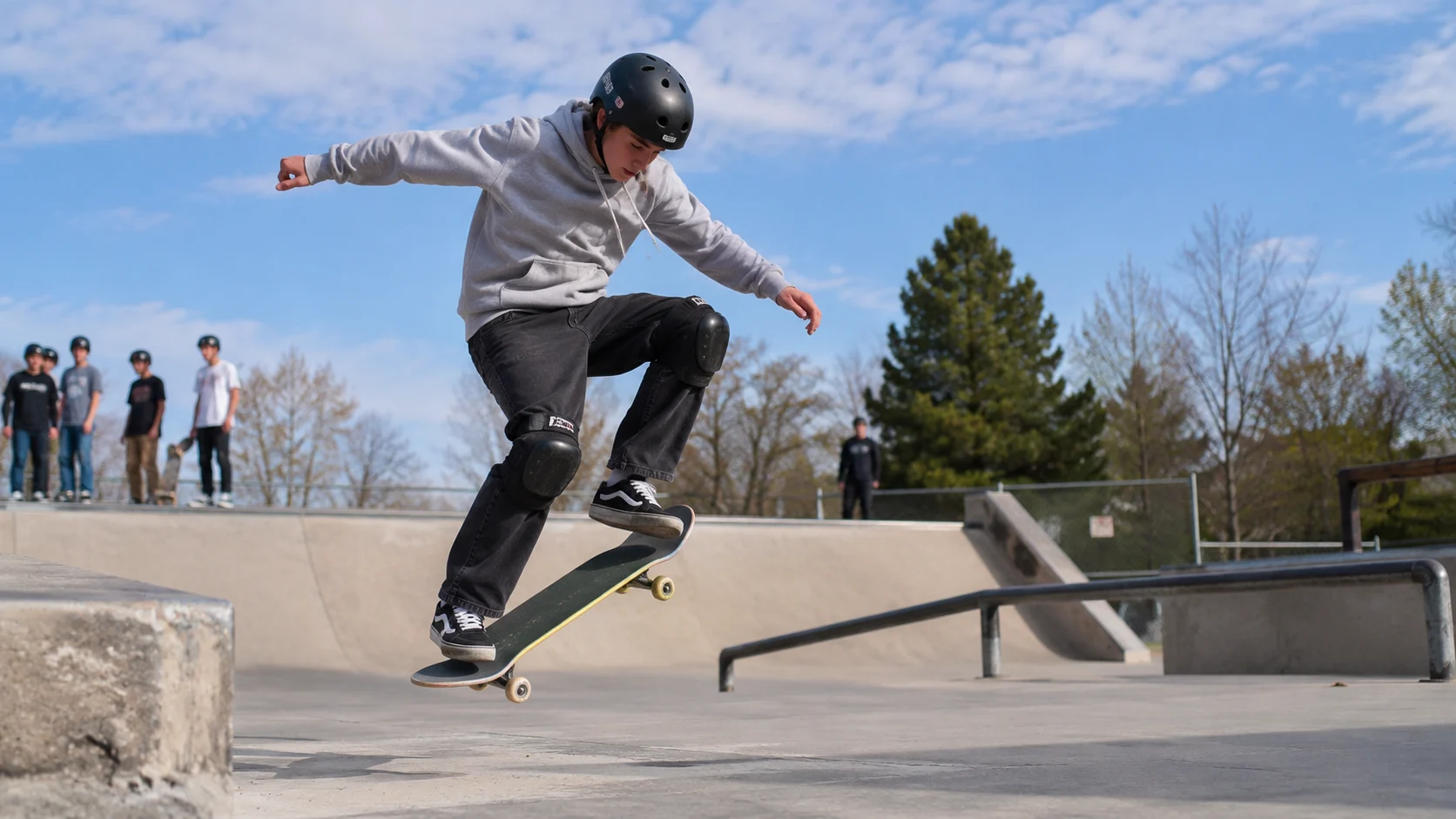
Week 4 is when the ollie becomes your entire personality for about ten days. This is completely normal.
The ollie is the foundation of almost every trick in skateboarding — a jump where the board comes with you. It requires three movements happening in close sequence: pop the tail (hit the tail against the ground), slide your front foot up the board, and level out in the air. Separately, each motion is simple. Together, at speed, they take most beginners between two weeks and two months to land cleanly. Start practicing it standing still — tail pop, front foot slide — before you attempt it while rolling. A stationary ollie isn't a real ollie but it teaches your feet the muscle memory they'll need when you add movement.
Week 4 is also when you should start spending real time at the skatepark rather than just your colony parking lot or terrace. Indian skatepark culture is more welcoming than it appears from the outside — experienced skaters generally respect people who are visibly trying and don't take up space they haven't earned yet. Don't drop into the bowl on Day 1. Skate the flat ground near the park first. Watch the flow of traffic in the bowl and transitions before joining it. Ask one person one genuine question about something you're trying to learn — almost every skater remembers being a beginner and most will help if you ask specifically rather than just hovering.
Where to skate in India — city by city:
Bengaluru: Cubbon Park skating area (free, flat, excellent for beginners), Shell Factory Skatepark in Whitefield (paid, full park with transitions).
Mumbai: Carter Road Bandra promenade (free, flat, popular weekends), Andheri Sports Complex (indoor facility with ramps).
Delhi: Siri Fort Sports Complex, Dilli Haat outdoor area on weekends, Navi Mumbai's Skateboarding Complex.
Pune: Sambhaji Park, Shivaji Nagar — growing scene with regular meet-ups.
Madhya Pradesh: Janwaar Skatepark — internationally recognised, completely free, built by and for a rural teen community. Worth a trip if you're nearby.
Find local spots: Search Instagram for #[yourcity]skate or #[yourcity]skateboarding. The Indian skate community is active on Instagram and genuinely helpful to beginners who reach out.
Quick Tips for Month One
- Skate on smooth concrete, not rough tarmac — rough road surface makes rolling control nearly impossible for beginners and kills your wheels faster. Find the smoothest flat surface near you for the first two weeks.
- Skate shoes matter more than the board — flat-soled shoes (Vans, Converse, any canvas flat sole) let you feel the board through your feet. Running shoes with cushioned soles disconnect that feedback completely.
- Film yourself from the side — your body feels like it's doing something completely different from what the video shows. The video is always more accurate. Watch it back after every session and notice what's actually happening.
- Morning sessions beat evening sessions — cooler, less crowded, and the concrete is better before the sun has been on it for six hours.
- The community is on Instagram — follow @sk8bharat, @theindianskater, and search your city's skate hashtag. These accounts post local meet-up information, beginner advice, and spots you won't find on Google.
Find out which skatepark is nearest to you right now — before you buy anything.
Go once just to watch. Stand at the edge for as long as you need. Notice that nobody is judging you. Then come back the next day with a board. Month one isn't about tricks — it's about becoming someone who skates rather than someone who wanted to. The difference is just showing up enough times that the board stops feeling foreign under your feet.
You'll fall. You'll get up. By Week 4, getting up will be automatic — and that's the whole skill.Comments 0
Keep reading
Similar blogs by topic

Learn to Bowl Spin in 30 Days — The Cricket Skill That Can Actually Get You on a Team
A beginner-friendly spin bowling guide for Indian teens, covering the off-break grip, daily drills, pitch reading, variations, and a 30-day plan to become team-useful.

Learn Table Tennis in 21 Days — India's Most Underrated Sport Produced Manika Batra and Sharath Kamal
A beginner-friendly 21-day table tennis guide for Indian teens, covering where to find a table, what gear to buy, the three strokes to learn first, and how to build real rallying skills fast.

Chess Is India's Coolest Sport Right Now — Here's How to Actually Get Good in 30 Days
A beginner-friendly chess guide for Indian teens, covering the best apps, tactical patterns, one opening to learn, and a realistic 30-day plan to reach 1000 Elo.