
Convert Any Boring Textbook Chapter Into a Podcast You'd Actually Listen To Using NotebookLM
Quick take
Turn any NCERT chapter into a 10-minute podcast with NotebookLM's free Audio Overview. Two AI hosts explain concepts, flag confusing parts. Listen on the bus, before sleep, or during commutes. Perfect for CBSE, JEE, NEET prep. No download needed.
Explore this topic
Article body
Convert Any Boring Textbook Chapter Into a Podcast You'd Actually Listen To Using NotebookLM
There's a specific kind of tired that happens at 10 PM when you open your Economics textbook for the third time that week. Not sleepy tired. Brain-dead tired. The kind where you read the same paragraph about the Balance of Payments four times and your eyes slide right off it like it's made of Teflon.
You know you need to study it. You just cannot make yourself care about it right now.
Here's what nobody told you: you don't have to read it.
Google has a free tool called NotebookLM that will take your textbook chapter — any chapter, any subject — and turn it into a 10-minute podcast. Two AI hosts. Actual conversation. One explains, the other questions. They go back and forth, make analogies, flag the confusing parts. It sounds like a real podcast. You can listen to it on the bus. Or while eating. Or lying in the dark when your eyes are too tired for another page.
I'm not saying replace studying. I'm saying this is one of the most useful things a Class 11 or 12 student can discover before boards.
What NotebookLM Actually Is
Your textbook chapter. Converted. Ready to play.
NotebookLM is Google's free AI research assistant. The feature that changed everything is called Audio Overview — the one that generates the podcast.
You upload your source material. NotebookLM reads all of it, understands it, and produces a conversation between two AI hosts who discuss, explain, debate and summarise the content. They don't read it back to you — they actually talk about it. "So what does this mean in practice?" "Right, and that connects back to what we said about X." They flag things that are "commonly confused." They make analogies. Sometimes they say "this is the part that trips most people up" — which is, ironically, more useful than most textbooks ever admit.
It's free. Google account. Any browser. Works on your phone. No download needed.
How to Set It Up — 8 Minutes the First Time
Go to notebooklm.google.com
Open in Chrome or any browser. Sign in with your Google account — same one you use for Gmail. No new account needed.
Create a New Notebook
Click "New Notebook." Name it by subject — "Class 12 Economics" or "NEET Biology Unit 3." Make one notebook per subject.
Upload Your Source
Click "Add Source." Your options: upload a PDF directly, paste chapter text, connect a Google Doc, or paste a YouTube lecture link. For NCERT: search "[chapter name] NCERT PDF," download, upload. Done in two minutes.
Click "Audio Overview" → Generate
Find the Audio Overview button on the right panel. Click "Generate." Wait 2–3 minutes while it processes. That's the only waiting you'll do.
Put in Your Earphones and Press Play
A media player appears. Hit play. Your chapter is now a podcast. You can listen anywhere — no internet needed after it generates.
What the Podcast Actually Sounds Like

35 minutes each way. That's a full chapter overview, both directions, every day.
The two hosts speak naturally — not robotic, not like a text-to-speech engine. One tends to explain clearly and build on concepts. The other asks the questions you'd actually want to ask: "okay but why does that happen?" or "so is this different from what we said earlier?"
For a 20-page NCERT chapter, the Audio Overview runs 8–12 minutes. Long enough to cover what matters, short enough to finish on a single bus ride.
Works very well for
- Conceptual explanations
- Cause-and-effect chains
- Historical context & narratives
- Definitions and how they connect
- Theory-heavy chapters
Doesn't replace
- Numericals & problem sets
- Derivations & proofs
- Diagrams & graphs
- Formula memorisation
- Practising answer writing
Real Use Cases for Indian Board Subjects
History — Ch. 10 onwards
Dense prose about events, causes, consequences. The hosts turn it into actual storytelling — much easier to retain than rereading.
Economics — Macro Concepts
Balance of Payments, Fiscal Deficit. The hosts explain relationships out loud — "so if X increases, Y happens." Exactly what you need.
Biology — Genetics & Ecology
Long theoretical chapters with heavy terminology. The hosts define terms in context, not isolation — the way you need to understand them.
Physics — Modern Physics
Good for conceptual understanding. Still needs the equations and numericals separately. Use as a first pass, then solve problems.
5 Things That Make It Work Better
Upload multiple sources together. Add the textbook chapter + your class notes + a previous year question paper. NotebookLM synthesises across all three. The podcast will cover what exams actually ask, not just what the textbook says.
First listen: do nothing else. Don't take notes. Don't pause constantly. Just listen. Your brain absorbs a surprising amount when you're not trying to capture everything at once.
Second listen: have your notes open. When you hear a concept, glance at your notes. Hearing and seeing at the same time — dual encoding — is one of the most effective retention techniques there is.
Ask questions after listening. NotebookLM has a chat interface alongside the audio. After the podcast, ask: "What are the 3 most common exam questions from this chapter?" It now knows your full source material.
Make one notebook per unit, not per chapter. Upload all three chapters of a unit together. The podcast covers how they connect — often more useful than three separate podcasts.
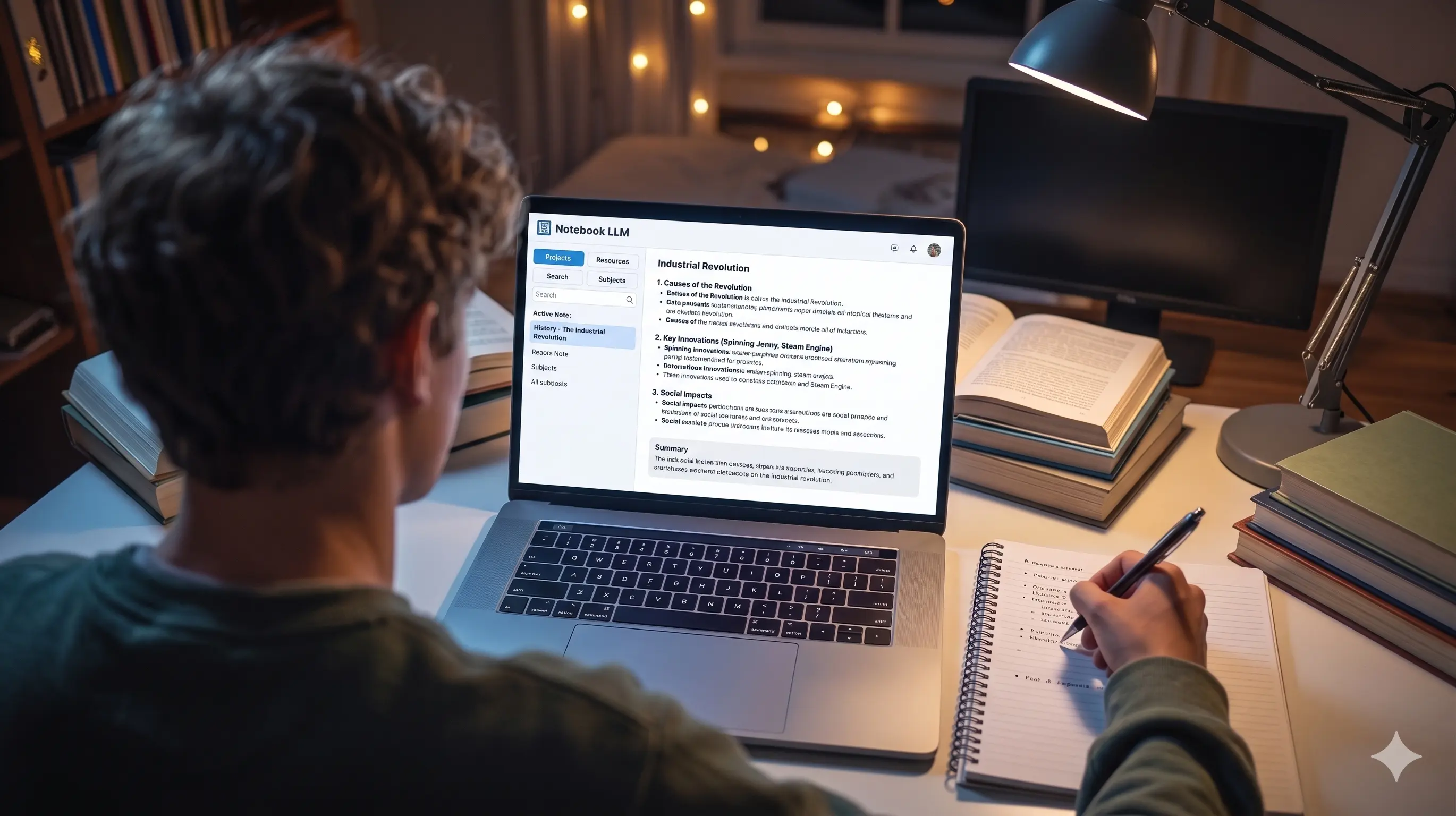
Listen once on the bus. Read once at the desk. You're covering the chapter twice without it feeling like twice.
The Honest Limitations
NotebookLM occasionally gets a detail slightly wrong — particularly with specific numbers or technical definitions. Cross-check anything the podcast states as a hard fact against your textbook before writing it in an exam.
More importantly: listening is not the same as learning. If you can explain the chapter in your own words after listening, you've learned it. If you can't, you've listened comfortably — which feels exactly the same in the moment but shows up differently on the paper. Close the audio and try to reproduce the ideas. That's where the real work is.
The real talk: We've all had chapters that felt impossible to get through — not because the content was too hard, but because the format was wrong for that particular moment.
NotebookLM doesn't make studying easier. It makes studying more likely to happen at 10 PM with tired eyes. That's a different thing — but it matters just as much.
The bus ride to school is 35 minutes for most people. That's a full NCERT chapter audio overview, every day, in both directions. That's time you were already spending doing something else.
Try it once on the chapter you've been avoiding the longest. See what happens.
Which chapter are you converting first?
Drop it in the comments. And if you figure out a smarter way to use NotebookLM for your specific subject — tell us. This tool is still new enough that everyone's figuring it out together.
Free. Google account. No download. Open it tonight.Comments 0
Keep reading
Similar blogs by topic

The Global Korea Scholarship — Why South Korea Is the Most Underrated Destination for Indian STEM Students
A complete Global Korea Scholarship (GKS) guide for Indian teens covering the full package, top universities, application process, and how to apply.

MEXT Scholarship — The Japanese Government Pays for Your Entire Degree and Nobody in India Is Talking About It
A complete MEXT scholarship guide for Indian teens covering the application process, eligibility, stipend details, universities, and how to apply from India.

The Night Before Any Exam — A 12-Hour Protocol That Actually Helps
A calm, hour-by-hour night-before-exam routine for Indian students, covering revision limits, sleep, food, logistics, and what to do inside the exam hall.