
6-Week Cycling Plan for Indian Teens: 30 km a Week
Quick take
Cycle 30 km a week for 6 weeks with a beginner-friendly Indian teen plan, safe ride times, gear tips, city routes, and road safety.
Explore this topic
Article body
Cycle 30 Kilometres a Week for 6 Weeks — A Plan for Indian Teens Who Want to Get Outside Without Joining a Gym
The first ride I did after buying my Decathlon cycle was 4 kilometres. Not 40. Not 14. Four. I turned back early because the sun was already doing something alarming to the back of my neck and I hadn't brought water. I walked the last stretch holding the handlebars, sweating through my shirt, wondering if I'd wasted ₹15,000 on something that was going to live in the corner of my room beside the badminton racket I used twice in Class 9.
Six weeks later I was doing 12 kilometres before breakfast and actually looking forward to it. The transformation wasn't fitness — it was figuring out the India-specific details that no cycling video from YouTube accounts ever mentions, because they're all filmed somewhere with 22°C mornings and dedicated bike lanes. Here's the actual plan for cycling in Indian cities as an Indian teen.
The 5:45 AM window before traffic builds is the one uninterrupted hour of peace most Indian teens never knew they had access to.
The Bike — What to Buy and What to Skip
You need a hybrid cycle — not a road bike (too aggressive a posture, no good on Indian roads), not a mountain bike (too heavy, too slow on tarmac), and definitely not the decorative cycle with a basket and a bell that costs ₹4,500 on Amazon and weighs as much as a scooter. A hybrid sits upright, rolls efficiently on road surfaces, and handles the occasional pothole or rough patch without drama.
Decathlon's Riverside 120 at ₹14,999 is the default recommendation for Indian teen beginners for one reason: Decathlon has service centres in every major Indian city, so when something breaks (and something will break, usually the rear derailleur cable), you're not hunting for a local cycle mechanic who knows the specific part. If you're in a city without a Decathlon, Hero Sprint Pro and Firefox Road Runner are available through local dealers and solid in the ₹12,000–₹18,000 range.
| Item | Where | Cost |
|---|---|---|
| Hybrid cycle (Riverside 120) | Decathlon | ₹14,999 |
| Helmet (non-negotiable) | Decathlon | ₹799–₹1,499 |
| Cycle lock (U-lock) | Decathlon / Amazon | ₹499–₹799 |
| Water bottle cage + bottle | Decathlon | ₹199–₹349 |
| Dust mask (N95 or cycling specific) | Decathlon / local pharmacy | ₹150–₹399 |
| Rear LED light (for visibility) | Decathlon / Amazon | ₹299–₹499 |
| Total starter setup | ₹16,945–₹18,544 | |
The India-Specific Details Nobody Else Tells You
The only time to ride in summer is before 7 AM. This sounds extreme until you've done a 10-kilometre ride at 9 AM in May and realised that the combination of 36°C air temperature, direct sun, and no breeze from a parked position at traffic lights is genuinely dangerous — not just uncomfortable. The 5:30–6:30 AM window is the Indian cyclist's secret: empty roads, cool air, and the specific quality of early morning light on familiar roads that makes a route you've driven a hundred times feel new. Set your alarm once and discover it.
Dust management is real. Indian roads — especially in metros during construction season and in Tier-2 cities year-round — carry particulate matter that builds up quickly in your lungs on a ride. A basic N95 mask (available at any pharmacy for ₹150–₹200 for a pack) makes the difference between returning from a ride feeling refreshed and returning feeling like you've been breathing construction dust, which you have. Cycling-specific masks with better filtration exist at Decathlon from ₹399.
Traffic patterns need to be read differently on a cycle. The most dangerous moment for Indian urban cyclists isn't a fast road — it's a slow road with autos stopping suddenly to pick up passengers, e-rickshaws drifting unpredictably, and two-wheelers materialising from side lanes without indicating. Keep a two-metre buffer from any vehicle that might stop without warning. Ride assertively enough that you're visible — not so far to the left that you're in the door-zone of parked cars or being squeezed against the shoulder.
The 6-Week Plan — 30 km Per Week, Built Up Gradually
Weeks 1 and 2 — 10 km per week. Two rides of 5 km each. The goal is finding your pace, your route, and your comfortable gear. Don't worry about speed. Don't push into fatigue. Arrive home feeling like you could have done more — that's the right level for Week 1. Use these rides to notice what's uncomfortable: Is the saddle too high? Too low? Is the handlebar position giving you neck strain? Fix these things in the first week, not the fourth.
Weeks 3 and 4 — 20 km per week. Two rides of 10 km. At 10 km you'll cross the threshold where the first kilometre stops feeling like an effort and becomes a warmup. This is the week most people quietly realise they've become a person who cycles. Not someone who goes cycling sometimes — someone for whom it's just what Saturday morning looks like now.
Weeks 5 and 6 — 30 km per week. Three rides across the week — two weekday rides of 8 km and one weekend ride of 14 km. The weekend long ride is where the feeling shifts again. At 14 km, you've crossed into territory that takes actual planning — water carried, route chosen, energy considered. It no longer feels like exercise. It feels like going somewhere.
What Actually Changes After 6 Weeks
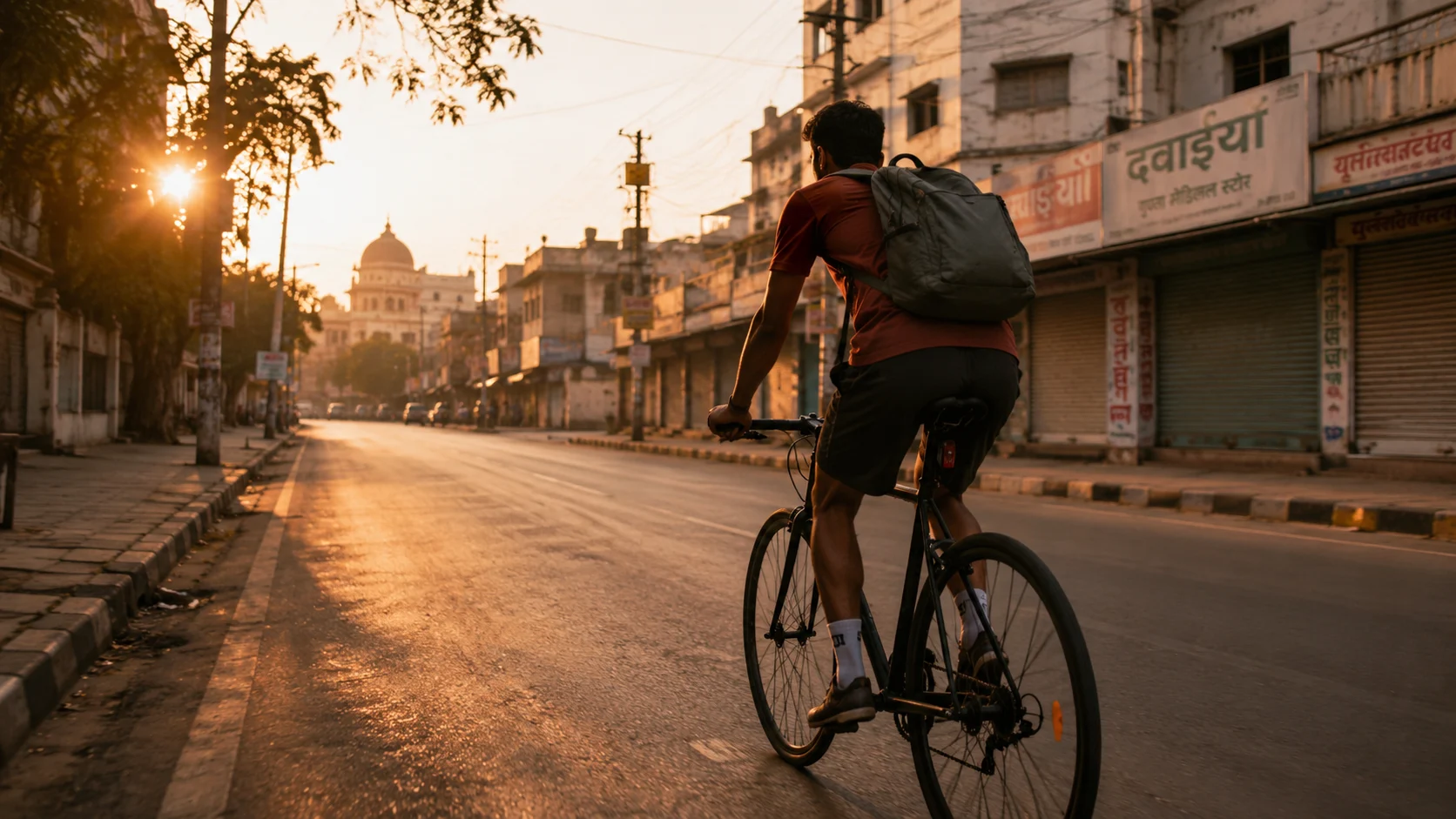
By Week 6, the ride you turned back from in Week 1 is your warm-up. The city looks different from a cycle than it does from a window.
The physical changes are real but not dramatic at 6 weeks — better lung capacity, stronger legs, more comfortable posture. What changes more noticeably is the relationship with your own city. Routes you've covered a hundred times by auto or car reveal things at cycling pace that motor speed obscures — the lane behind the vegetable market that smells like flowers at 6 AM, the underbridge that's always 4 degrees cooler than the road above it, the community of other early-morning cyclists who nod at each other with the specific acknowledgment of people who all made the same slightly unreasonable decision that morning.
The gym conversation also resolves itself. Six weeks of 30 km per week is roughly equivalent to two gym sessions per week in cardiovascular benefit, costs nothing after the initial setup, requires no monthly commitment, and can be done alone or in a group, early morning or evening, at whatever pace matches how you feel. It is, genuinely, the most accessible form of regular exercise available to an Indian teen with access to a bike and a safe early morning window. The only thing standing between you and it was the first ride.
Quick Tips for Indian Teen Cyclists
- Tell one family member your route before every ride — not because something will go wrong, but because the habit of communicating where you're going is the difference between a worried parent and a supportive one.
- Carry exactly two things always: water and a charged phone — everything else is optional. The phone covers navigation, emergency contact, and the Strava app if you want to track your rides.
- Strava is free and genuinely motivating — it maps every ride, tracks distance and elevation, and has a social layer where you can see other cyclists' routes in your city. Following local Strava segments reveals good routes you wouldn't find on Google Maps.
- Clean your chain every two weeks — a dirty chain makes pedalling harder and wears the drivetrain faster. Decathlon sells chain lube for ₹199. A clean chain on a ₹15,000 bike feels better than a dirty chain on a ₹30,000 bike.
- Don't ride with earphones — you need to hear the auto behind you before you see it. Music can wait 45 minutes. Your hearing cannot be replaced.
Find your 5 km route tonight — before you've even bought the bike.
Open Google Maps, drop a pin at your house, and trace a 2.5 km loop that avoids the busiest roads. Screenshot it. That's your Week 1 route. The bike comes after the route, not before — because knowing exactly where you're going on Day 1 removes the last excuse for not starting. Week 6 is 6 weeks of that route, extended and repeated and made yours.
The 5:45 AM version of your city is a different place entirely. You just haven't been awake to see it yet.Comments 0
Keep reading
Similar blogs by topic

Learn to Bowl Spin in 30 Days — The Cricket Skill That Can Actually Get You on a Team
A beginner-friendly spin bowling guide for Indian teens, covering the off-break grip, daily drills, pitch reading, variations, and a 30-day plan to become team-useful.

Learn Table Tennis in 21 Days — India's Most Underrated Sport Produced Manika Batra and Sharath Kamal
A beginner-friendly 21-day table tennis guide for Indian teens, covering where to find a table, what gear to buy, the three strokes to learn first, and how to build real rallying skills fast.

Chess Is India's Coolest Sport Right Now — Here's How to Actually Get Good in 30 Days
A beginner-friendly chess guide for Indian teens, covering the best apps, tactical patterns, one opening to learn, and a realistic 30-day plan to reach 1000 Elo.